
Listener with an open-plan living space
You want to listen to your records through suitable speakers and place your turntable somewhere stable, rather than right next to a speaker.


Start with the records you want to play. A suitable 33⅓/45 rpm model is enough for LPs and singles, but 78 rpm records also require the right speed and stylus. Next, check that the output is compatible with your existing equipment, and give the turntable a stable spot away from speakers. Automatic operation makes it easier to get started, while a manual model may offer more settings.
You want to listen to your records through suitable speakers and place your turntable somewhere stable, rather than right next to a speaker.
You want to check whether your collection includes LPs and singles, or also 78 rpm records that need a different speed and a suitable stylus profile.
You’re looking for simple controls and a connection that works with the equipment you already own, without paying for features you don’t need.
Choose this if: you mainly play LPs and singles and want to start the tonearm at the touch of a button. Sony and Audio-Technica describe automatic models with Bluetooth and a switchable phono preamp for this purpose.
Trade-off: the models mentioned don’t play 78 rpm records. Also check whether Bluetooth or a wired connection is right for your setup.
Choose this if: your collection actually includes 78 rpm records, or you want a replaceable cartridge and manual settings. Audio-Technica lists 33⅓, 45 and 78 rpm for the AT-LP120XUSB.
Trade-off: manual operation requires more attention. For 78 rpm shellac records, check that the stylus profile is suitable; the supplied AT-VM95E is not a dedicated 78 rpm stylus.
Choose this if: you play 33 or 45 rpm records, don’t need Bluetooth and already have suitable active speakers or an amplifier. Pro-Ject lists the E1 Phono as having a built-in, switchable phono preamp.
Trade-off: the listed speeds for the E1 Phono don’t include 78 rpm, and you’ll still need a suitable speaker setup.
| What to consider | What should you check? | Who is this important for? |
|---|---|---|
| Connections and placement | Check whether you have active or passive speakers, which PHONO or LINE input is available, and where the turntable can sit securely. | If I want to connect the turntable to my existing speakers and find a suitable spot in an open-plan space, getting the setup right is my first concern. Around 33% of consumers make connections and placement their top priority. |
| Compatibility with your records | Check the speed and material of your records, then make sure both the turntable and stylus are suitable. | If I want to be sure I can play my soundtrack records, I check not only the format but also the speed and, for 78 rpm shellac, the stylus profile. Around 25% of consumers put record compatibility first. |
| Ease of use | Check whether the exact model operates automatically or manually, and decide whether you want to position the tonearm yourself. | If I want to get started without positioning the tonearm manually, automatic operation matters more to me than extra manual settings. Around 25% of consumers make ease of use their top priority. |
| Complete setup and components | Make a note of which speakers and amplifier you already have, and check which cartridge or stylus can be replaced. | If I want to know what else I’ll need besides the turntable and which components will fit later, I look at the complete setup and what can be replaced. Around 17% of consumers put these practical considerations first. |
A turntable for 33⅓ and 45 rpm won’t automatically play 78 rpm records. The stylus profile also matters for 78 rpm shellac.
First check the speed and material of your records, then check the supported speeds and whether the cartridge or stylus is suitable.
A phono preamp provides a suitable signal level, but it doesn’t replace the amplifier needed for passive speakers.
Check the entire chain—output, input, amplifier and speakers—before choosing a turntable.
Audio-Technica warns that vibrations from speakers can make a turntable’s stylus vibrate and disrupt playback.
Set aside a stable spot for the turntable and try different speaker positions separately.
The AT-LP70XBT and AT-LP120XUSB illustrate two different options: automatic playback at 33⅓/45 rpm, or manual operation with support for 78 rpm.
According to Sony, the PS-LX3BT is a fully automatic 33⅓/45 rpm turntable with Bluetooth and a switchable phono preamp.
According to Pro-Ject, the E1 Phono is a wired turntable for 33 and 45 rpm records, with a built-in, switchable phono preamp.
According to Denon, the DP-29F is an example of a wired setup with automatic operation and a built-in phono equaliser.
These Joybuy products are automatic Sony turntables for 33⅓ and 45 rpm records, with Bluetooth and wired connection options. Check which connection suits your equipment for each model.
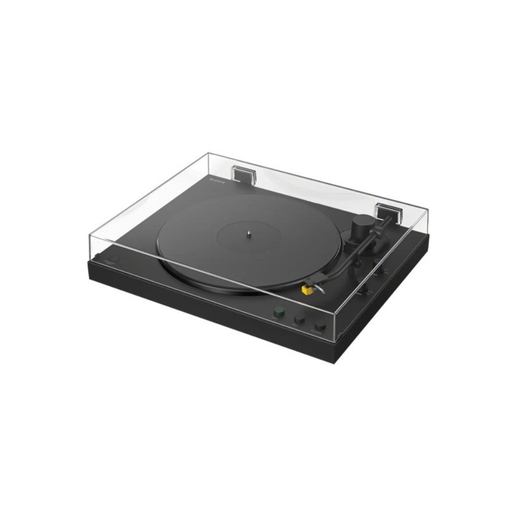 No image available
Suitable for 33⅓ and 45 rpm records if you want automatic operation and to use Bluetooth or a wired connection.
The product description lists belt drive, automatic operation, Bluetooth and a built-in phono preamp.
The description mentions a PHONO/LINE switch. Check which input your audio equipment has.
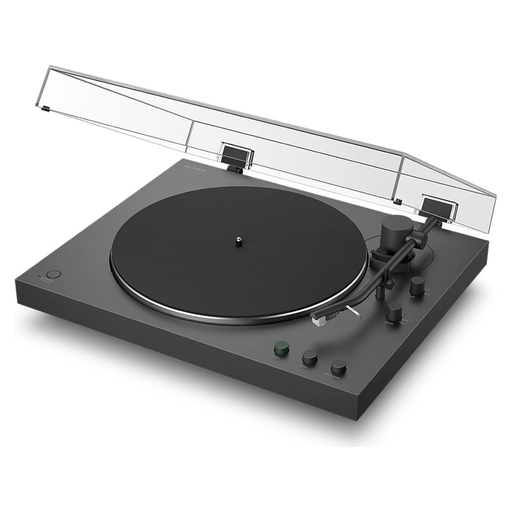 No image available
Suitable for 33⅓ and 45 rpm records if you want automatic start-up and to use Bluetooth or a wired connection.
Sony lists fully automatic operation, Bluetooth and a switchable phono preamp with a PHONO/LINE connection.
Sony confirms that this model doesn’t play 78 rpm records.
No, check the speed of the record itself. For example, Sony confirms that the PS-LX3BT doesn’t play 78 rpm records. For 78 rpm shellac, you need both a suitable speed and a suitable stylus.
No, the preamp alone can’t power passive speakers; you’ll also need an amplifier. If you have active speakers, check that the turntable has a suitable LINE output. Don’t connect a turntable with its internal phono preamp switched on to the PHONO input on an amplifier.
Choose a stable spot, and don’t place the turntable right next to speakers if vibrations could reach it. Speaker position and where you sit also affect what you hear; the turntable’s specifications alone can’t determine the ideal setup for your room.
Check which replacement stylus is compatible with the cartridge on the exact model. Audio-Technica lists VM95-series styli as compatible with the AT-LP70XBT; don’t assume the same applies to other models.
According to the Dutch government, distance purchases are often covered by a 14-day cooling-off period; whether it applies depends on the purchase and any exceptions. You’re also entitled to a product that is fit for purpose. The Dutch government says there’s no fixed statutory guarantee period in the Netherlands; a manufacturer’s guarantee is in addition to your statutory rights.