
Careful listener of classical LPs
You want to consider speed, cartridge and set-up, rather than focusing only on wireless features. Technics’ published specifications and Audio-Technica’s set-up guidance offer some practical points to consider.


If you listen closely to classical LPs, compare the speed specifications, cartridge and set-up, but don’t assume that one specification proves a turntable will sound better. If you’re working at the same time, automatic tonearm return can be useful; also check whether your amplifier or speakers need a phono preamp. The Consumers’ Association often describes the sound quality of suitcase record players as inferior to that of standard turntables, but a standard turntable may need extra equipment to connect it.
You want to consider speed, cartridge and set-up, rather than focusing only on wireless features. Technics’ published specifications and Audio-Technica’s set-up guidance offer some practical points to consider.
You don’t want to keep starting and returning the tonearm yourself while you work. Compare the automatic functions of each model: Audio-Technica, Denon and Sony describe models with automatic features.
You want to connect the turntable to your amplifier or active speakers, so you need to know which phono or line input is suitable. Check the connections on both devices and the turntable’s switch setting.
First decide whether you’d rather operate the turntable yourself while working or have fewer tasks to handle. Then make sure the connections and set-up suit your audio system and workspace.
| What to consider | What should you check? | Who is this important for? |
|---|---|---|
| Speed and playback | Check that it supports 33⅓ tpm and compare wow and flutter figures only when they use the same measurement basis. Also check which cartridge and replacement stylus are listed. | If I listen closely to classical LPs, I want to know which speed and cartridge details are specified for the model. Around 33% of consumers put playback and speed first. |
| Controls while you work | Check separately whether starting, stopping and tonearm return are automatic; the word ‘automatic’ doesn’t tell you which functions are included. | If I play a record while working, I don’t want to operate the tonearm every time. Around 27% of consumers give ease of use their highest priority. |
| Connecting to your audio system | Check whether your equipment has a PHONO or LINE/AUX input and which output or switch setting the turntable offers. Also establish whether you use active speakers or an amplifier. | If I want to use my existing amplifier or active speakers, the turntable’s output needs to be compatible. Around 20% of consumers put connection to their audio system first. |
| Positioning and maintenance | Measure the space available and check that you have a level surface away from speaker vibrations. Also find out how to clean the stylus and whether it can be replaced. | If my desk is short on space or the speakers are nearby, I want to be able to choose a suitable spot in advance. Around 20% of consumers give positioning and maintenance their highest priority. |
A turntable doesn’t automatically output a signal that suits every audio input. The PHONO or LINE setting and the connections on your existing audio system determine which connection you can use.
Before buying, check the inputs on your speakers or amplifier and the connection options on the turntable.
Depending on your existing equipment, you may need a phono preamp, an amplifier or a suitable pair of active speakers.
The Consumers’ Association often describes the sound quality of suitcase record players as inferior to that of standard turntables and advises taking care with delicate records.
If sound quality matters a lot to you, weigh the convenience of easy set-up against a standard turntable with separate audio equipment.
Starting, stopping and returning the tonearm are separate functions. The difference can matter when you’re listening while working and the record finishes.
Check these functions separately in the specifications of the model you’re considering.
For the AT-LP70XBT, Audio-Technica recommends a flat, level surface away from speakers that cause vibrations.
Plan where to place the turntable and speakers together, and measure the available space in advance.
The AT-LP70XBT is a fully automatic model with Bluetooth and a switchable phono preamp.
The DP-300F is designed for fully automatic operation and has a switchable phono preamp.
The SL-1500C is a direct-drive model with published speed specifications.
According to Lenco, the LBT-188PI combines manual operation with Bluetooth transmission and USB.
The PS-LX3BT is a fully automatic model with a Bluetooth transmitter and a built-in, switchable phono preamp.
These models are suited to anyone who wants automatic operation while listening in their study.
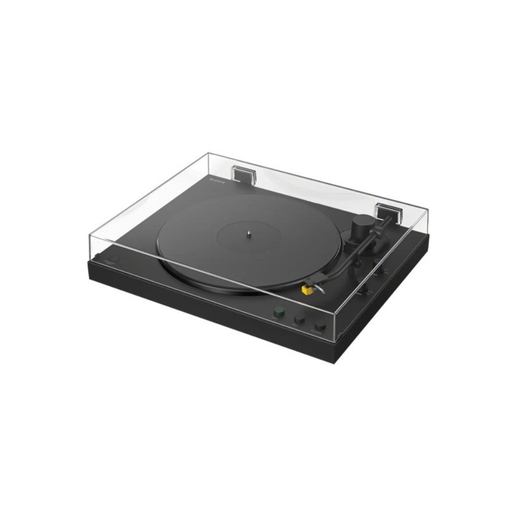 No image available
Ideal if you want to handle the tonearm less while working and are looking for a Bluetooth turntable.
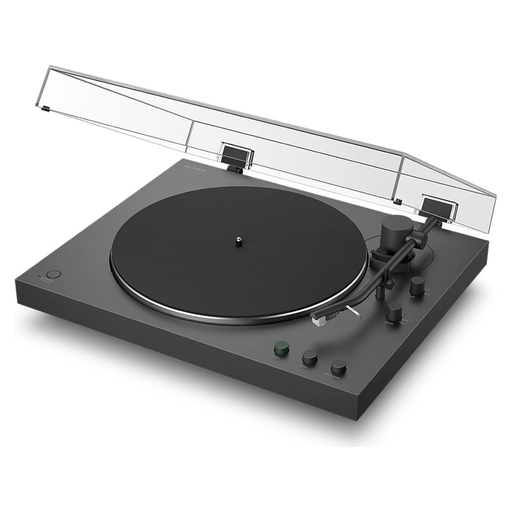 No image available
Ideal if you want to operate the tonearm yourself less often while working and are looking for a Bluetooth turntable.
That depends on the inputs on your speakers and the turntable’s phono preamp. Audio-Technica says that a turntable with its line output switched on can be connected to suitable active speakers; use the appropriate phono setting with a PHONO input. Check the connections on both devices.
Choose a flat, level spot away from speakers that cause vibrations. This is Audio-Technica’s set-up advice for the AT-LP70XBT; consult the manual for your own turntable.
Follow the care instructions for your turntable’s cartridge. Audio-Technica recommends careful cleaning with a suitable tool and warns against brushing sideways when using a brush.
No. According to ACM ConsuWijzer, your statutory rights apply alongside a manufacturer’s or seller’s warranty. If a product develops a fault sooner than you could reasonably expect under normal use, the seller is responsible for providing an appropriate remedy free of charge; there isn’t one fixed statutory warranty period for every turntable.
For a private purchase of a new, similar appliance, the Dutch Government describes a free old-for-new scheme, including for online purchases. This scheme for private customers doesn’t apply to equipment bought for business use.