
Listeners with old 78 rpm records
You’ll want to establish whether your records are made of shellac, and make sure you have both the right speed and a suitable stylus. Not every 78 rpm record needs the same stylus.


First, check whether your records play at 33⅓, 45 or 78 rpm. For old shellac records, you’ll also need a stylus suited to the record material. Don’t place your speakers and turntable together on a surface that vibrates: Audio-Technica warns that speaker vibrations can affect the stylus. Then choose a connection that works with your active speakers or amplifier. Automatic operation makes starting and stopping easier, but it doesn’t replace these checks.
You’ll want to establish whether your records are made of shellac, and make sure you have both the right speed and a suitable stylus. Not every 78 rpm record needs the same stylus.
If your speakers are close to your turntable, you’ll want to stop vibrations from affecting the stylus. That makes positioning just as important as choosing the right turntable.
You want to connect your active speakers or amplifier without needing unnecessary extra equipment. Automatic operation can be handy if you’d rather not position the tonearm yourself each time.
Start with the speed and material of your records. Then check the set-up and connections. That way, you can avoid choosing a turntable that’s suitable in principle but doesn’t work well with your speakers or collection.
| Consideration | What should you look for? | Who is this important for? |
|---|---|---|
| Record type and speed | Check the speed and, for 78 rpm records, the material and the type of stylus required. | I want to make sure my spoken-word records can be played. Around 36% of consumers give record compatibility top priority. |
| Vibrations and positioning | See if the turntable and speakers can be placed on separate, stable surfaces. Check that any wall bracket is suitable. | My speakers are close to the turntable, and I want to stop vibrations reaching the stylus. Around 29% of consumers prioritise a set-up with minimal vibration. |
| Connecting to your system | Check whether your speakers are active or passive, which inputs are available and where the phono preamp is located. | I want to connect my existing speakers or amplifier without using the wrong signal level. Around 21% of consumers start by checking the connections. |
| Operation and equipment | Compare automatic and manual operation, and check what amplification and replacement stylus you’ll need. | I want to start and stop playback easily and know which equipment I can already use. Around 14% of consumers prioritise operation and the equipment required. |
The speed alone doesn’t tell you whether the fitted stylus is suitable for the material and groove of your record.
First establish the speed and record material, then check that the turntable, cartridge and stylus are a suitable match.
Vibrations from speakers close to the turntable can affect the stylus. Choosing a turntable based only on its distance from the wall won’t automatically solve a vibration problem.
First plan a stable place for both devices. If you’re using a wall bracket, check that it’s suitable for the specific model and mounting location.
Passive speakers need an amplifier. Feeding a line-level signal into a phono input for further amplification can cause distortion.
Check the inputs and amplification available on your system, then set the PHONO or LINE switch accordingly.
The AT-LP60X is an automatic turntable for 33⅓ and 45 rpm. The manual AT-LP120XUSB adds 78 rpm and USB. These are differences between the models, not features shared across the brand.
The DP-300F is a fully automatic turntable for 33⅓ and 45 rpm, with a switchable phono preamp.
According to Rega, the Planar 78 is designed exclusively for 78 rpm records. The brand also offers a wall bracket that fits certain other Planar models.
According to Lenco, the L-3810WH is a manual turntable with a built-in preamp and USB recording, designed for use with external speakers.
These product picks are suited to spoken-word records played at 33⅓ or 45 rpm. Before buying, check that the speeds and connections of the exact model suit your records and speakers.
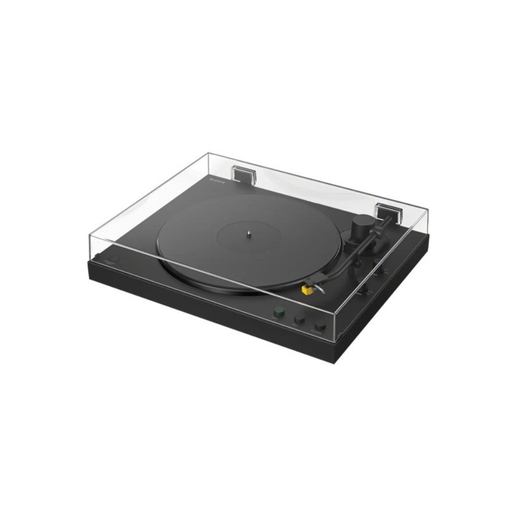 No image available
An option to consider if Bluetooth is an important feature in your choice of turntable. Check that the specifications confirm the speed of your records and the connection you need.
Bluetooth is listed in the product name.
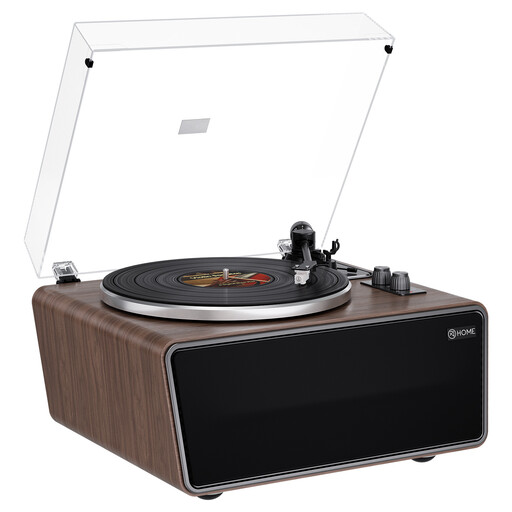 No image available
An option to consider if you want built-in speakers and are also considering a connection for external speakers. Check that the connections and speeds work with your system and records.
The product name lists four built-in speakers, a phono preamp and an AT-3600L (MM) cartridge.
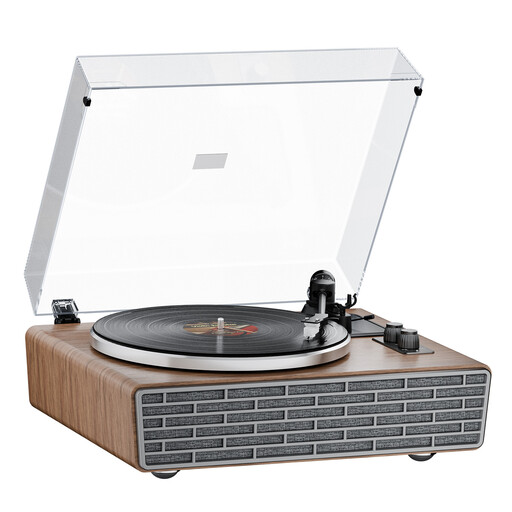 No image available
An option to consider if you’re looking for a turntable with built-in speakers. Check that the connections for external speakers are compatible with your existing equipment.
The product name lists Bluetooth, four built-in speakers and a dust cover.
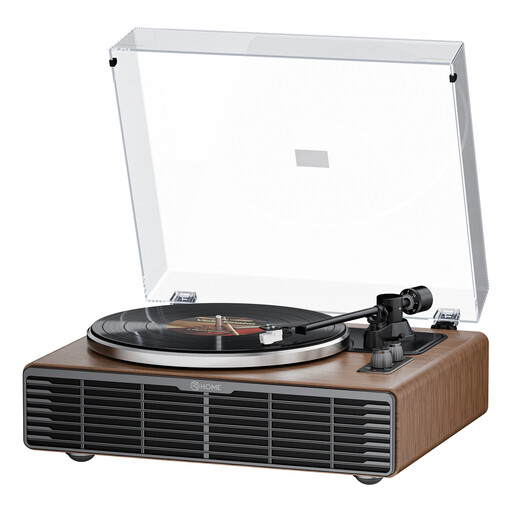 No image available
An option to consider if you’re looking for built-in speakers and a choice of connections. Check which PHONO or LINE connection you need, as well as the speed of your records.
The product name lists four speakers, belt drive, an AT3600L cartridge and a transparent dust cover.
No. Check the speed and, for 78 rpm records, the material too. Audio-Technica describes different styli for 78 rpm shellac and 78 rpm vinyl. The 78 rpm marking on a turntable doesn’t prove that the fitted stylus is right for your record.
No. The main thing is to check whether speaker vibrations can reach the turntable’s surface and stylus. A separate, stable position may help. Only use a wall bracket if it’s suitable for the turntable and the mounting location.
Active speakers have a built-in amplifier; passive speakers need a separate amplifier. If you have a suitable line input, use the line output from a turntable with its phono preamp switched on. For a phono input, set up the signal chain so the signal isn’t amplified by the phono preamp twice.
Hold records by the edge and label, and identify the record material before choosing a cleaning method. The Library of Congress recommends this way of handling records, including shellac and vinyl records.