What should you look for?
First, check the speed and material of your records. Then choose the controls and connections to suit where you listen and the audio equipment you already own.
| What to consider |
What should you check? |
Who is this important for? |
| Clarity and positioning |
Check how your speakers or headphones connect: via phono, line or Bluetooth. Assess the sound where you usually listen. |
If you want to follow spoken-word recordings in an open-plan space, you’ll want to know whether your audio setup works there. Around 36% of consumers give clarity and positioning top priority. |
| Controls |
Check separately whether the turntable starts and stops automatically and returns the tonearm; these features aren’t a given on manual models. |
If you often want to start a record without operating the tonearm yourself each time, focus on automatic features. Around 29% of consumers prioritise ease of use. |
| Connections and equipment |
Check the inputs on your amplifier and speakers. See whether you need a phono preamplifier, a suitable line input or a Bluetooth receiver. |
If you want to use your existing audio equipment, you’ll want to know in advance which components will work together. Around 21% of consumers make their existing equipment and the complete setup their top priority. |
| Speed and stylus |
Check the speed printed on the record. For 78 rpm records, find out whether they’re shellac or vinyl. Choose a stylus suitable for shellac records. |
If you have a mixed collection or may own 78 rpm records, you’ll need to match the speed and material carefully. Around 14% of consumers prioritise record format and material. |
Turntables at Joybuy
The models shown are aimed at listeners looking for automatic operation for spoken-word records at 33⅓ and 45 rpm. Before buying, check that the connections will work with your speakers or headphones.
 No image available
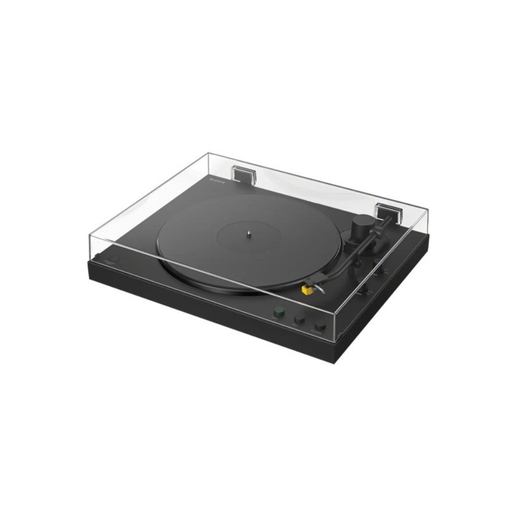
Sony PS-LX5BT
A good fit if you want to play spoken-word records at 33⅓ or 45 rpm and are looking for automatic operation.
Bluetooth is included in the product name; check that the available connections work with the receiver in your audio setup.
View on Joybuy
 No image available
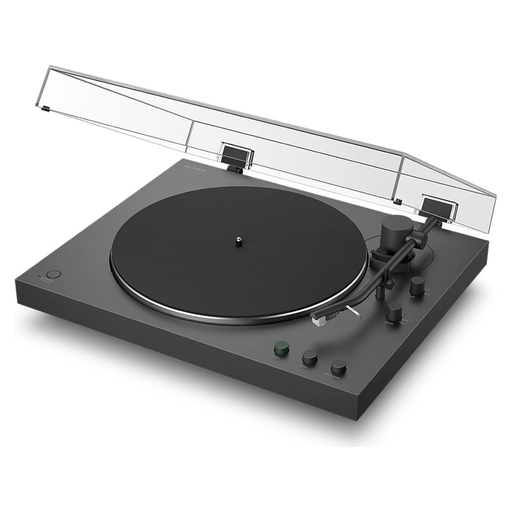
Sony PS-LX3BT
A good fit if you want to play spoken-word records at 33⅓ or 45 rpm and are looking for fully automatic operation.
Bluetooth is included in the product name; check that the available connections work with the receiver in your audio setup.
View on Joybuy
Frequently asked questions
Can I play any spoken-word record on a 33⅓ or 45 rpm turntable?
No. Check the speed printed on the record. According to Audio-Technica, 78 rpm shellac records need both the correct speed and a suitable shellac stylus; 78 rpm vinyl requires a different type of stylus.
How do I connect a turntable if my amplifier doesn’t have a phono input?
Use a turntable with its phono preamplifier switched on and connect it to a suitable standard audio input, or connect a separate phono preamplifier. Check the manuals for both devices before choosing an input.
What should I check when using and maintaining a turntable?
Check the condition of the stylus and whether it can be replaced, and position it carefully in the groove. With a manual turntable, also check whether it stops by itself; according to Lenco, the LBT-188 doesn’t have an automatic stop function.
Does a two-year manufacturer’s warranty cover the full warranty period in the Netherlands?
No. According to the Dutch government, there’s no fixed statutory warranty period in the Netherlands: you’re entitled to a product that works as it should, and the retailer is your point of contact if something goes wrong. A manufacturer’s warranty is in addition to this.
Can I return a turntable bought online within 14 days?
According to the Dutch government, purchases made at a distance from a business usually come with a 14-day cooling-off period. Purchases from private sellers aren’t covered by the same rules, so check the terms that apply to your purchase.


