What should you look for when choosing?
Start with the speed and the right stylus for your records. Then check the audio connection, where you’ll place the turntable and how much you want to operate it yourself.
| What to consider |
What to look for when buying |
Who is this important to? |
| Record compatibility |
Compare the speed marked on the record and sleeve with the speeds listed for the turntable. For old 78 rpm records, also check which stylus and cartridge are suitable. |
If I have records with different speed markings, I want to know which ones I can actually play. Around 33% of consumers making this choice care most about compatibility with their own records. |
| Connecting to your audio set-up |
Check whether your speakers are powered or passive, which input your amplifier has, and whether the turntable offers a switchable phono/line output. |
Anyone wanting to connect a turntable to existing speakers or an amplifier will want to know in advance what connections are needed. Around 27% of consumers prioritise connecting to their existing audio set-up. |
| A stable place to set it up |
Assess the shelf or floor as you walk past and use the speakers. Check the load capacity, dimensions and model compatibility before choosing a wall bracket. |
If my shelf vibrates, I want to find a suitable place before setting up a turntable. Around 20% of consumers prioritise a stable set-up. |
| Operation and maintenance |
Compare automatic start and stop with manual operation. Also check which replacement stylus is designed for the exact model, and whether USB recording is available if you want to digitise your records. |
Anyone who plays records regularly may value ease of use and a clear replacement option for wear parts more than adjusting settings themselves. Around 20% of consumers pay most attention to operation and maintenance. |
Turntables at Joybuy
These models are designed for 33⅓ and 45 rpm records and have built-in speakers, so you can play records without separate speakers. Check that the speeds match your collection and that the other connections suit your set-up.
 No image available
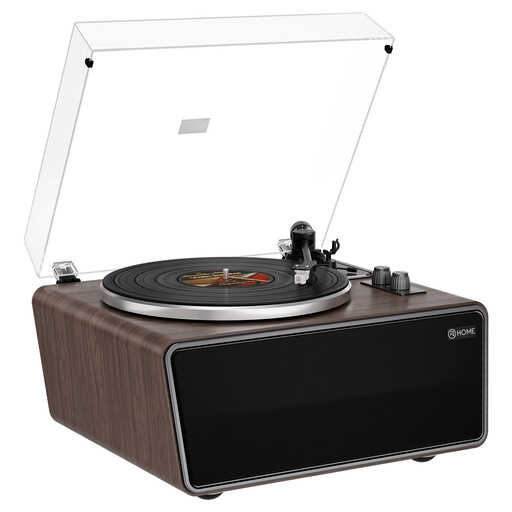
XJ-HOME XJ-H01 all-in-one turntable
An option if you want to play records without separate speakers.
The product information lists 33⅓ and 45 rpm, four built-in speakers, a phono preamp and an AT-3600L cartridge.
View at Joybuy
 No image available
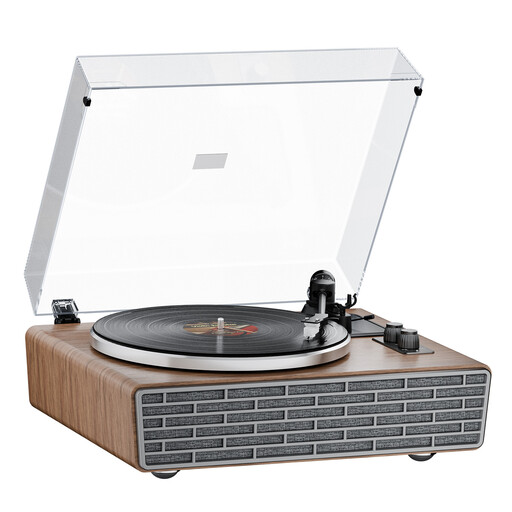
XJ-HOME XJ-H02 Bluetooth turntable
This model may suit you if you want built-in speakers and are also looking for Bluetooth, as stated in the product name.
The product information lists 33⅓ and 45 rpm, four built-in speakers, a belt drive, a transparent dust cover, RCA outputs and an AT cartridge.
View at Joybuy
 No image available
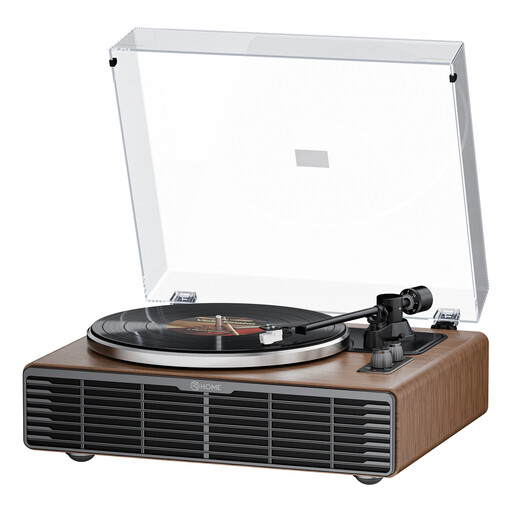
XJ-HOME XJ-H03 Bluetooth turntable
An option if you want built-in speakers and the listed phono or line RCA output suits your set-up.
The product information lists 33⅓ and 45 rpm, four speakers, a belt drive, an AT3600L cartridge and a transparent dust cover.
View at Joybuy
Frequently asked questions
Can I play any spoken-word record on a standard LP turntable?
No. First check the speed marked on the record itself. The AT-LP60X and Sony PS-LX3BT are listed for 33⅓ and 45 rpm; the Library of Congress describes historical spoken-word records at 16⅔ rpm. For old 78 rpm records, also check whether the stylus is suitable.
Why can’t I hear anything after connecting it?
Check whether you’re using powered speakers or an amplifier with speakers. If the turntable has a switchable phono preamp and you’re using a line input, check the manual to see whether the switch should be set to LINE.
How do I care for the stylus?
Follow the instructions for the specific cartridge. When cleaning a stylus, Audio-Technica advises not moving the platter or the cleaning brush during the process.
Will I have to pay to repair a faulty turntable after two years?
Not necessarily. According to the Netherlands Authority for Consumers and Markets, statutory guarantees in the Netherlands don’t have a fixed term; what you can expect from a product depends, among other things, on normal use. If there’s a fault, contact the seller.
Which product safety rule applies when buying in the Netherlands?
According to the Dutch government, electronic devices sold in the EU must carry a CE marking. When buying, also check the product information and who the seller is; a CE mark in an advert doesn’t by itself prove that a specific item meets every requirement.


