
Listener with old spoken-word records
First check whether your collection includes any 78 rpm records. For these, identify the material and the right stylus. Audio-Technica distinguishes between styli for shellac and vinyl 78 rpm records.


Start by checking your records’ speed and material: a turntable for 33⅓ or 45 rpm records will play at those speeds, while 78 rpm records also need a suitable stylus. Then choose between built-in speakers and connecting to your existing system, and check the controls and how much space the complete setup will take up.
First check whether your collection includes any 78 rpm records. For these, identify the material and the right stylus. Audio-Technica distinguishes between styli for shellac and vinyl 78 rpm records.
Find room for both the turntable and the speakers, or compare this with a model that has built-in speakers. Lenco describes the LS-15WD as having built-in speakers; the Consumers’ Association notes that all-in-one players often sound less good than conventional turntables. This is not a test result for this specific model.
Match the turntable’s output to the input and amplification of your existing system. Sony describes the PS-LX3BT as having a phono/line switch; check which connection your audio equipment needs.
First check your records and the stylus they need, then match the audio connection and finally measure the space required for the complete setup.
| Buying consideration | What should you check? | Who is this important for? |
|---|---|---|
| Speed and stylus | Check the speed required by the record. For 78 rpm records, also check whether the record is made of shellac or vinyl and which stylus is suitable. | If you want to play old records, you’ll want to avoid using a speed or stylus that isn’t right for the record. Around 29% of consumers put record compatibility first. |
| Connection to speakers | Check the input and amplification available on your speakers or receiver, and match them to the turntable’s output. | If you want to connect the turntable to an existing system or avoid extra equipment, focus on the complete audio chain. Around 29% of consumers give top priority to connecting without additional equipment. |
| Space for the setup | Measure the space for the turntable, allowing for an open dust cover, accessible connections and any separate speakers. | If your living room has limited space, consider the room needed for the whole setup, not just the turntable. This is the main buying consideration for around 21% of consumers. |
| Controls and stopping | Check separately whether the turntable starts automatically, returns the tonearm or only stops; auto-stop doesn’t automatically mean the turntable is fully automatic. | If you’d rather not operate the tonearm yourself, look for information on both starting and returning at the end of a record. Ease of use is a top priority for around 21% of consumers. |
A turntable with a 78 rpm setting doesn’t automatically come with the right stylus for every record. Audio-Technica recommends a 3 mil stylus for shellac 78 rpm records and distinguishes between stylus sizes for 78 rpm vinyl.
First identify the record material, then check the speed, cartridge and suitable stylus.
Some records may need a separate, suitable stylus.
A phono preamp doesn’t provide the power amplification that passive speakers need. Lenco recommends using a suitable amplifier or active speakers.
Before buying, check which amplification and inputs you already have.
You may need an amplifier or active speakers to complete the setup.
Auto-stop, automatic start and automatic tonearm return are different features. Lenco lists auto-stop for the LS-15WD; Sony lists automatic start and return for the PS-LX3BT.
Check which actions the specific turntable performs automatically rather than relying on the term auto-stop alone.
The complete setup may also need space for an open dust cover and separate speakers. So even if a turntable fits on your furniture, you may not have enough room to use it.
Measure the available space and check that the dust cover can open and the connections remain accessible.
The PS-LX3BT is an automatic option for 33⅓ and 45 rpm records, with a choice of phono or line output and a Bluetooth transmitter.
The AT-LP120XUSB is a manual turntable with 33⅓, 45 and 78 rpm settings, USB and a switchable phono preamp.
The LS-15WD is an all-in-one option for 33 and 45 rpm records, with built-in speakers.
The DP-29F is an automatic option with a built-in phono equaliser for connecting to suitable audio equipment.
The Primary E Phono is a manual 33/45 rpm option with a phono/line output for an existing audio setup.
This option is aimed at listeners who play 33⅓ or 45 rpm records and want automatic operation alongside a connection to an existing audio setup.
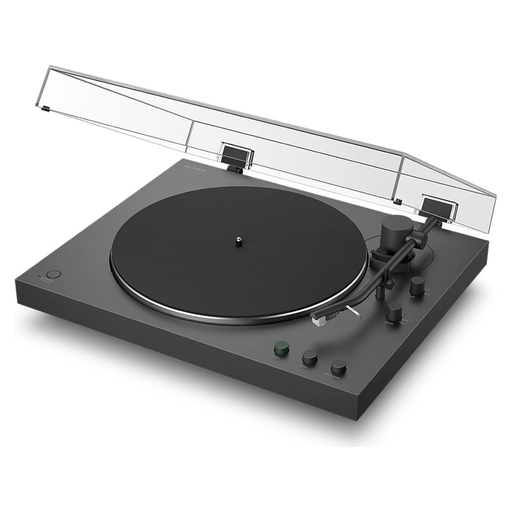 No image available
Suitable for listeners who play 33⅓ and 45 rpm records and want automatic start and tonearm return.
Sony lists Bluetooth and a PHONO/LINE switch. The listed speeds are 33⅓ and 45 rpm; for 78 rpm records, check for a suitable turntable and stylus.
No. Audio-Technica recommends a 3 mil stylus for 78 rpm shellac records and distinguishes between stylus sizes for 78 rpm vinyl. So check both the record material and the suitable stylus.
No, passive speakers also need power amplification. Lenco recommends a suitable receiver or active speakers; also check that the input matches the selected PHONO or LINE output.
Measure the space for the turntable and allow for an open dust cover, accessible connections and any separate speakers. The turntable’s external dimensions alone don’t show how much room the complete setup needs.
No. Auto-stop can mean something different from automatic start or tonearm return. Sony lists automatic start and return for the PS-LX3BT; for other models, check which features are specified separately.