
Second-hand record listener
You want to play used LPs regularly and need a turntable with a stylus that can be maintained or replaced. NVPI’s Music Monitor 2026 reports that half of vinyl buyers purchase second-hand records.


Start by working out where the complete setup will go and how it will connect to your speakers or amplifier. Then decide whether you prefer automatic or manual operation. An all-in-one player can reduce the number of separate devices, but the Consumentenbond reports that these players, usually suitcase-style record players, often sound worse than standard turntables. When buying second-hand records, also check the condition of the records and whether the stylus can be maintained or replaced.
You want to play used LPs regularly and need a turntable with a stylus that can be maintained or replaced. NVPI’s Music Monitor 2026 reports that half of vinyl buyers purchase second-hand records.
You need to fit both the turntable and the necessary audio equipment into a small living room. So measure the space for the complete setup, not just the turntable.
You want to connect your turntable to active speakers, an amplifier or compatible Bluetooth equipment. Make sure the turntable’s output is compatible with the input on your existing equipment.
| What to consider | What to look for when buying | Who is this important for? |
|---|---|---|
| Second-hand records and stylus maintenance | Check which replacement stylus is compatible with the exact model, and follow the manufacturer’s maintenance instructions. | I want to play used records regularly and be able to maintain or replace the stylus. Around 33% of consumers prioritise maintaining used records. |
| Space for the complete setup | Measure the space for the turntable and speakers, and allow for the dust cover to be used. | If my living room is short on space, I want to know in advance whether the whole setup will fit. Around 27% of consumers give available space top priority. |
| Connecting to existing equipment | Check the inputs on your speakers or amplifier and compare them with the phono, line or Bluetooth connections on the exact model. | I want to keep using my current speakers or amplifier and need to know which connection is suitable. Around 20% of consumers prioritise connectivity. |
| Automatic or manual operation | Compare automatic start, return and stop functions with placing the tonearm yourself. | If I’d rather not place the tonearm myself, I’ll look for simple controls. If I want to operate the tonearm myself, I may prefer a manual model. Around 20% of consumers give ease of use top priority. |
A standard turntable isn’t automatically a complete sound system. Separate speakers and other necessary equipment also take up space.
Before buying, measure the space for the complete setup and check which connections your existing equipment has.
Depending on your equipment, a separate setup may also need space for individual speakers, an amplifier or a phono pre-amplifier.
The Consumentenbond reports that all-in-one players, usually suitcase-style record players, often sound worse than standard turntables. A compact size alone says nothing about sound quality.
Decide whether you’d rather have as few separate devices as possible or a setup with individual components, then check the specifications of the specific model.
Replacement options vary by model. Audio-Technica lists VM95-series styli for the AT-LP70XBT; Sony states that the PS-LX310BT has no interchangeable headshell.
Use the full model number to find a suitable replacement stylus and check which options are supported.
You may need a compatible replacement stylus to keep using your chosen turntable.
The AT-LP70XBT is an automatic option for anyone who values stylus replacement options and a choice of connection types.
The PS-LX310BT is an automatic turntable with phono and line connections, as well as Bluetooth.
The DP-29F is an automatic, wired option with a built-in phono equaliser.
The Planar 1 Plus is a manual option with a built-in MM phono stage.
These Joybuy products focus on automatic Bluetooth turntables for anyone who wants to listen wirelessly.
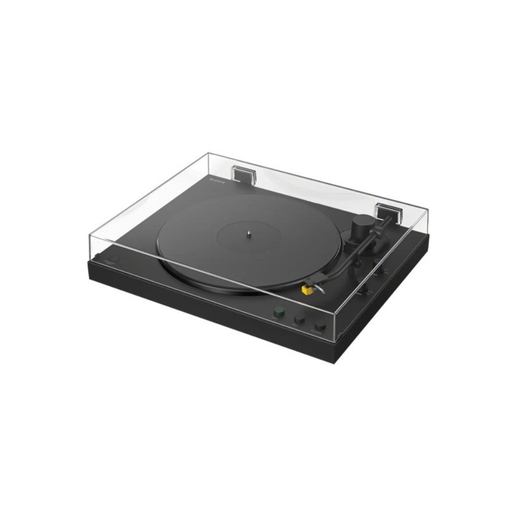 No image available
A good choice if you’re looking for a Bluetooth turntable for wireless listening.
Bluetooth is mentioned in the product name.
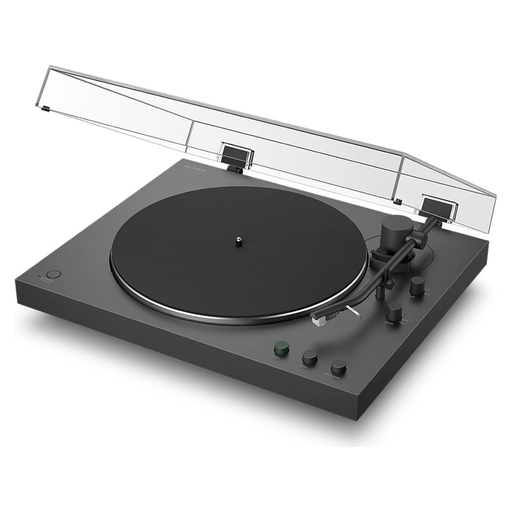 No image available
A good choice if you want to listen wirelessly and are looking for a Bluetooth turntable.
Bluetooth is mentioned in the product name.
Not if your turntable or amplifier has a suitable phono pre-amplifier. If your model has a switch, match the phono or line setting to the input you’re connecting it to. An RCA plug alone doesn’t tell you which setting you need.
Place it on a flat, level surface and keep it away from speakers that cause vibrations. Audio-Technica gives this advice for the AT-LP70XBT. For another model, check its manual and make sure you can still use the dust cover.
Check the record and stylus before playing, and follow the manufacturer’s cleaning instructions. When cleaning the stylus, Audio-Technica recommends brushing from back to front, not from side to side.
ACM ConsuWijzer states that online purchases generally come with a 14-day cooling-off period from the date of delivery; exceptions depend on the purchase. Under the statutory guarantee, the product must meet what you could reasonably expect of it. In the Netherlands, there is no fixed statutory guarantee period of exactly two years. Contact the seller if there’s a fault.