
Listener with second-hand LPs
You want to play second-hand records regularly and are looking for careful stylus handling and the option to replace it.


Start with the records you own and the connections on your audio system. For standard LPs and singles, 33⅓ and 45 rpm are the relevant speeds, while you should check 78 rpm records separately. Then choose between the convenience of automatic operation and manual control, and, if you have second-hand records, check which stylus is suitable and how to replace it. A built-in phono preamp can make it easier to connect to a standard audio input, but it doesn’t necessarily mean that speakers are included.
You want to play second-hand records regularly and are looking for careful stylus handling and the option to replace it.
You already have speakers or an amplifier and want to know which phono or line connection is right for your set-up.
You check whether your collection includes 78 rpm records as well as LPs and singles, as not every turntable supports this speed.
First check your records and existing connections, then compare the controls and the options for replacing the stylus.
| What to consider | What should you check? | Who is this important for? |
|---|---|---|
| Stylus and careful playback | Check which cartridge and replacement stylus are compatible with the model, and how the tonearm is operated. | If I play second-hand LPs regularly, I want to know how to lower and replace the stylus carefully. Around 38% of consumers prioritise careful playback and stylus replacement. |
| Connection to your audio system | Check the inputs on your amplifier or active speakers, and whether the turntable has a phono or line output. | If you want to use an existing system, you’ll want to make sure the turntable connects to an available input. Around 31% of consumers put compatibility with their audio system first. |
| Ease of use | Check whether the tonearm starts and returns automatically, and how to switch between 33⅓ and 45 rpm. | If I play records often, automatic start and return can save me a few steps. Around 23% of consumers prioritise ease of use. |
| 78 rpm records | Check that the turntable has a 78 rpm setting and that the stylus is suitable for the record in question. | If you own 78 rpm records, you need to check both points rather than looking only at LPs and singles. Around 8% of consumers prioritise owning 78 rpm records. |
Consumentenbond notes that suitcase record players often have poorer sound quality, and that their tonearms make it harder to lower the stylus gently into the groove.
Compare the convenience of an all-in-one model with the tonearm, stylus and connection options of a standard turntable, especially if you want to look after your records.
If you switch to a standard turntable later, you may need a compatible audio system or phono preamp.
A turntable needs a suitable phono stage, either in the turntable, in your system or as a separate device.
Before buying, check the inputs on your audio system and whether the turntable has a phono or line output.
A turntable that supports only 33⅓ and 45 rpm won’t play 78 rpm records. Sony confirms this for the PS-LX3BT, for example.
Check the speeds of your records and, for 78 rpm records, make sure you also check which stylus is suitable.
The Dutch government states that there is no fixed statutory warranty period in the Netherlands. What you can reasonably expect from a used device also depends on its condition and the description provided when you bought it.
Check the terms of any additional warranty and keep the description of the device’s condition.
Audio-Technica describes the AT-LP70XBT as an automatic turntable for 33⅓ and 45 rpm, with Bluetooth and a switchable phono preamp. The separate AT-LP120XBT-USB is manual and also lists 78 rpm.
The Dutch specifications for the PS-LX3BT describe a fully automatic turntable with Bluetooth, a built-in phono preamp, and 33⅓ and 45 rpm.
Denon describes the DP-300F as a fully automatic, belt-drive turntable with a switchable phono preamp for 33⅓ and 45 rpm.
The product information for the DUAL DT 250 USB describes a belt-drive turntable for LPs and singles, with an integrated phono equaliser.
The Rega Planar 1 manual specifies that it must be connected to a suitable phono stage.
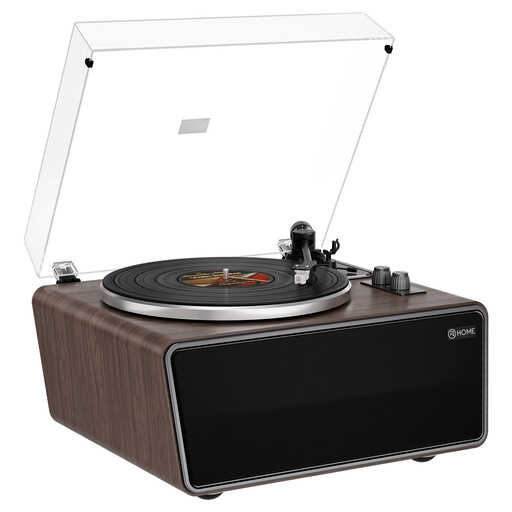
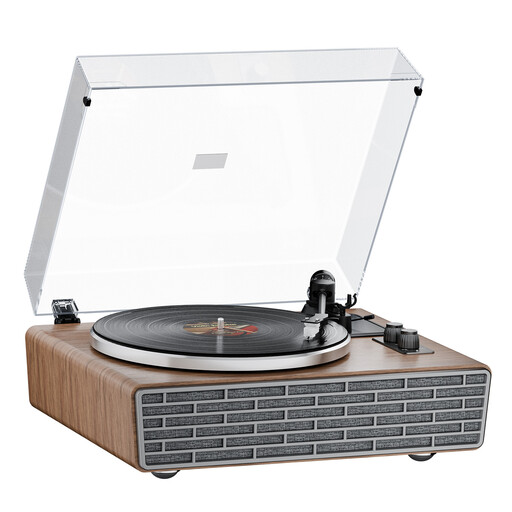
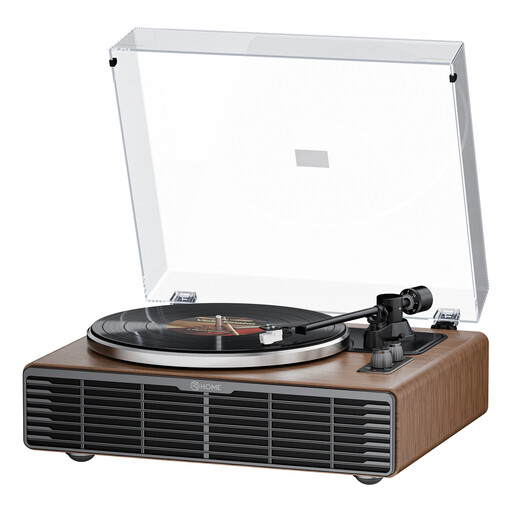
These Joybuy picks are turntables with built-in speakers for listening in your hobby room. Before buying, check the connections, compatibility with your records and the conformity documentation for the specific version.
 No image available
An option for anyone who wants to listen in their hobby room without separate speakers.
The product name lists four built-in speakers, a phono preamp and an AT-3600L (MM) cartridge.
 No image available
A good fit if you’re looking for built-in speakers and Bluetooth connectivity in your hobby room.
The product name lists four built-in speakers, a dust cover, belt drive and an AT cartridge.
 No image available
An option to consider if you want built-in speakers and Bluetooth connectivity.
The product name lists four speakers, belt drive, an AT3600L cartridge, phono/line RCA output and a dust cover.
No. Check the speed shown on the record. Sony confirms that the PS-LX3BT does not play 78 rpm records, while Audio-Technica lists 78 rpm for the AT-LP120XBT-USB. Also check that the stylus is suitable for the record in question.
Follow the manual for your chosen model and place the turntable in a suitable location. For the AT-LP70XBT, Audio-Technica recommends a spot away from strong vibrations, extreme heat, moisture and dirt. Ortofon recommends looking after your records regularly and carefully cleaning the stylus in line with its instructions.
That depends on your existing audio system and the turntable. A standard turntable needs speakers and suitable amplification. If neither the turntable nor your system has a phono stage, you may need a separate phono preamp. Check your equipment’s connections first.
When you buy from a business, the product must meet what you can reasonably expect, taking into account factors including its used condition; there is no fixed statutory warranty period. The Dutch government states that, in many cases, you have 14 days to change your mind when buying goods, including second-hand goods, from a business online or at a distance. According to the Dutch government, purchases made online from a private individual are not covered by those distance-selling rules.
The Netherlands Food and Consumer Product Safety Authority states that CE marking is compulsory for electrical products. Check the conformity documentation for the specific turntable and the version supplied; a CE marking is not an independent quality test. Audio-Technica lists European conformity documents for the AT-LP70XBT and AT-LP120XBT-USB.