
Second-hand record collector
You want to play a variety of finds and are particularly interested in record size, a suitable stylus and maintenance. Audio-Technica offers cleaning advice for old and second-hand records.


Start by checking the speeds and types of records in your collection, then see how the turntable connects to your existing speakers. A fully automatic model means less to do while you work; a manual turntable may suit you if you prefer to choose the settings or stylus yourself. For older records, also consider cleaning and choosing a stylus that’s suitable for the record material.
You want to play a variety of finds and are particularly interested in record size, a suitable stylus and maintenance. Audio-Technica offers cleaning advice for old and second-hand records.
You want to start a record easily and would rather not have to get up as soon as it finishes. Denon, Sony and Technics describe different ways to start playback automatically, return the tonearm or lift it at the end of a record.
You want to connect the turntable to equipment already in your home office. The Consumers’ Association notes that not every amplifier has a phono preamp, so check the inputs and the turntable’s output setting.
First, check which records you want to play and which connections your current equipment has. Then decide how much you want to operate the turntable yourself while working. USB is mainly relevant if you also want to make recordings.
| Consideration | What should you check? | Which consumers? |
|---|---|---|
| Suitability for your records | Check the speed of your records and the turntable’s available speeds. For 78 rpm records, also check the exact cartridge and which stylus is suitable. | If I play second-hand records at different speeds, I want to know whether both the turntable and the stylus are suitable. Around 33% of consumers give compatibility with their own records top priority. |
| Operating it while you work | Compare automatic start and return with a tonearm that simply lifts at the end of a record. | If I don’t want to keep operating the tonearm while I work, I check what the turntable does automatically. Around 27% of consumers prioritise ease of use while working. |
| Connecting to your listening setup | Check whether your equipment has a phono input and whether the turntable offers a switchable phono preamp, line output or Bluetooth. | If I want to use my existing speakers, the turntable’s output needs to match their inputs and any wireless receiver. Around 27% of consumers consider compatibility with their existing listening setup their main buying concern. |
| Recording via USB | Check whether the turntable has a USB output and whether you need it to make recordings on a computer. | If I also want to digitise my records, USB is relevant to me; if I only want to listen, it doesn’t need to be a deciding factor. Around 13% of consumers give digitisation top priority. |
The Consumers’ Association describes suitcase-style record players as easy to connect, but warns that they often sound mediocre and may be less gentle on delicate records.
Compare the convenience of connecting one with that of a standard turntable and suitable speakers. Don’t judge a model on its retro looks alone.
Not every amplifier has a phono preamp. Without the right pre-amplification, your chosen connection may not work properly.
Before buying, check your amplifier’s input and whether the turntable is set to phono or line.
A 78 rpm setting alone doesn’t mean the fitted stylus is suitable for 78 rpm records. For Bluetooth, your receiving speaker or headphones also need to be compatible.
Check the speed, stylus and receiving device separately.
The AT-LP120XUSB is a manual turntable with adjustable tracking force, USB and 33⅓, 45 and 78 rpm settings.
The DP-300F is a fully automatic turntable with a switchable built-in phono preamp.
According to Sony, the PS-LX3BT combines fully automatic operation, Bluetooth and a built-in phono preamp.
The E1 Phono is a manual model with a built-in phono preamp and pre-set controls.
The SL-1500C combines direct drive with a supplied cartridge, a built-in phono equaliser and tonearm lift at the end of a record.
These models are designed for fully automatic playback of records at 33⅓ or 45 rpm, with Bluetooth and a built-in phono preamp.
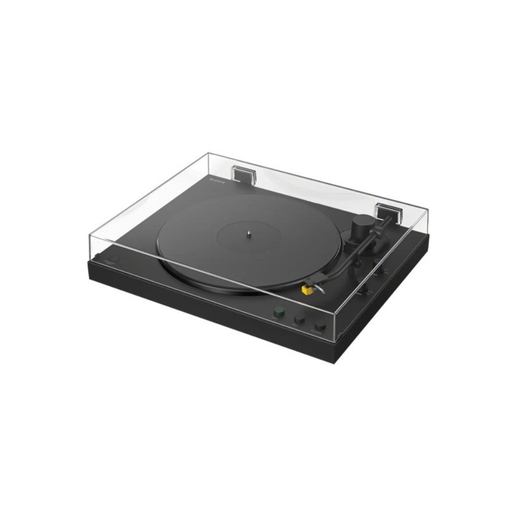 No image available
Ideal if you want to play 33⅓ or 45 rpm records with minimal effort while working from home.
The product description lists fully automatic operation, Bluetooth, an MM cartridge and a built-in phono equaliser with a PHONO/LINE switch.
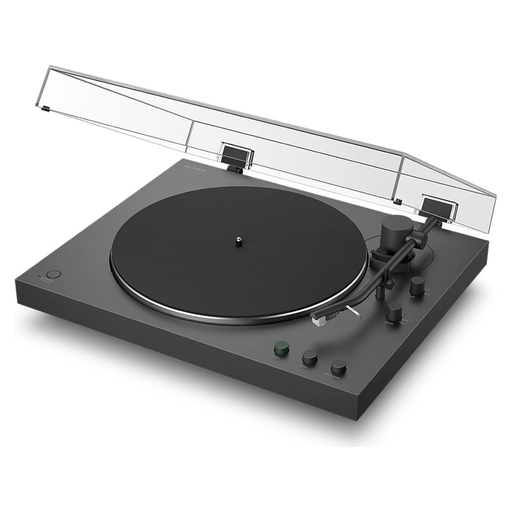 No image available
Ideal if you’re looking for a fully automatic turntable with Bluetooth for 33⅓ and 45 rpm records.
The product description lists an MM cartridge, a built-in phono equaliser, a PHONO/LINE switch and automatic tonearm return. Sony doesn’t list a USB connection or removable headshell for this model.
No. You also need to check whether the stylus is suitable for the record. Audio-Technica lists a separate VM95SP stylus with a 3 mil tip for 78 rpm records; the 78 rpm setting on the AT-LP120XUSB doesn’t mean the supplied stylus is designed for them.
Remove the dust and follow the cleaning product and manufacturer’s instructions for a more thorough clean. Audio-Technica recommends more thorough cleaning for old or second-hand records, but this doesn’t guarantee that scratches will disappear.
Check whether the turntable has a built-in phono preamp and a line output. If neither the turntable nor your existing equipment provides pre-amplification, you may need a separate phono preamp.
When you buy from a business, your statutory guarantee depends on what you can reasonably expect from the product. Online purchases generally come with a 14-day cooling-off period from delivery; ACM ConsuWijzer says this generally also applies to second-hand products, subject to legal exceptions. Don’t assume there’s a fixed statutory warranty period of two years for every turntable.
Electrical or electronic equipment placed on the market in the Netherlands must meet the applicable European requirements. Once the required conformity assessment has been completed, the manufacturer must affix the CE marking. Bluetooth models are also subject to radio equipment regulations. Check the information for the specific model: the general product requirement alone doesn’t mean that every item offered for sale has been assessed.