
Quiet listener at home
You play records while others are at home, so first consider whether low-volume speakers or headphones will work best in your space.


Start by deciding how you want to listen: through active speakers at a low volume or with compatible headphones. Check your records’ speed and condition, choose the right stylus, and find out whether your setup needs a phono preamp. A different turntable won’t repair a worn record.
You play records while others are at home, so first consider whether low-volume speakers or headphones will work best in your space.
You want to take the condition of your records and stylus into account. If you also own 78 rpm records, check the record material, playback speed and the type of stylus you need.
You want to know in advance whether the turntable will connect to your active speakers or hi-fi system, and how much you’ll need to do to play a record.
First decide whether you want to listen through speakers or headphones. Then check the connections and controls, and see whether your collection includes records with speeds or materials that need extra attention.
| Priority | What to look for when buying | Who is this most relevant to? |
|---|---|---|
| Quiet listening | Check whether the turntable and headphones support Bluetooth, or choose a suitable wired setup through your amplifier or speakers. | If I don’t want to disturb others at home with speaker noise, I look for a listening option that works with my headphones. Around 38% of consumers say quiet listening is their main concern when buying. |
| Record and stylus condition | Check whether a suitable replacement stylus is available, and inspect or clean second-hand records before playing them. | When I play second-hand records, I want to know whether the record or stylus needs attention before I blame any problems on the turntable. Around 31% of consumers put the condition of records and styluses first. |
| Connections and controls | Check for a phono or line input, whether your speakers are active or passive, and whether you want automatic or manual operation. | If I want to use my existing setup and keep things simple, I check all the connections in advance. Around 23% of consumers give connecting and operating their turntable top priority. |
| 78 rpm records | Check both the playback speed and the record material; the stylus needs to be suitable for the record. | If my collection includes 78 rpm records, I check what they’re made of and which stylus is suitable. Around 8% of consumers say 78 rpm playback is their main concern when buying. |
A phono preamp and an amplifier for passive speakers do different jobs. So, a built-in phono preamp won’t power passive speakers on its own.
Before buying, map out the connection from the turntable through the phono or line output to your speakers. Also check whether your speakers are active or passive.
Bluetooth changes how the sound is transmitted, but it won’t repair a worn record. Ortofon lists surface noise or distortion as possible signs of a worn stylus.
Inspect the record and stylus, and allow for regular maintenance before deciding the turntable is the cause.
A 78 rpm setting determines the rotation speed, but it doesn’t guarantee that the supplied stylus is suitable for the record material.
First find out whether the record is made of shellac or vinyl, then check which stylus is suitable. Audio-Technica makes the same distinction for 78 rpm records.
The AT-LP70XBT is an automatic turntable for 33⅓ and 45 rpm records, with Bluetooth and a built-in phono preamp. The manual AT-LP120XUSB also has a 78 rpm setting and adjustable tonearm settings.
According to Sony, the PS-LX3BT is an automatic turntable for 33⅓ and 45 rpm records, with a Bluetooth transmitter and built-in phono preamp.
According to Denon, the DP-300F is a fully automatic, belt-driven turntable for 33⅓ and 45 rpm records, with a switchable phono preamp.
The E1.2 series includes several versions. According to Pro-Ject, the E1.2 Phono has a switchable phono preamp.
This selection focuses on Sony turntables with Bluetooth for 33⅓ and 45 rpm records. Check that your headphones are compatible and that the wired connection works with your setup.
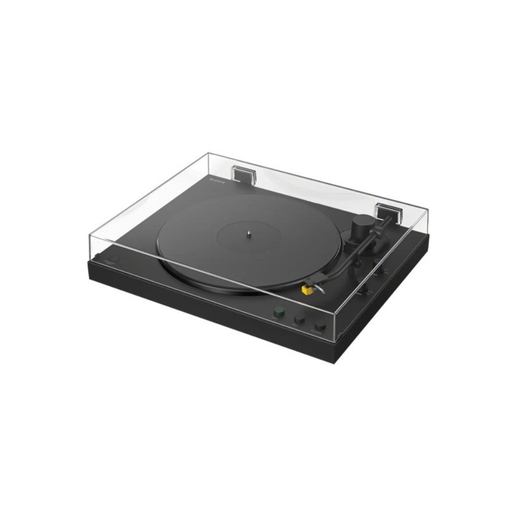 No image available
Ideal if you want fully automatic playback and to listen through compatible Bluetooth headphones.
Supports 33⅓ and 45 rpm. The product description lists Bluetooth and a PHONO/LINE switch.
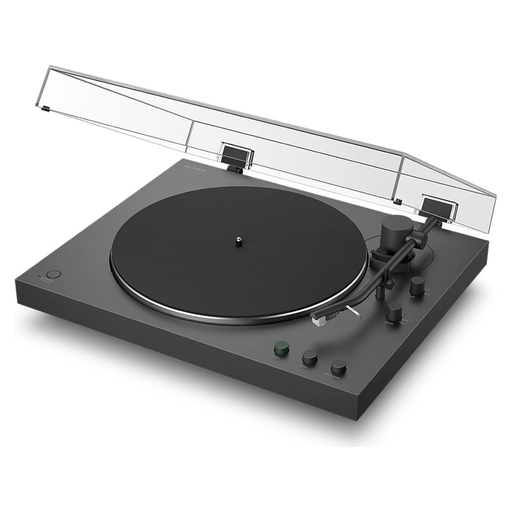 No image available
Ideal if you want automatic playback and to listen through compatible Bluetooth headphones.
Supports 33⅓ and 45 rpm. The product description lists a PHONO/LINE switch and Bluetooth.
It depends on your connections and speakers. A built-in phono preamp can connect to a suitable line input or active speakers, but it won’t power passive speakers on its own. If neither your turntable nor your setup has a phono preamp, you’ll need a separate one.
Inspect your records and keep them clean. Ortofon recommends regular record care and gently brushing the stylus in the direction indicated. Surface noise or distortion can also be a sign of a worn stylus.
First check that the stylus is suitable for the record material. Audio-Technica distinguishes between styli for shellac records and those for 78 rpm vinyl records, so a 78 rpm setting doesn’t automatically make the standard stylus suitable.
For eligible distance purchases from a business, you’ll often have a 14-day cooling-off period, including for second-hand products. The Netherlands’ government distinguishes between buying from a business and buying online from a private individual, so check who the seller is and whether an exception applies.
You don’t need one to have statutory protection when buying as a consumer: you’re already entitled to a product that’s fit for purpose, and the seller is your point of contact if something goes wrong. The Netherlands’ government says there’s no fixed statutory warranty period in the Netherlands, so compare what extra rights a paid plan offers.