
Listener with charity-shop LPs
You buy or inherit second-hand records and want to take dust, a dirty stylus and different record sizes into account when choosing a turntable.


Choose based on your records, the audio equipment you already own and where you plan to put the turntable. An automatic model with a switchable phono stage makes connecting your equipment straightforward; a manual model is a good fit if you’re happy to choose the controls and phono connection you need. Also factor in cleaning second-hand records and looking after the stylus, and place the turntable on a stable surface.
You buy or inherit second-hand records and want to take dust, a dirty stylus and different record sizes into account when choosing a turntable.
You want to know in advance whether you need a phono or line connection, active speakers or Bluetooth.
You’re looking for a practical place for your turntable and speakers, while keeping housemates and neighbours in mind.
A good fit if: you want to play LPs and singles with minimal effort and having a choice of connections is important to you. Audio-Technica lists support for 33⅓ and 45 rpm, Bluetooth and a switchable phono stage for the AT-LP70XBT.
Bear in mind: automatic operation and Bluetooth don’t replace cleaning your records or setting up the turntable on a stable surface. Check that the connections work with your speakers.
A good fit if: you want to operate the tonearm yourself and put your set-up together with care. The Pro-Ject E1 Phono has a switchable phono stage; the Rega Planar 1 manual specifies connection to a suitable phono stage.
Bear in mind: you may need a separate phono stage if you don’t have a suitable one. According to Rega, you change the speed on the Planar 1 using the belt.
A good fit if: you don’t want to set up separate speakers and simplicity or saving space is your priority. The Lenco LS-50GY has built-in speakers and lists playback speeds of 33, 45 and 78 rpm.
Bear in mind: the Consumers’ Association says all-in-one and suitcase models often sound worse than standard turntables. A 78 rpm setting alone doesn’t confirm that the supplied stylus is suitable for every old 78 rpm record.
When choosing a turntable for second-hand records in an open-plan flat, the main things to consider are maintenance, connections, placement and operation.
| What to consider | What should you check? | Who is this most important for? |
|---|---|---|
| Record and stylus care | Check which replacement stylus fits the cartridge. Look for dirt and damage on second-hand records; cleaning off dust won’t repair groove wear. | If I buy or inherit second-hand records, I want to know how to care for the record and stylus. Consumers who put record and stylus care first are estimated to make up around 36% of this group. |
| Connecting to your system | Check whether your amplifier has a phono input, whether your active speakers have a line input and whether a built-in phono stage can be switched on or off. | I want to know in advance whether the turntable will connect to my amplifier or speakers. Consumers who put connectivity first are estimated to make up around 29% of this group. |
| Vibrations and listening position | Check that the furniture is sturdy and doesn’t noticeably vibrate with the speakers. Also decide where you can listen when your housemates want some peace and quiet. | In an open-plan flat, I want to find somewhere stable for the turntable that also makes listening practical. Consumers who put set-up first are estimated to make up around 21% of this group. |
| Controls and playback speed | Check whether your records play at 33⅓, 45 or possibly 78 rpm, and whether starting, stopping and changing speed suit the controls you want. | If I’d rather not operate the tonearm myself every time, I’m looking for suitable automatic functions and speed options. Consumers who put ease of use first are estimated to make up around 14% of this group. |
Without a suitable phono stage, the turntable may not work as intended with the audio input you’ve chosen. Check the entire signal path from the exact model to the speaker.
If the turntable doesn’t have a suitable phono stage and your amplifier doesn’t have one either, you may need a separate phono stage.
A dust cover helps keep dust off the turntable, but dirt on a second-hand record can still get onto the stylus. Audio-Technica explains that a build-up of dirt on the stylus can affect playback quality.
Make a separate plan for cleaning your records and stylus, and check which replacement stylus fits your chosen cartridge.
Vibrations from the speakers or surface can cause mechanical feedback. Wireless audio transmission won’t change the physical set-up.
Choose a stable position first, then decide whether you need additional isolation.
Built-in speakers take up less space than separate equipment, but the Consumers’ Association notes that all-in-one and suitcase models often sound worse than standard turntables. Playback speed alone also doesn’t tell you whether a stylus is suitable for every old 78 rpm record.
Weigh the space-saving benefits against what you want from your listening experience, and check the compatibility of the record, cartridge and stylus separately.
The AT-LP70XBT is an automatic option with Bluetooth, a switchable phono stage and support for 33⅓ and 45 rpm.
The manual E1 Phono has a built-in, switchable phono stage and electronic switching between 33 and 45 rpm.
The PS-LX3BT and PS-LX310BT are examples of automatic turntables with wireless connectivity.
The manual Planar 1 is a good fit if you already have a suitable phono stage or want to add one separately.
The LS-50GY is an all-in-one option with built-in speakers, an RCA line output and speeds of 33, 45 and 78 rpm, according to Lenco’s product details.
These Joybuy products are automatic turntables for LPs and singles, with connection options for compatible wired equipment or Bluetooth receivers.
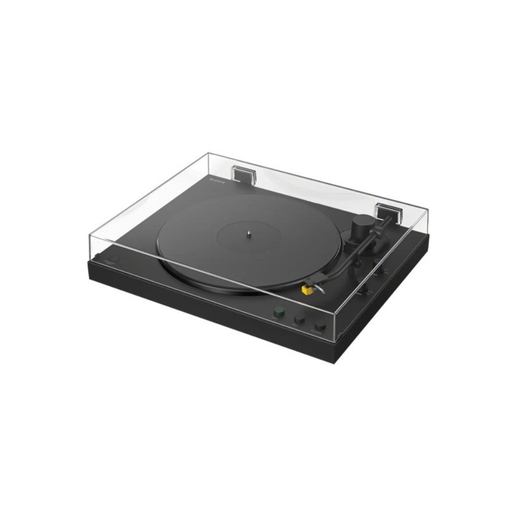 No image available
An automatic option for anyone who wants to play LPs and singles with minimal effort and use a compatible wireless receiver.
The product description lists support for 33⅓ and 45 rpm, a built-in phono stage with a PHONO/LINE switch and Bluetooth.
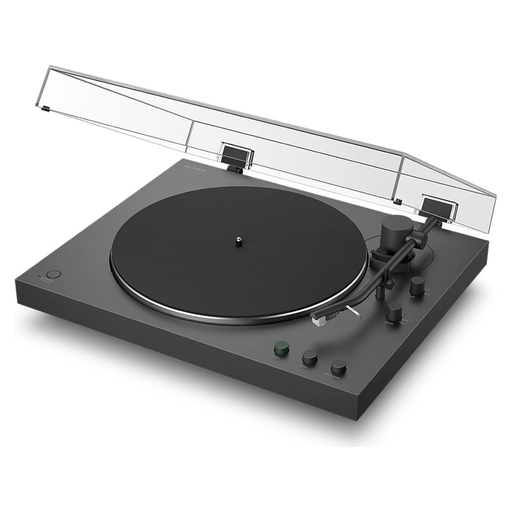 No image available
An automatic option for anyone who wants to play LPs and singles and needs a suitable phono/line or Bluetooth connection.
The product description lists support for 33⅓ and 45 rpm, a built-in phono equaliser with a PHONO/LINE switch, Bluetooth and automatic tonearm return after playback.
Yes, if the turntable has a suitable line output, for example through a built-in phono stage that’s switched on, and the active speakers have a suitable input. Check the connections and switch position on the exact model; you may need a separate phono stage if neither piece of equipment provides this function.
Check and clean dusty records using a suitable method before playing them. Audio-Technica says that a build-up of dirt on a stylus can affect playback quality. Follow the instructions for the cartridge and cleaning tool you’re using when cleaning the stylus.
No, don’t assume that from the speed setting alone. Audio-Technica offers a separate stylus suitable for 78 rpm records; check that the record, cartridge and stylus are compatible with your turntable. The 78 rpm setting on the Lenco LS-50GY alone doesn’t confirm that the supplied stylus is suitable for every old record.
Place the turntable on a stable surface and check whether the furniture noticeably vibrates with the speakers. Pro-Ject describes additional isolation for vibrating surfaces; whether you need it depends on your set-up and where you place the turntable. The Netherlands government advises neighbours to agree arrangements for things such as playing music.
You may need a separate phono stage if neither the turntable nor the amplifier provides this function. You may also need to maintain or replace the stylus; check which type fits your cartridge and which cleaning products are suitable for your records.