For listening to vintage soundtracks at low volume, a standard turntable is a good choice if you can adjust the connection to your amplifier or active speakers. The Dutch Consumers’ Association (Consumentenbond) says that suitcase record players as a category often have poorer sound quality, but this is not an assessment of every model. Adjust the volume using your connected equipment, and if you have 78 rpm shellac records, check both the turntable speed and whether the stylus is suitable.
Who is this buying guide for?
Listening quietly at home
You mainly play soundtrack LPs and want to enjoy them at a gentle volume through your own speakers or hi-fi system. Check the volume controls and connections across your whole set-up rather than relying on a general promise of warm sound. The Dutch Consumers’ Association (Consumentenbond) compares suitcase record players as a category with standard turntables.
Easy operation and existing audio equipment
You’d rather not operate the tonearm manually every time, and are considering using an existing Bluetooth speaker or headphones. Sony lists automatic operation and Bluetooth for the PS-LX3BT; check that these features will work with your playback device.
Collectors of older pressings
You may have delicate second-hand records or 78 rpm shellac in your collection. Audio-Technica points out that shellac records need the right speed and a suitable stylus.
What to prioritise when listening quietly and playing older records
For quiet listening, the whole chain from record to speaker matters. Start by checking your set-up, then consider operation and the type of record you want to play.
| What to consider |
What should you check? |
Who is this important for? |
| Listening quietly |
Check where you adjust the volume and whether your amplifier or active speakers have a suitable input. |
If I want to listen to soundtracks quietly, I look at the volume controls on my amplifier or active speakers. Around 36% of consumers put quiet listening first. |
| Connecting to your equipment |
Make a note of the inputs on your amplifier or speakers. If there’s a PHONO/LINE switch, check which setting matches the input. |
I want to connect the turntable to the equipment I already own, without finding out afterwards that I’m missing an input or a phono preamp. Around 29% of consumers put connectivity first. |
| Operation and record care |
Check whether the turntable starts and returns automatically, and whether the stylus can be replaced. |
If I’d rather not operate the tonearm manually every time, I want to know how the turntable handles starting and returning, and which parts can be replaced. Around 21% of consumers prioritise easy operation and care for older LPs. |
| 78 rpm shellac |
Check the record material, playback speed and whether the stylus or cartridge is suitable for shellac. |
I first want to find out whether my old records are vinyl LPs or 78 rpm shellac, so I can match them with the right speed and stylus. Around 14% of consumers prioritise 78 rpm shellac records. |
Common pitfalls
-
Confusing a vintage look with careful playback
The Dutch Consumers’ Association (Consumentenbond) warns that suitcase record players as a category often handle delicate records less carefully. This is not an assessment of every individual model.
First check whether your records are vinyl or shellac, then choose a turntable and stylus that are suitable.
-
Assuming a turntable will produce sound on its own
A standard turntable needs to be connected to suitable audio equipment. The phono preamp you need depends on the model and version.
Before buying, check the whole connection from turntable to speakers, including any PHONO or LINE setting.
-
Assuming a 78 rpm setting means a turntable is fully suitable for shellac
Audio-Technica stresses that the right speed alone isn’t enough: 78 rpm shellac records also need a suitable stylus.
Check the speed, record material and stylus or cartridge together.
-
Confusing an extended warranty with your statutory rights
According to the Dutch government, there is no fixed statutory warranty period in the Netherlands. An extended warranty is separate from your statutory rights.
Check what an extended warranty actually covers. If a product is faulty, contact the seller.
Brands to consider
The features mentioned apply to the models and versions described; they are not a general assessment of an entire brand.
Audio-Technica
The AT-LP60X is fully automatic and designed for records at 33⅓ and 45 rpm. According to Audio-Technica, the manual AT-LP120XUSB also has a 78 rpm setting.
- Audio-Technica lists a switchable phono preamp and a replaceable stylus for the AT-LP60X.
- The AT-LP60X’s listed speeds do not include 78 rpm. Shellac records need both a suitable turntable and a suitable stylus; these are model specifications, not a comparison of sound quality.
Sony
The PS-LX3BT is an option if you want automatic playback and Bluetooth connectivity.
- Sony lists fully automatic operation and Bluetooth for this model.
- Check that the features suit your audio set-up. Automatic playback and Bluetooth alone don’t show that the turntable sounds better at low volume.
Denon
Denon describes the DP-29F as an easy-to-use turntable with a built-in phono equaliser.
- According to Denon, the turntable starts at the touch of a button and the tonearm returns when playback ends.
- Denon lists speeds of 33⅓ and 45 rpm. Don’t choose this model for 78 rpm shellac based on those specifications; the brand’s description of its sound is not an independent test.
Pro-Ject
According to Pro-Ject, the T1 EVO range is available in Standard, Phono and BT versions, so you can choose one to suit your set-up.
- Pro-Ject lists a switchable phono preamp for the Phono version.
- Don’t assume the Standard version includes that preamp. The listed speeds are 33 and 45 rpm.
Turntables at Joybuy
This selection includes an automatic Bluetooth turntable and XJ-HOME models with built-in speakers and wired connections. Check how you’ll adjust the volume in your chosen set-up, and whether the turntable is suitable for the records you want to play.
 No image available
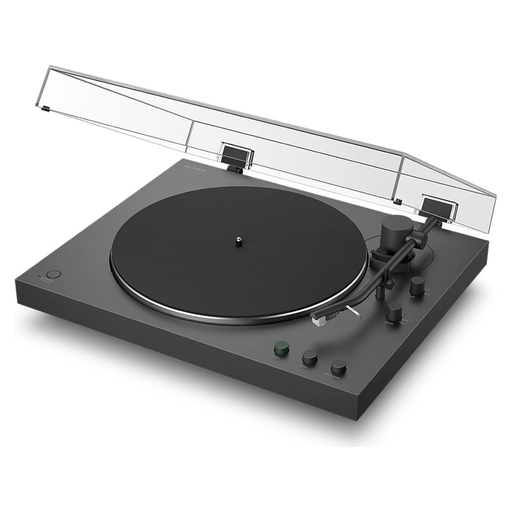
Sony PS-LX3BT
Ideal if you want automatic playback and Bluetooth connectivity. Check that your wireless device is compatible and where you’ll adjust the volume.
Fully automatic belt drive; Bluetooth and a built-in phono equaliser with a PHONO/LINE switch are listed.
Suitable for 33⅓ and 45 rpm records.
View at Joybuy
 No image available
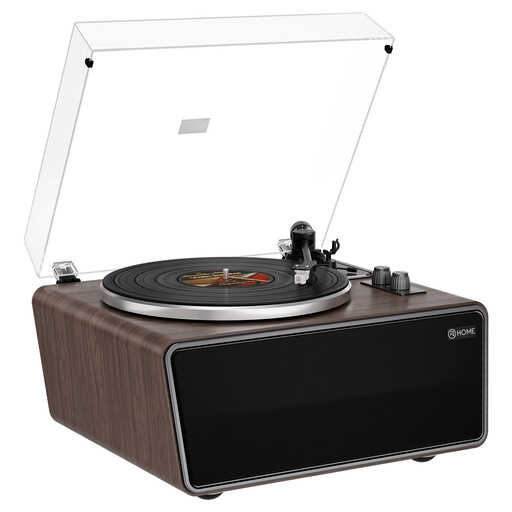
XJ-HOME XJ-H01
Ideal if you want to listen without separate speakers. Check in advance how you’ll adjust the volume in your set-up.
Four built-in speakers and RCA Phono/Line outputs are listed.
The description lists an AT-3600L cartridge, belt drive and adjustable counterweight. Suitable for 33⅓ and 45 rpm.
View at Joybuy
 No image available
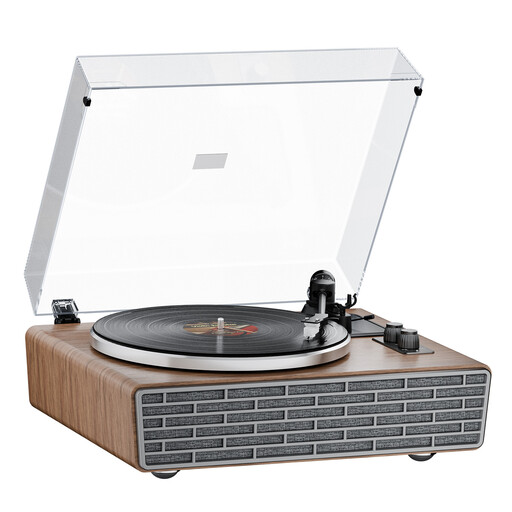
XJ-HOME XJ-H02 Retro Walnut Bluetooth
Ideal if you want to combine built-in speakers with Bluetooth connectivity. Check the volume controls and connections you need.
Four built-in speakers, belt drive and Bluetooth are listed.
The description lists an AT-3600L cartridge and playback at 33⅓ and 45 rpm.
View at Joybuy
 No image available
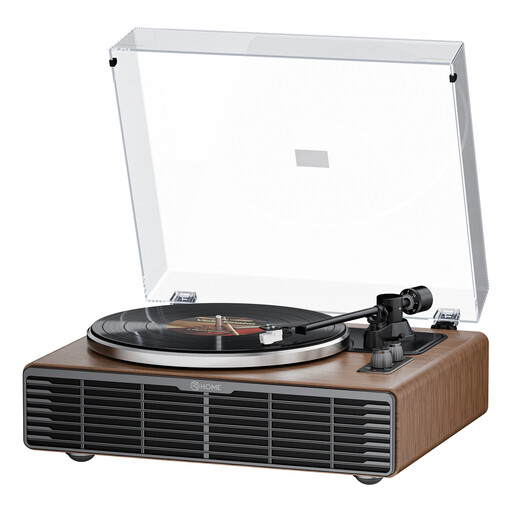
XJ-HOME XJ-H03 Walnut Bluetooth
Ideal if you want built-in speakers and are also considering Bluetooth or a wired connection. Check where you’ll adjust the volume.
Four built-in speakers, Bluetooth and RCA Phono/Line outputs are listed.
The description lists belt drive, an AT3600L cartridge and playback at 33⅓ and 45 rpm.
View at Joybuy
Frequently asked questions
Can I connect a turntable directly to active speakers?
Yes, if the turntable has a suitable line output or a built-in phono preamp that’s set correctly, and the speakers have a compatible input. Audio-Technica lists a switchable phono preamp for the AT-LP60X; check the connections on your own speakers.
Is an old soundtrack automatically a 78 rpm record?
No. Check the record material and the stated playback speed. 78 rpm shellac records need both the right speed and a suitable stylus; a standard vintage LP doesn’t need a shellac stylus.
Where should I put a turntable?
Place the turntable on a flat, stable surface, away from speakers. For the AT-LP3XBT, Audio-Technica recommends this to avoid the effects of vibration and acoustic pressure. For other models, follow the manufacturer’s instructions.
What are my returns and warranty rights when buying in the Netherlands?
When you buy online from a business, you generally have 14 days to change your mind, including for second-hand or vintage products. Purchases from private sellers aren’t covered by the same distance-selling rules. The Dutch government also states that there is no fixed statutory warranty period in the Netherlands: contact the seller if a product is faulty. An extended warranty is separate from your statutory rights.


