
Listeners looking to fill an open-plan living space
You want to position speakers to suit your open-plan room, so you’re considering the whole audio system, not just the turntable.


For an open-plan flat, choose a separate turntable with suitable speakers if you want to position them around the room; Bluetooth if you want to listen through a compatible speaker or headphones without an audio cable; or an all-in-one player if simplicity is your priority. The Consumers’ Association notes that conventional turntables generally sound better than all-in-one models. Also check your records’ playback speeds and whether the connections are compatible with your equipment.
You want to position speakers to suit your open-plan room, so you’re considering the whole audio system, not just the turntable.
You have records for which playback speed, stylus, cartridge and maintenance matter more than a quick set-up.
You prioritise easy connections or wireless listening, and accept that this may limit your choice of speakers or options for expanding your set-up.
Choose this if: you want to position speakers around your open-plan room, or you already have suitable amplification and speakers.
Trade-off: you’ll need to match the connections; you may also need a phono preamp or amplifier.
Choose this if: you want to listen wirelessly through a compatible Bluetooth speaker or headphones.
Trade-off: the receiving device needs to be able to pair with the turntable; Bluetooth doesn’t replace the speaker or headphones.
Choose this if: a simple set-up matters more to you than the freedom to position speakers separately.
Trade-off: according to the Consumers’ Association, all-in-one players often sound worse than conventional turntables. Their built-in speakers also stay beside the player.
Start by thinking about where you’ll place the speakers and how they’ll connect to your existing equipment. Then check that the player supports the speeds and styluses your collection requires.
| What to consider | What should you check? | Who is this important for? |
|---|---|---|
| Speaker set-up | Check whether you can connect separate speakers and have room to position them away from the player. Choose a stable spot for the turntable too, away from unwanted vibrations. | If I want to spread the sound across my open-plan living space, I focus on speaker placement and the complete audio system. Around 40% of consumers put speaker set-up first. |
| Speeds and stylus | Check the speeds of your records and make sure the player supports them. Also check whether the stylus or cartridge suits your collection and can be replaced. | If you want to take care when playing records from an existing collection, look beyond the speed listed on the box. Around 30% of consumers make this their top priority. |
| Connections | Make a note of the inputs on your amplifier or active speakers, and check whether the turntable has a phono preamp, whether it can be switched, and whether it transmits audio over Bluetooth. | If I want to use my existing speakers, receiver or Bluetooth receiver, the turntable’s output needs to be compatible. Around 20% of consumers put connections first. |
| Minimal separate equipment | Check whether the speakers are built in and what connections are available for any external equipment. | If you want to keep separate equipment to a minimum, built-in speakers may be practical, but they can limit your placement options. Around 10% of consumers make simplicity their top priority. |
A conventional turntable needs to be connected to a suitable audio system. As the Consumers’ Association points out, not every amplifier has a phono input.
Before you buy, map out the connection from cartridge to speakers and check which inputs your equipment has.
Depending on your current set-up, you may need extra equipment, such as active speakers, an amplifier or a phono preamp.
To listen wirelessly, the turntable needs to be able to transmit audio to a suitable receiver, so its Bluetooth function must support the way you want to listen.
Check what Bluetooth does on both the turntable and the receiving device, and make sure they can pair with each other.
If your existing equipment isn’t compatible, you may need a different speaker or connection method.
Lenco says the built-in preamp on the Lenco LS-50 cannot be switched off. The manufacturer therefore recommends connecting it to a receiver’s line input.
Follow the instructions for your chosen model, and don’t treat phono and line inputs as interchangeable.
On a player with built-in speakers, their position is tied to the position of the turntable. The Consumers’ Association also notes that all-in-one players often sound worse than conventional turntables.
Choose this type if a simple set-up matters most to you; otherwise, check whether the player has an output for separate speakers.
If you want to switch to a separate sound system later, you may need extra equipment.
According to Sony, the Sony PS-LX3BT is a fully automatic turntable with Bluetooth and a wired phono or line connection.
According to Audio-Technica, the AT-LP60XBT combines automatic operation, Bluetooth and a wired RCA output.
According to Lenco, the Lenco LS-50WD is an all-in-one player with built-in speakers and an RCA line output.
According to Rega, the Rega Planar 1 Plus is designed for a set-up with separate speakers and has a built-in MM phono preamp.
According to Technics, the Technics SL-1500C is a direct-drive model supplied with a cartridge and a built-in phono equaliser.
This selection features Sony Bluetooth turntables for wireless listening through a compatible speaker or headphones, as well as a wired connection option.
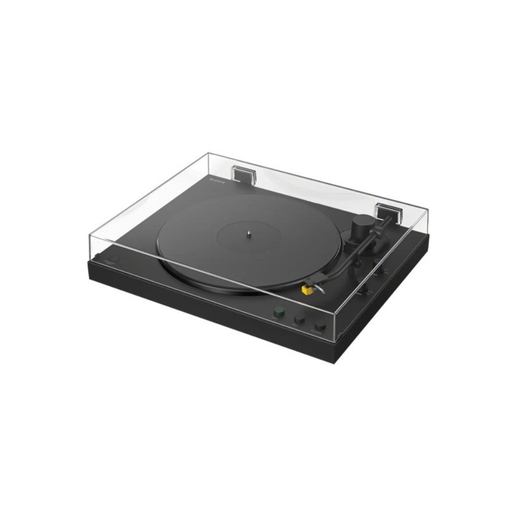 No image available
Ideal if you want to stream vinyl wirelessly to a compatible speaker or headphones, while also having the option of a wired connection.
The product description lists fully automatic operation, Bluetooth, a built-in phono preamp with a PHONO/LINE switch, and support for 33⅓ and 45 rpm.
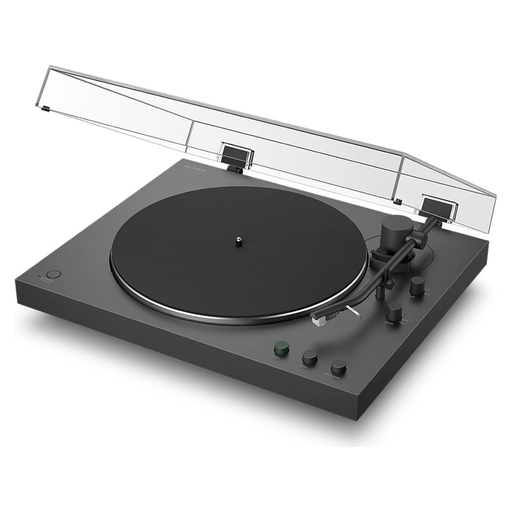 No image available
Ideal if you want to listen to vinyl over Bluetooth, while also having the option of a wired connection to active speakers or an audio system.
The product description lists fully automatic operation, automatic tonearm return, Bluetooth, a built-in phono equaliser with a PHONO/LINE switch, and support for 33⅓ and 45 rpm.
Yes, if the speakers have a suitable input and the signal has passed through a suitable phono preamp. Check whether the preamp is built into the turntable or needs to be bought separately, and consult the manuals for both devices. Passive speakers also need an amplifier.
Carefully remove dust and follow the cleaning instructions from your cartridge’s manufacturer. Ortofon recommends using a suitable fibre brush on its styli, brushing in the direction of the stylus, and advises against using solvents.
No, also check that the stylus is suitable for your records and fits the cartridge. Ortofon, for example, lists a separate 78 stylus for specific cartridge families; that compatibility doesn’t automatically apply to other turntables.
No. According to ACM ConsuWijzer, when you buy as a consumer in the Netherlands, you have a statutory guarantee in addition to any commercial warranty if the product doesn’t meet reasonable expectations under normal use. The seller is responsible for providing an appropriate solution; there isn’t one fixed statutory guarantee period in years for every turntable.
The Dutch government advises trying to reach an agreement with your neighbours first if there’s a noise problem, for example about what time you play music. If the disturbance continues, your landlord, residents’ association or local council may be able to help. National guidance doesn’t set a generally permitted volume or a universal cut-off time for every home, so check which agreements and rules apply to your flat.