First, check whether your records play at 33⅓, 45 or 78 rpm. 78 rpm records need a compatible turntable, as well as a suitable specialist cartridge and stylus. If you’re using separate speakers, choose a standard turntable with connections that work with your amplifier or active speakers. Automatic operation is convenient, while a manual set-up gives you more control. An all-in-one turntable needs less separate equipment, but the Consumentenbond notes that these models often don’t sound as good as standard turntables.
Who is this choice relevant to?
Soundtrack listener with separate speakers
You want to listen to records through your choice of speakers in an open-plan living space. Pay close attention to how the turntable, amplifier and speakers connect. The Consumentenbond explains the difference between standard and all-in-one turntables.
Vinyl listener looking for convenience
You want to play an LP or single without having to position the tonearm yourself. Check exactly what the model does automatically: for example, Sony lists automatic start, return and stop functions for the PS-LX3BT, while Lenco lists auto-stop for the LS-15WD.
Collector of older records
If your collection may include 78 rpm records, check both the speed and whether the cartridge and stylus are suitable. The Consumentenbond points out that these records need a specialist cartridge and stylus.
What should you look for when choosing?
Automatic operation with separate speakers
A good fit if: you want to start playing records easily and position your speakers separately around the living space.
Bear in mind: you’ll need suitable separate speakers. Bluetooth alone doesn’t tell you how the set-up will sound in your room.
Manual operation with separate speakers
A good fit if: you want to operate the tonearm yourself and put together your own audio set-up.
Bear in mind: check that the phono or line output is compatible with the input on your amplifier or active speakers.
All-in-one with built-in speakers
A good fit if: your main priority is having as little separate equipment as possible.
Bear in mind: the Consumentenbond notes that all-in-one turntables often don’t sound as good as standard turntables. This is not a separate test of every model.
For original 78 rpm records
A good fit if: your collection includes records that need to play at 78 rpm.
Bear in mind: check for both a 78 rpm setting and the availability of a suitable specialist cartridge and stylus.
In an open-plan living space, your choice mainly comes down to the speaker set-up you want, how easy you’d like the turntable to use and the speeds of the records you own.
| What to consider |
What should you look for? |
Who is this important for? |
| Sound and placement |
Consider where the turntable and speakers can go, and check that their inputs and outputs are compatible. |
If I want to position my speakers separately in my open-plan living space, I’ll focus on the layout and connections. Around 33% of consumers put sound and placement first. |
| Ease of use |
Check what each model does automatically: start, return and stop. Auto-stop doesn’t necessarily mean it also starts automatically. |
If I don’t want to operate the tonearm myself, I’ll compare exactly which actions the model takes care of. Around 25% of consumers prioritise ease of use. |
| Fewer separate components |
Check whether the speakers are built in and which outputs are available if you want to expand your set-up later. |
If I’d rather not have separate speakers, a compact set-up matters more to me than the freedom to choose speakers separately. Around 25% of consumers make keeping separate equipment to a minimum their main priority. |
| Compatibility with your records |
Check the speed on the record or sleeve. For 78 rpm records, also check the cartridge and stylus. |
If my collection includes 78 rpm records, I’ll check the whole set-up, not just the speed. Around 17% of consumers prioritise compatibility with older record formats. |
Common mistakes when choosing
-
Choosing an all-in-one model for its retro looks
A retro look doesn’t tell you how a turntable sounds. The Consumentenbond notes that all-in-one turntables often don’t sound as good as standard turntables. This is an observation about the category, not a test of every individual model.
First decide whether you mainly want to keep separate equipment to a minimum or have the freedom to position your speakers separately.
-
Assuming a phono output is the same as a line output
The turntable’s output needs to match the input on your amplifier or active speakers. According to the Consumentenbond, you’ll need a phono preamp if one isn’t already built into the turntable or amplifier.
Check the connections on both devices and set any phono/line switch to the right position.
-
Assuming ‘vintage’ means a record plays at 78 rpm
The genre or age of a soundtrack doesn’t determine the speed it needs. According to the Consumentenbond, 78 rpm records also need a specialist cartridge and stylus.
Check the speed on the record or sleeve, then make sure the turntable, cartridge and stylus are all suitable.
Brands to consider
Audio-Technica
The AT-LP70XBT is an example of an automatic turntable for 33⅓ and 45 rpm records, designed to work with separate active speakers.
- Audio-Technica lists automatic operation and Bluetooth for the AT-LP70XBT.
- The listed speeds don’t include 78 rpm, and the specifications don’t tell you how the set-up will sound in your room.
Sony
The PS-LX3BT is an example of an automatic 33⅓/45 rpm turntable with Bluetooth and a phono/line switch.
- For this model, Sony lists automatic start, return and stop, a built-in phono preamp and a phono/line switch.
- The listed speeds don’t include a 78 rpm setting. These are model specifications, not an independent comparison of sound quality.
Pro-Ject
The Primary E Phono is an example of a manual turntable with a phono/line output, for putting together your own audio set-up.
- The product specifications list 33 and 45 rpm, with manual speed changes.
- Check that the output is compatible with the rest of your audio set-up. The listed speeds don’t include 78 rpm.
Lenco
The LS-15WD is an example of an all-in-one option for anyone who values built-in speakers and minimal separate equipment.
- For this model, Lenco lists two built-in speakers, Bluetooth reception and transmission, and auto-stop.
- The Consumentenbond’s general observation about sound quality in all-in-one turntables isn’t a separate test of the LS-15WD.
Turntables at Joybuy
These Joybuy product choices are suited to automatic playback with separate speakers, for records that play at 33 or 45 rpm.
 No image available
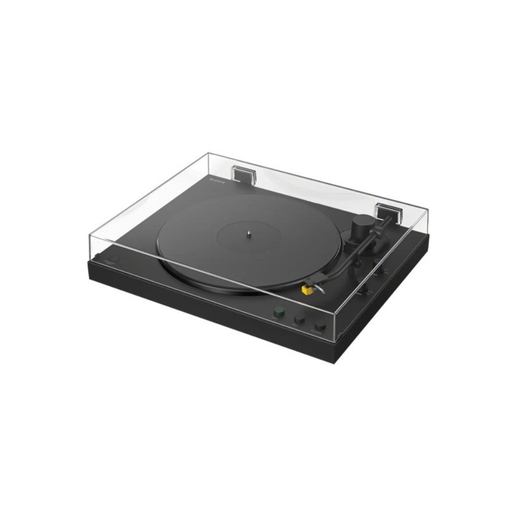
Sony PS-LX5BT
Ideal if you want automatic record playback and to connect separate speakers.
Supports 33 and 45 rpm records. The product description lists Bluetooth and a phono/line switch for a wired connection.
View at Joybuy
 No image available
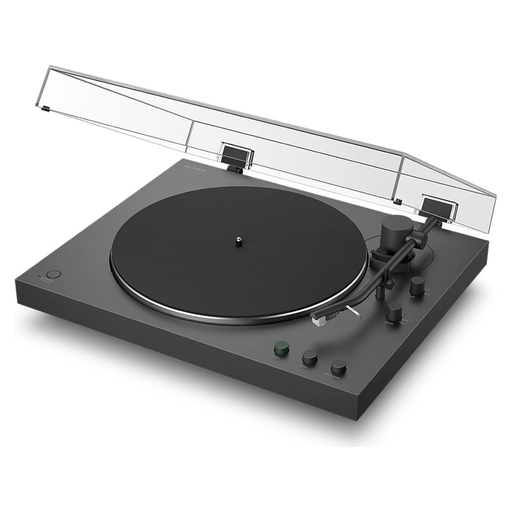
Sony PS-LX3BT
Ideal if you want automatic playback and the choice of Bluetooth or a wired connection.
Supports 33⅓ and 45 rpm records. Sony lists automatic start, return and stop, a built-in phono preamp and a phono/line switch.
View at Joybuy
Frequently asked questions
Can I play any old soundtrack on a 33/45 rpm turntable?
No. Check the speed on the record or sleeve. A 78 rpm record needs a turntable that supports that speed, as well as a suitable specialist cartridge and stylus. A retro look or the description ‘old soundtrack’ won’t tell you what speed it needs.
When do I need a separate phono preamp?
According to the Consumentenbond, you need a phono preamp if one isn’t built into the turntable or amplifier. Before connecting your devices, check the turntable’s output and the input on your amplifier or active speakers.
What should I bear in mind when positioning and maintaining my turntable?
Place the turntable on a stable surface and consider whether vibrations could affect your set-up. Pro-Ject describes a stable surface as one way to reduce the transfer of vibration. If your turntable is belt-driven, the belt may need maintenance or replacing over time, as Pro-Ject explains in its maintenance information.
Who should I contact about a faulty product, and what is the cooling-off period for online purchases in the Netherlands?
Report a faulty product to the seller: according to the Dutch government, they can’t simply send you to the manufacturer. For online purchases from a business, the cooling-off period is generally 14 days. Purchases from a private seller aren’t covered by the distance-selling rules. This is separate from any manufacturer’s warranty.


