
Listeners with a vibration-prone setup
You want to play live albums at a decent volume, with your speakers close to the turntable or sharing the same piece of furniture. First, see if you can place them on separate surfaces.


Start with your setup: position the turntable level and on a separate, sturdy surface from any speakers that cause vibrations. Then choose based on the connections your existing equipment has, the controls you want and the speeds your records require. Damping components are no substitute for good positioning. The Dutch government says that electrical appliances placed on the EU market must carry the applicable CE marking, so check that the version on offer has one.
You want to play live albums at a decent volume, with your speakers close to the turntable or sharing the same piece of furniture. First, see if you can place them on separate surfaces.
You already have active speakers or an amplifier and want to know in advance whether you need a phono preamp, line input or wireless connection.
You’re choosing between automatic start-up and a manually operated tonearm, and want to check which speeds your records require.
| What to consider | What should you check? | Who is this important for? |
|---|---|---|
| Vibrations and positioning | Can the turntable and speakers stand on separate, sturdy surfaces? Make sure the turntable is level. | If I play live albums at volume and my speakers make the furniture vibrate, I want to limit vibrations reaching the stylus first. Around 33% of consumers prioritise vibration control. |
| Connecting to existing equipment | Check whether the turntable has a phono preamp and whether your amplifier or active speakers have the right phono or line input. Use Bluetooth only if the receiving speaker is compatible. | If I already have active speakers or an amplifier, I want to know which connection will actually work. Around 27% of consumers prioritise compatibility with their existing equipment. |
| Controls | Decide whether you want automatic operation. For manual models, check how to switch between the speeds you need. | If I’d rather not operate the tonearm myself, I look for automatic start and return. Easy operation is the top priority for around 20% of consumers. |
| Speeds and stylus maintenance | Check which speeds your records require and which replacement stylus is suitable for the exact model. | For my record collection, I want to be able to play records at the right speeds and know which stylus to buy when it needs replacing. Around 20% of consumers prioritise record compatibility and stylus maintenance. |
Vibrations from speakers can travel through a shared surface and reach the stylus. Adjustable or damped feet alone don’t prove that feedback will disappear in your room.
First, work out where you can position the turntable and speakers. If necessary, put them on separate, sturdy surfaces.
You may need a separate spot for your setup or an isolation base.
The phono preamp and inputs available determine whether the connection will work. If neither the turntable nor the amplifier has a phono preamp, you may need a separate phono preamp; the Consumers’ Association explains this connection requirement.
Before buying, check the turntable’s output setting and the input on your existing equipment.
If neither the turntable nor the amplifier has the phono preamp you need, you’ll need a separate one.
The recommended positioning can vary between speaker models. A distance given in the manual for one model won’t necessarily apply to other speakers.
Check the instructions for your speakers and keep the turntable on a separate, sturdy surface.
Audio-Technica says the AT-LP70XBT is automatic, supports Bluetooth and has a switchable phono preamp.
Denon describes the DP-300F as a fully automatic, belt-driven turntable with a switchable phono preamp.
According to Rega, the Planar 1 Plus combines manual operation with a built-in MM phono preamp.
Pro-Ject says the Debut EVO 2 is manually operated, with electronic speed switching between 33 and 45 rpm.
This selection includes turntables that support 33⅓ and 45 rpm, with built-in speakers or connections for existing audio equipment. Position the turntable separately from speakers that cause vibrations, and check that the version on offer has the applicable CE marking before buying.
 No image available
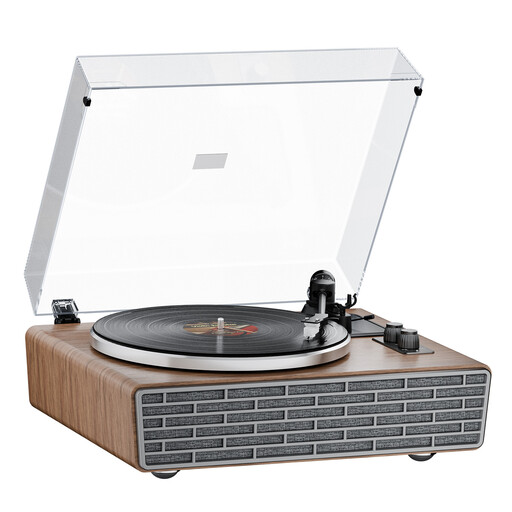
An option if you want connections for external audio equipment as well as built-in speakers.
The product description lists four built-in speakers, Bluetooth and RCA phono/line outputs. It also mentions 33⅓ and 45 rpm and an AT-3600L cartridge.
 No image available
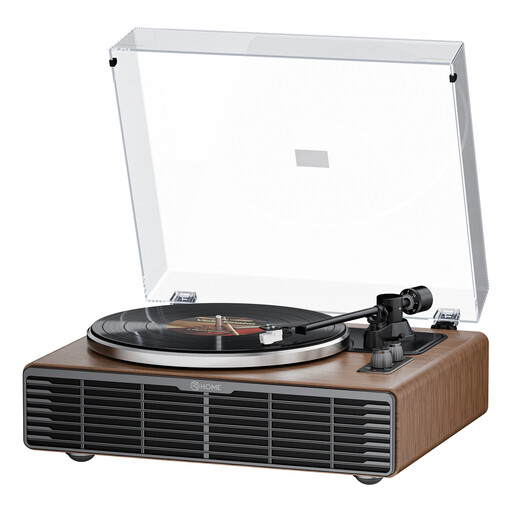
This turntable offers connections for anyone looking to use existing speakers or an amplifier.
The product description lists four built-in speakers, an AT3600L cartridge, RCA phono/line outputs and Bluetooth. It also mentions 33⅓ and 45 rpm.
 No image available
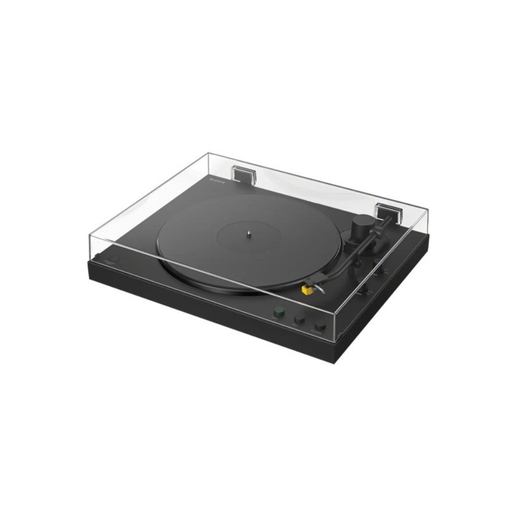
An option if you want automatic operation and both wired and wireless connections.
The product description lists fully automatic operation, a belt drive, Bluetooth and a PHONO/LINE switch. It also mentions 33⅓ and 45 rpm.
 No image available
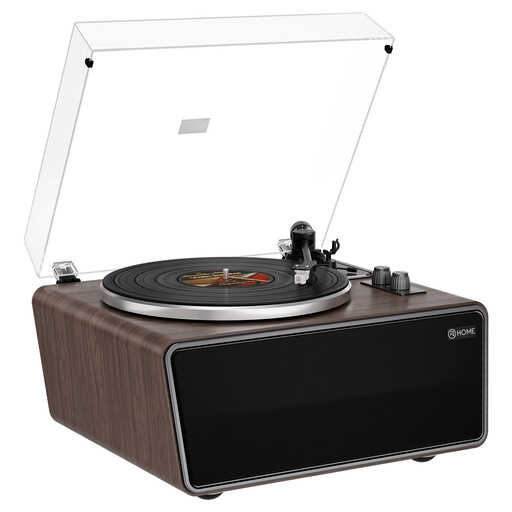
This all-in-one model could be a good fit if you want built-in speakers as well as connections for external equipment.
The product description lists four built-in speakers, AUX and RCA connections, an AT-3600L cartridge, and 33⅓ and 45 rpm. The product title mentions a phono preamp.
If you can hear vibrations or feedback, it’s not a good place to start. Audio-Technica and Fluance advise against placing speakers that cause vibrations on the same surface as the turntable. First, put them on separate, sturdy surfaces and make sure the turntable is level.
Follow the guidance for your exact speaker model; there’s no single distance that works for every speaker. Also keep the turntable on a separate, sturdy surface.
Not if your turntable has a suitable built-in phono preamp and you connect it to a compatible line input. If neither the turntable nor the amplifier has a phono preamp, you’ll need a separate one.
If a product is faulty, you can claim under the Dutch statutory guarantee. According to the Dutch government, there is no fixed statutory two-year period. For eligible distance sales, you’ll usually have a 14-day cooling-off period, although exceptions apply.
Check that the version on offer has the applicable CE marking. The Dutch government says that electrical appliances placed on the EU market must carry a CE marking.