
Collectors of 45 rpm jazz singles
If you mainly play 7-inch singles, you’ll want to be able to select the right speed and record size, and check that an adapter and the connections are compatible with your existing set-up.


First, choose a turntable that suits the speed and type of your jazz singles. For 45 rpm vinyl, you can choose between automatic and manual models, but 78 rpm shellac records also need a suitable stylus. In a large living room, the complete set-up – turntable, pre-amplification and speakers – determines how everything fits together. Also check the relevant product compliance for the model you’re considering.
If you mainly play 7-inch singles, you’ll want to be able to select the right speed and record size, and check that an adapter and the connections are compatible with your existing set-up.
The turntable is just one part of your set-up. Also consider the phono preamp, amplifier and speaker placement.
Check whether your records are actually 78 rpm shellac. You’ll need both the right speed and a suitable stylus for this combination.
Start by checking the speed and material of your records, then match the connections and speaker set-up to your room.
| What to consider | What to look for | Who is this important for? |
|---|---|---|
| Speed and record size | Check the speed printed on the record. For 7-inch 45 rpm records, make sure the turntable’s size settings and any centre adapter are suitable. | If you mainly play vinyl singles, you’ll want to make sure they can be played correctly; around 34% of consumers with this purchasing query put compatibility first. |
| Living room set-up | Check which inputs and speakers you already have, choose the appropriate PHONO or LINE connection, and don’t place the speakers right next to the turntable. | If you’re putting together a system for a large living room, you’ll want the turntable to work well with the rest of your equipment; around 33% of consumers put room set-up first. |
| Ease of use | Compare automatic start and tonearm return with manual operation; check the speed and connections separately. | If you regularly change singles and would rather not handle the tonearm yourself, automatic operation may be a priority; around 20% of consumers put ease of use first. |
| 78 rpm shellac | Check the record material and speed, as well as the suitability and set-up of the stylus or cartridge. | If your collection includes vintage 78 rpm shellac records, both the speed and stylus need to be suitable; around 13% of consumers put shellac first. |
Vintage jazz singles may be 78 rpm shellac. Audio-Technica lists 78 rpm playback for the AT-LP120XUSB. Shellac also requires a suitable stylus or cartridge, as Ortofon’s product specifications for the 2M 78 explain.
Check the speed and material of your own records before choosing a turntable.
A turntable can’t replace the amplification needed for passive speakers. Audio-Technica Europe distinguishes between passive speakers and active speakers with built-in amplification.
First, check which speakers and inputs are available, then see whether you’ll need a separate amplifier.
Having the right speed alone doesn’t confirm that the stylus is suitable for the wider grooves of shellac records. Ortofon says the stylus for its 2M 78 is specially designed for 78 rpm grooves.
For the specific cartridge, check the manufacturer’s guidance on stylus compatibility, tracking force and set-up.
According to the Government of the Netherlands, there is no general statutory warranty period of exactly two years in the Netherlands. If a product is faulty, the seller is your point of contact for a solution.
Read any additional manufacturer’s warranty terms separately, and keep your proof of purchase and product information.
The models listed range from an automatic turntable for 33⅓ and 45 rpm records to a manual model with 78 rpm playback.
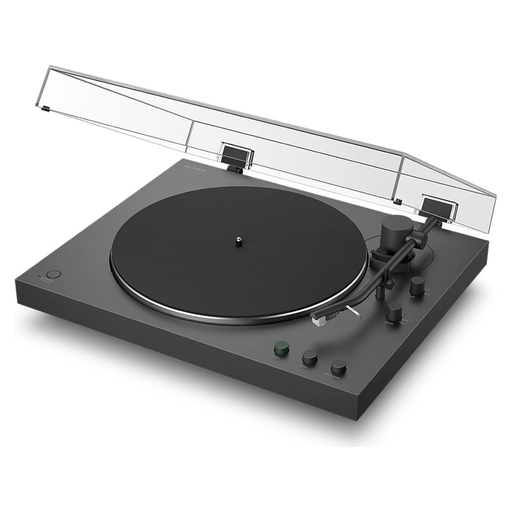
According to Sony, the PS-LX3BT and PS-LX5BT are automatic models for 33⅓ and 45 rpm records, with wired and Bluetooth connectivity.
The DP-300F is a fully automatic turntable for 33⅓ and 45 rpm records.
The LBT-288WA is a manually operated option for 33 and 45 rpm, with RCA, Bluetooth transmission and a switchable preamp.
These turntables are suited to listening to 45 rpm vinyl, with options for automatic operation and built-in or external audio set-ups. For the model you choose, also check the relevant EU compliance and compatibility with your speakers.
 No image available
Worth comparing if you want to play 45 rpm jazz singles automatically; Sony lists 33⅓ and 45 rpm playback and Bluetooth.
Sony confirms that this model doesn’t play 78 rpm records.
 No image available
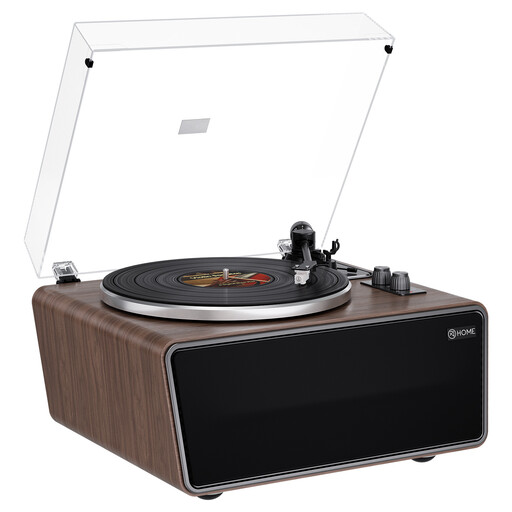
May suit you if you’re considering a set-up with built-in speakers; check whether they’ll work for listening in your living room.
The product name lists four built-in speakers, a phono preamp and an AT-3600L (MM) cartridge.
 No image available
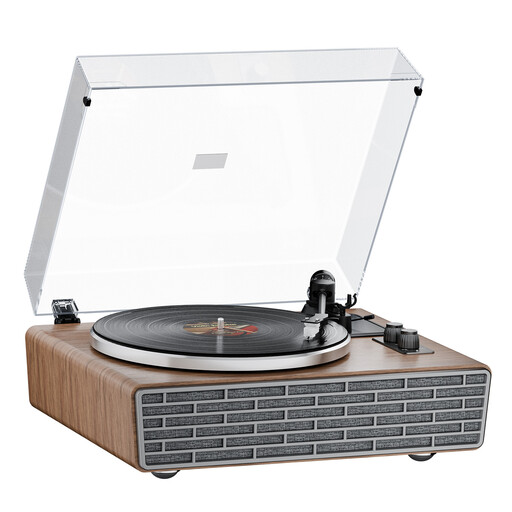
Compare this model if you’re weighing up built-in speakers against an external audio set-up; check which connections and record formats suit your system.
The product name lists Bluetooth, four speakers, belt drive and a transparent dust cover.
 No image available
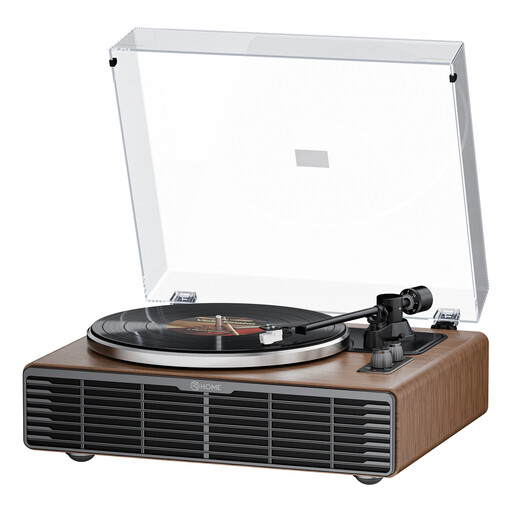
An option to compare if you’re considering built-in speakers or connecting to external audio equipment; check that the connections will work with your set-up beforehand.
The product name lists four speakers, belt drive, an AT3600L cartridge and RCA PHONO/Line outputs.
Active speakers have a built-in power amplifier. Use a suitable LINE output or phono preamp; don’t connect a phono signal to a standard line input without pre-amplification. Passive speakers do need an amplifier.
Don’t place the speakers right next to the turntable, as vibrations can affect playback. Audio-Technica Europe gives this as set-up advice; it isn’t a fixed minimum distance in metres.
No, check the record’s speed and material first. For 78 rpm shellac, you’ll need a turntable that supports 78 rpm and a suitable stylus or cartridge; Sony confirms that the PS-LX3BT and PS-LX5BT support only 33 and 45 rpm.
The Government of the Netherlands states that electrical appliances placed on the market in the EU must carry the relevant CE marking; check this for the specific model. According to the Government of the Netherlands, there is no general statutory warranty period of exactly two years in the Netherlands, and the seller is your point of contact for a solution if a product is faulty.
According to the Government of the Netherlands, when buying a similar new appliance, private customers can hand their old appliance in to the seller free of charge. For online purchases, this applies under an arrangement if the delivery driver doesn’t take it away straight away.