
Jazz single collector
You want to play your singles, so you’re checking their speed and size, and whether they need a centre adapter.


First, check the speed and size of your jazz singles, then choose a turntable that works with your speakers or headphones. For quiet listening, the right connection and a way to control the volume are what matter most. Automatic controls can make it easier to switch between singles, but they don’t mean a turntable will make jazz sound better.
You want to play your singles, so you’re checking their speed and size, and whether they need a centre adapter.
You prefer listening at a low volume and want to check which connection works with your existing speakers or headphones.
You often play short records one after another. Automatic start and tonearm return can mean fewer steps when changing records.
Start with the records you want to play. Then check that the turntable connects to your listening equipment and offers controls that suit the way you switch records.
| What to consider | What should you check? | Who should consider this? |
|---|---|---|
| Playing singles | Compare the speed and size of your records with the speeds and record sizes the turntable supports. Also check whether you need a centre adapter. | I want to play my jazz singles without wondering whether each one is compatible with the turntable. Around 34% of consumers put being able to play their own singles correctly first. |
| Connection and volume | Make a note of the inputs on your amplifier or active speakers, whether your listening device can receive Bluetooth, and where you can control the volume. | I listen quietly through equipment I already own, or want to choose a different listening setup. Around 33% of consumers give connection and volume control top priority. |
| Ease of use | Check separately whether the turntable starts and stops automatically and returns the tonearm; these features vary between models. | If I often switch between singles, I don’t want to have to do every step myself. Around 20% of consumers prioritise ease of use when changing records. |
| Care of records and turntable | Read the manual for the exact model to find out about placement, any adjustments and a suitable replacement stylus. | I want to look after my records and know what care the turntable will need over time. Around 13% of consumers make record care and maintenance their top priority when choosing. |
Record size, speed and the adapter you need are separate things to consider. The word ‘single’ or the record’s diameter alone won’t tell you which speed it needs.
Check the record or sleeve for details, then confirm the speed and size and whether you need a centre adapter before buying.
A phono preamp on its own won’t play sound through passive speakers. You’ll also need a suitable amplifier.
Check the connection from the turntable through to your listening device, and decide where you’ll control the volume.
The Dutch Consumers’ Association often describes all-in-one suitcase-style models as having lower sound quality and being less gentle on delicate records than standard turntables.
Weigh up the convenience of a simple connection against the controls and record care offered by the specific model.
According to the Government of the Netherlands, there is no fixed statutory warranty period in the Netherlands. The retailer is your point of contact if a product is faulty.
Compare any additional warranty with your existing legal rights and the terms and conditions for the product you’re considering.
According to Sony Netherlands, the PS-LX3BT is an automatic turntable that supports 7- and 12-inch records, 33⅓ and 45 rpm, Bluetooth, and phono and line outputs.
Audio-Technica says the AT-LP70XBT combines automatic operation and 33⅓/45 rpm speeds with Bluetooth and a switchable phono preamp.
Denon describes the DP-29F as having automatic operation and a built-in phono equaliser. According to Denon, the DP-300F has a switchable phono preamp and supports 33⅓ and 45 rpm.
According to Lenco, the LBT-188 combines 33/45 rpm speeds, Bluetooth transmission, a switchable preamp and manual operation.
According to Pro-Ject, the E1.2 is a component turntable with a choice of 33/45 rpm speeds.
These turntables are options if you want to play jazz singles at home and choose a suitable wired or wireless listening setup.
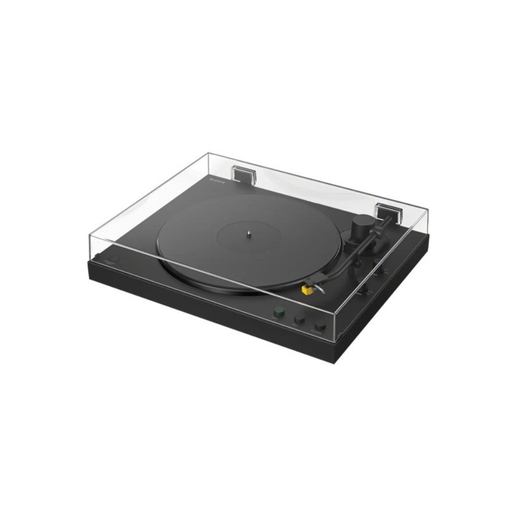 No image available
An option if you’re looking for a Sony turntable with Bluetooth. Before buying, check that its connections and support for your singles suit your listening setup.
Bluetooth functionality is listed in the product name.
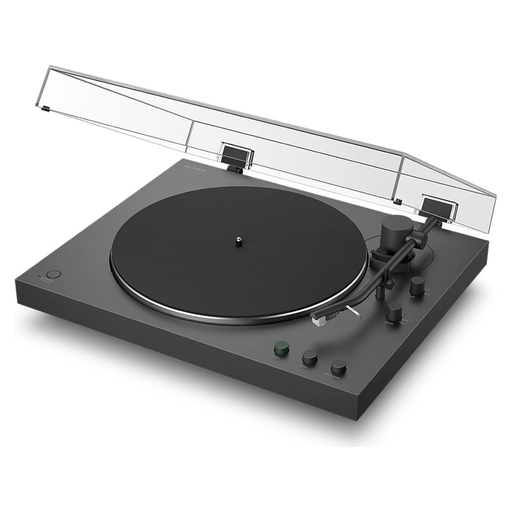 No image available
An automatic option if you play singles and want to listen through a wired connection or Bluetooth. Match the output to the input on your listening equipment.
Sony lists support for 7- and 12-inch records, 33⅓ and 45 rpm, Bluetooth, and phono and line outputs. Sony also lists automatic start, stop and tonearm return.
No. Use the speed shown on your record or sleeve; neither the style of music nor the record’s diameter determines it. Then check that the turntable supports the speed and size, and whether you need a centre adapter. Sony lists support for 33⅓ and 45 rpm and for 7- and 12-inch records on the PS-LX3BT.
That depends on your full setup. A correctly configured line output can connect to a suitable input on active speakers; passive speakers also need an amplifier. Choose the appropriate phono or line setting for your equipment’s input, and check where you can control the volume.
Follow the manual for the exact model when positioning the record and adapter and making any tonearm adjustments. Audio-Technica says the AT-LP3XBT must be adjusted before use, but states that the AT-LP70XBT doesn’t need tonearm configuration. So don’t assume the instructions for one model apply to another.
If a product is faulty, the retailer is your point of contact for your statutory guarantee. According to the Government of the Netherlands, there is no fixed statutory warranty period; what you can expect depends, among other things, on the product and the information provided. A manufacturer’s warranty or additional cover is separate from these rights.
Keeping the volume low doesn’t automatically exempt you from rules about noise nuisance. The Government of the Netherlands advises making arrangements with your neighbours if noise is an issue, for example agreeing when you’ll play music. This doesn’t set a nationwide permitted volume level for this listening setup.