
Jazz single collectors
You want the turntable to support your records’ size and speed, and check whether you need an adapter for singles with a large centre hole.


Start by choosing a turntable that supports the size and speed of your singles and has the right connections for your speakers or amplifier. For low-volume listening, the condition of your records and stylus, along with a stable setup, also matters. Automatic operation and Bluetooth don’t, by themselves, guarantee better sound.
You want the turntable to support your records’ size and speed, and check whether you need an adapter for singles with a large centre hole.
You pay attention to the condition of your records and stylus, as well as your setup. A turntable’s specifications alone don’t tell you how quietly your complete system will run.
You want to know whether the turntable will connect to your speakers or amplifier, and whether you’ll need a phono preamp.
Start with your records: check their size and speed. Then see which connections suit your existing system, before choosing the type of operation you prefer.
| What to consider | What should you check? | Who is this most important for? |
|---|---|---|
| Size and speed | Check the record size, whether it’s marked for 33⅓ or 45 rpm, and whether you need an adapter for a large centre hole. | If I mainly play singles, I want them to fit the turntable properly and play at the stated speed. Around 33% of consumers say playing their singles correctly is their top priority. |
| Low-volume listening | Check the condition of the record and stylus, the maintenance options and that the turntable is set up on a stable surface. | When I listen at a low volume, I want to play my records carefully and avoid unnecessarily amplifying distracting clicks. Around 27% of consumers prioritise relaxed listening at a low volume. |
| Connections | Check whether your speakers are active or passive, whether your amplifier has a phono input, and which setting or output you need. | If I already have speakers, I want to know in advance what equipment my system needs to connect to the turntable. Around 27% of consumers name connectivity as their main consideration. |
| Operation | Check whether the tonearm starts and returns automatically, or only lifts at the end of the record. | If I often put on short records, I want to operate the tonearm manually as little as possible. Around 13% of consumers say ease of use is their top priority. |
A turntable may need a phono preamp built into the turntable or amplifier, or a separate device. Using the wrong setting or connection can prevent the system from working as it should.
Make a note of the inputs on your speakers and amplifier, then check the connections and switch on the exact model you’re considering.
These features describe functions or the drive mechanism, but don’t tell you on their own how jazz singles will sound in your room and system.
Choose Bluetooth if you need that connection. For low-volume listening, pay attention to your records, stylus and setup too.
A turntable with built-in speakers isn’t automatically the best choice if you already use speakers or an amplifier.
Compare the connections and equipment needed for an all-in-one turntable with those of a standard turntable and your existing system.
The PS-LX3BT is an option if you’re looking for support for 7-inch singles, automatic operation and a choice of connections.
The AT-LP70XBT combines automatic operation with Bluetooth and a switchable phono preamp.
The E1.2 range is designed for listeners looking for a pre-adjusted turntable with more manual operation.
The DP-29F is a fully automatic option with built-in, switchable phono EQ.
The SL-1500C is a direct-drive model with a built-in phono equaliser and a tonearm lift at the end of the record.
These Sony turntables at Joybuy are options if you’re considering a fully automatic model. For each version, check that the supported record sizes, speeds and connections suit your singles and system.
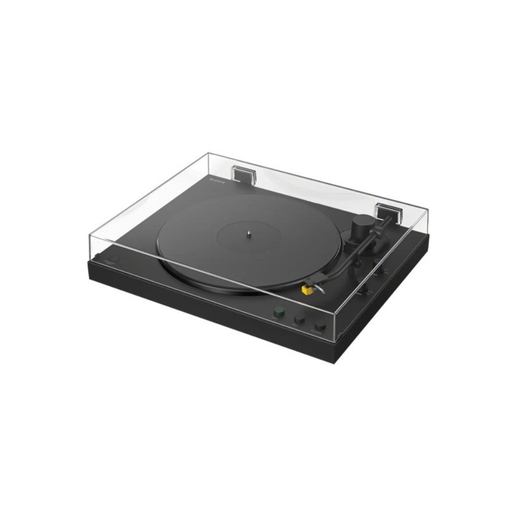 No image available
An option to consider if you’re looking for a Sony turntable with Bluetooth; check the product details for the record sizes, speeds and connections supported by this version.
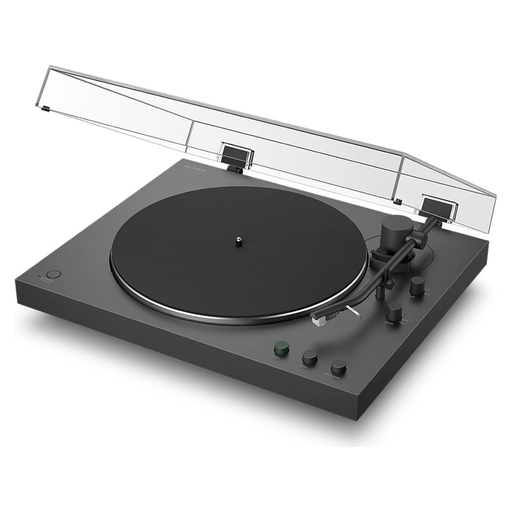 No image available
Worth considering if you play jazz singles and want automatic operation. Sony Netherlands lists support for 7- and 12-inch records, 33⅓ and 45 rpm, Bluetooth and a phono/line switch.
Check that the selected output is suitable for your speakers or amplifier.
No, it depends on the size of the record’s centre hole. According to the Denon manual, use an adapter if needed for a single with a large centre hole; set the speed according to the marking on the record.
It depends on your speakers and connections. Active speakers or a suitable line input may work with a phono preamp switched on; if you’re using a phono input, the output or setting must be compatible. Passive speakers also need an amplifier.
Place the turntable on a stable surface, check the condition of the record and stylus, and use the tonearm lift carefully. The Dutch Consumers’ Association highlights the tonearm, tonearm lift and cartridge as relevant components. Which turntable sounds quietest at a low volume also depends on your own system.
If a product is faulty, the Dutch Government says you can contact the seller under your statutory guarantee rights. The Netherlands has no fixed statutory guarantee period; what you can expect from the product depends, among other things, on the product itself and the information provided. Also check which replacement stylus is compatible with the exact model.
If you buy online from a business as a consumer, the Dutch Government says you’ll often have a 14-day cooling-off period. There’s no fixed statutory guarantee period; your rights depend, among other things, on what you could reasonably expect from the product.