
Listener with 7-inch jazz singles
You want to switch between singles quickly, so look for the right speed, format recognition and, if needed, a centre adapter.


Start by checking the speed and size of your records, then make sure the turntable connects to your amplifier or speakers. In a loft, you’ll also need to think about where you put it: Audio-Technica says vibrations from nearby speakers can affect the stylus. For 78 rpm shellac records, you need more than a turntable with that speed setting: you’ll also need a suitable cartridge or stylus.
You want to switch between singles quickly, so look for the right speed, format recognition and, if needed, a centre adapter.
You want to connect your turntable properly and find a spot where nearby speakers will transmit as little vibration as possible.
You only need a turntable with 78 rpm if your records require that speed, as well as a suitable cartridge or stylus.
First, check the details on your records. Then choose based on your audio connections and where you plan to put the turntable.
| What to consider | What should you check? | Who should give this more weight? |
|---|---|---|
| Playing your singles | Check the stated speed, record size and centre hole, and whether the model includes any adapter you need. | I want my 7-inch records to play at the right speed and sit correctly on the turntable; around 36% of consumers put compatibility first. |
| Finding a suitable spot in your loft | Plan for a level surface and check whether you can avoid placing the turntable right next to your speakers. | If the turntable’s position is fixed, I want to take vibrations from nearby speakers into account; around 29% of consumers prioritise where it will go. |
| Connecting to your audio equipment | Check the inputs on your amplifier or active speakers, and where the phono preamp is located. | I want to use my existing audio equipment and know in advance which connection I need; around 21% of consumers choose primarily based on connectivity. |
| 78 rpm shellac records | Check whether your records require 78 rpm and whether the cartridge and stylus are suitable for the record material. | I want to check both the speed and stylus compatibility for my old shellac records; around 14% of consumers prioritise the need for 78 rpm. |
The type of music doesn’t tell you the speed or material of your record. A turntable that supports only 33⅓ and 45 rpm isn’t designed for 78 rpm records.
Check the speed and material of your records before choosing a model. If you want automatic operation, also check the guidance on selecting the record size and using an adapter.
The connection you need depends in part on the inputs on your equipment and where the phono preamp is located.
Make a note of the inputs on your amplifier or active speakers before you buy, and check that the turntable offers a suitable phono or line connection.
Audio-Technica says vibrations from nearby speakers can affect the stylus. That doesn’t mean every loft will have the same vibration issues.
Where possible, plan a separate, level spot for your turntable before arranging the rest of your setup.
According to Audio-Technica, the AT-LP70XBT is an automatic 33/45 rpm turntable with Bluetooth and a switchable phono preamp.
According to Sony, the PS-LX310BT is an automatic 33/45 rpm turntable with a built-in phono preamp and a phono/line switch.
Denon describes the DP-300F as a fully automatic turntable with a switchable phono preamp and support for 33⅓ and 45 rpm.
According to Reloop, the RP-4000 MK2 is a manual direct-drive turntable with 33⅓, 45 and 78 rpm speeds and an SME cartridge connection.
These options include models for playing singles at 33⅓ or 45 rpm, with built-in speakers as well as options to consider for a separate audio setup.
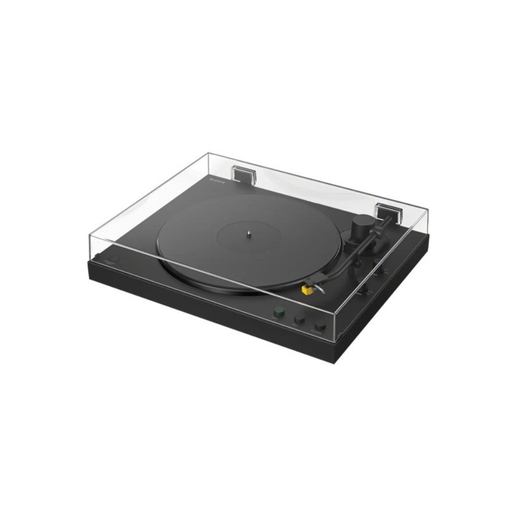 No image available
An option to compare if you want to play singles at 33⅓ or 45 rpm. Check that the Bluetooth connection works with your existing speakers.
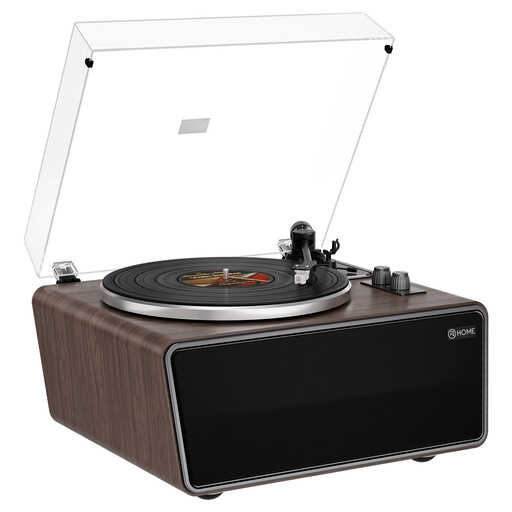 No image available
An option to compare if you want to play singles at 33⅓ or 45 rpm without setting up separate speakers. The product name lists four built-in speakers, a phono preamp and an AT-3600L (MM) cartridge.
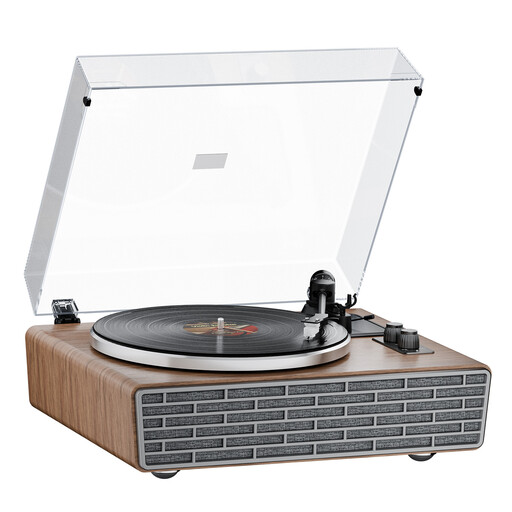 No image available
An option to compare if you want to play singles at 33⅓ or 45 rpm and are looking for an all-in-one setup. The product name lists four built-in speakers, belt drive, an AT cartridge and a transparent dust cover.
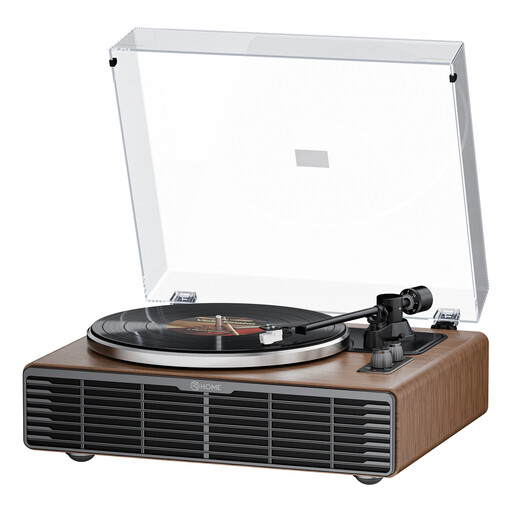 No image available
An option to compare if you want to play singles at 33⅓ or 45 rpm and have built-in sound. The product name lists four speakers, belt drive, an AT3600L cartridge and an RCA Phono/Line output.
It depends on more than just the size: check the speed and centre hole of your record. Sony lists a 45 rpm adapter for the PS-LX310BT, while Denon describes a size selector for 17 cm records on the DP-300F. Also check which accessories are included with the model you’re buying.
Choose a level surface and, where possible, avoid putting it right next to speakers. Audio-Technica says speaker vibrations can affect the stylus; this placement advice doesn’t guarantee that a particular loft will be free from vibration.
Only if there isn’t a usable phono preamp in the turntable or elsewhere in your audio setup. Check the inputs on your amplifier or active speakers. The Consumers’ Association (Consumentenbond) recommends a separate preamp if neither has one.
According to ACM ConsuWijzer, a product must meet what you can reasonably expect from it when used normally. If it develops a fault too soon, the seller must offer an appropriate remedy at no extra cost. For a standard online product purchase, you generally have up to 14 days after delivery to change your mind, subject to legal exceptions.
Yes. The Dutch Ondernemersplein outlines European safety requirements for electrical equipment and the Radio Equipment Directive for devices with Bluetooth. A product listing by itself doesn’t prove that an individual item meets the applicable requirements.