
Jazz single collectors
You’ll want to check that the speed, record material and, where applicable, adapter or stylus are right for your collection. Audio-Technica distinguishes between 45 rpm records and older 78 rpm records.


First, check the speed and centre hole of your singles: a turntable that plays records at 45 rpm won’t necessarily play old 78 rpm records. Then choose a model that works with your amplifier or active speakers. In a large living room, the speakers and where you position them matter too, while automatic operation and stylus choice involve other considerations.
You’ll want to check that the speed, record material and, where applicable, adapter or stylus are right for your collection. Audio-Technica distinguishes between 45 rpm records and older 78 rpm records.
You’ll want to know how the turntable connects to your existing system or to speakers you’re still choosing. The Consumers’ Association points out that a standard turntable doesn’t provide amplification and speakers on its own.
You regularly play short records and may want automatic start and return. Sony and Denon describe these features on specific models; also check the connections and whether the stylus can be replaced.
Start with the records you actually own, then check the connections and controls for your complete listening setup.
| Key consideration | What to check before buying | Who should consider this? |
|---|---|---|
| Speed and record material | Check the speed shown on the record and whether shellac records require a suitable 78 rpm stylus. | If I also own older 78 rpm records, I want to avoid using a speed or stylus that isn’t right for them. Around 27% of consumers give record compatibility their top priority. |
| Connections and room sound | Compare the phono or line connection with the inputs on your amplifier or active speakers; also decide where the turntable can sit on a level surface. | If I’m using the turntable in a large living room, I want it to connect to my system and have a suitable place to sit. Around 27% of consumers focus mainly on connections and how the sound works in the room. |
| Controls for singles | Check whether the model starts automatically, returns the tonearm or only lifts it at the end of a record. | If I regularly change singles, I want to handle the tonearm as little as possible. Around 20% of consumers put ease of use first. |
| Stylus and maintenance | Find the replacement stylus for the exact model; a 78 rpm record may require a suitable stylus. | If I want to be able to replace my stylus and play different types of records, I want to know in advance which version is right. Around 13% of consumers consider stylus choice and maintenance most important. |
| Complete system | Make a list of the speakers, amplification and phono preamplification you already have or still need. | When I upgrade my system, I want to consider all the necessary components together rather than just the turntable. Around 13% of consumers focus mainly on the cost and expandability of the complete system. |
A turntable that supports 45 rpm won’t necessarily play older 78 rpm records. Shellac records may also need a suitable stylus.
Check the speed shown on your records and what they’re made of before choosing a model.
If your collection includes 78 rpm records, you may need a different turntable or a suitable additional stylus.
A standard turntable doesn’t automatically make a complete system for a large living room. The Consumers’ Association points out that you’ll also need amplification and speakers.
Make a note of the components you already own and the connections available before settling on a turntable.
Allow for the practical need for speakers, amplification or a phono preamplifier if you don’t already have them.
The output setting needs to match the input you’re connecting the turntable to. According to Audio-Technica’s setup instructions, setting the Audio-Technica AT-LP70XBT to PHONO when connecting it to a standard amplifier input can result in little or no sound.
Check the input and follow the instructions for the exact model before connecting your turntable.
Built-in speakers don’t automatically provide suitable playback in a large living room. The Consumers’ Association notes that suitcase turntables can have limitations in sound quality and may not handle delicate records gently enough.
Also compare a standard turntable with speakers suited to your setup and listening space.
The AT-LP70XBT is designed for automatic playback of 33⅓ and 45 rpm records, while the manual AT-LP120XUSB also supports 78 rpm.
The PS-LX310BT is an option if you want to play 45 rpm singles automatically and use Bluetooth.
The E1 Phono is designed as a turntable for an existing stereo setup where a phono preamplifier is needed.
The DP-300F combines automatic operation with a switchable phono preamplifier.
The SL-1500C is a direct-drive model for anyone with, or looking for, a more advanced stereo setup.
These Joybuy products are aimed at playing 45 rpm singles and, according to their product titles, have built-in speakers. Check that the connections and speaker setup suit your large living room.
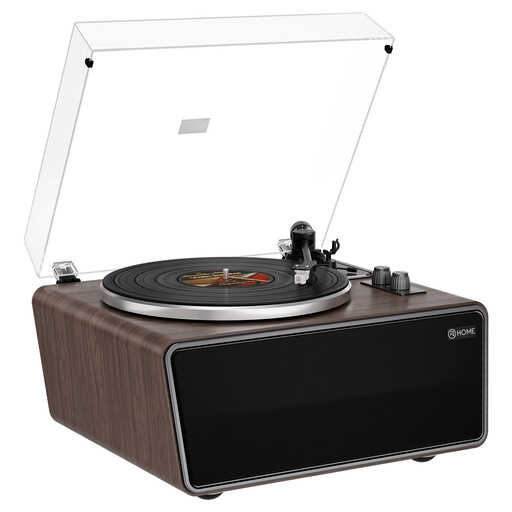 No image available
An option to consider if you’re looking for a turntable with built-in speakers.
The product title lists a phono preamplifier and an AT-3600L (MM) cartridge.
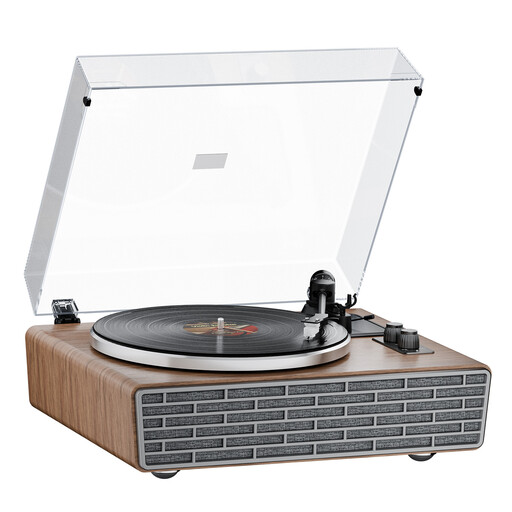 No image available
Consider this model if you’re looking for a turntable with built-in speakers and Bluetooth.
The product title lists a belt drive, a transparent dust cover and an AT cartridge.
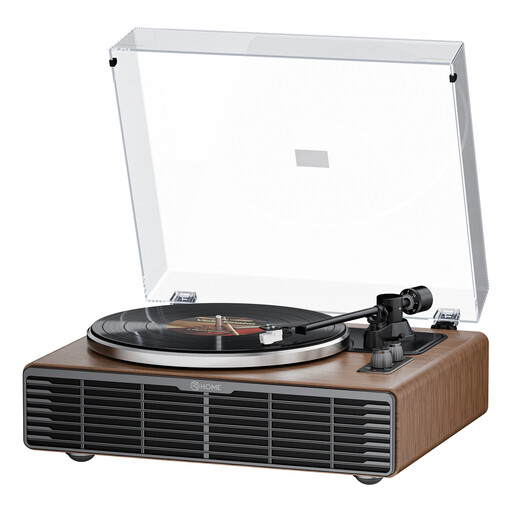 No image available
An option to consider if you’re looking for built-in speakers and wireless Bluetooth connectivity.
The product title lists an AT3600L cartridge, a belt drive, an RCA Phono/Line output and a clear dust cover.
No. Check both the speed of the record and the turntable’s specifications. Shellac records at 78 rpm also require a suitable 78 rpm stylus. Audio-Technica says the AT-LP120XUSB supports 78 rpm, but that doesn’t automatically make its standard stylus suitable.
Choose a model with a built-in phono preamplifier and check which output setting is right for your line or aux input. For the AT-LP70XBT, Audio-Technica specifies the PHONO setting when connecting to a PHONO input; always follow the instructions for the exact model.
Place it on a flat, level surface, away from speakers that could cause vibrations. Audio-Technica gives this advice for the AT-LP70XBT; also consider where your speakers are positioned in your own setup.
In many cases, purchases made at a distance from a business come with a 14-day cooling-off period, according to the Dutch Government. Exceptions may apply, and the rules aren’t necessarily the same when buying from a private seller; check the terms for your specific purchase.