
Jazz single collector
You want to play your singles at the correct speed. With older records, check the material too: Audio-Technica warns that a standard LP stylus is not suitable for an old shellac record.


Start by checking the speed and material of your jazz singles. Choose a turntable that supports the speed specified, and bear in mind that old shellac records also need a suitable stylus. Then check that the connections are compatible with your speakers and amplifier. Place the turntable on a flat, stable surface, not right next to a speaker.
You want to play your singles at the correct speed. With older records, check the material too: Audio-Technica warns that a standard LP stylus is not suitable for an old shellac record.
You need a practical spot for your turntable and speakers, without unnecessary vibrations reaching the turntable. Audio-Technica recommends placing the turntable on a level surface and keeping it away from speakers.
You want to check in advance that your speakers, amplifier and turntable will work together. The Consumers' Association points out that a turntable needs a preamplifier; Audio-Technica also explains the difference between active and passive speakers.
First check which records you want to play, then check the connections and where you plan to put the turntable.
| What to consider | What should you check? | Who is this important for? |
|---|---|---|
| Record format, speed and stylus | Check the speed and record material on the record or sleeve, then compare them with the supported speeds and suitable stylus. | I want to know whether my singles need to be played at 33⅓, 45 or possibly 78 rpm, and whether the stylus is suitable for the material. Around 31% of consumers put record format, speed and stylus at the top of their list of buying considerations. |
| Positioning and vibrations | Choose a flat, stable surface and don't place the turntable right next to a speaker. | In an open-plan living space, I want to position the turntable so that the speakers aren't right beside it. Around 25% of consumers prioritise a stable position that's free from interference. |
| Connecting to existing speakers | Check whether your speakers are active or passive, which inputs are available and whether your audio set-up includes a phono preamplifier. | I want to use my existing speakers or amplifier without missing a link in the audio chain. Around 25% of consumers prioritise these connections. |
| Controls | Compare automatic start and return, speed switching and tonearm controls for the exact model. | If I often change singles, I want to know how much I need to do with the tonearm myself. Around 19% of consumers give ease of use top priority. |
The word ‘single’ doesn't tell you the speed or record material. Audio-Technica says a standard LP stylus isn't suitable for an old shellac record.
Check the speed and material on the record or sleeve before choosing a model and stylus.
Vibrations and acoustic pressure can affect playback. Audio-Technica recommends placing the turntable on a level surface and keeping it away from speakers.
First find a stable spot for the turntable, then check whether the cabling or a suitable wireless connection will work with your set-up.
A turntable needs a compatible audio chain. Active speakers have a built-in amplifier; passive speakers need an amplifier between them and the turntable.
Before you buy, make a note of the inputs on your equipment and check whether the chain already includes a phono preamplifier.
The Sony PS-LX3BT is worth considering if you're looking for an automatic turntable for 7-inch vinyl singles, with Bluetooth or a wired connection.
The AT-LP70XBT and AT-LP120XUSB offer different ways of operating the turntable; supported speeds and connections depend on the exact model.
The LBT-188 is one to compare if you're looking for Bluetooth, USB and a switchable preamplifier in one turntable.
The T1 EVO BT is an option to compare if you're looking for wired and Bluetooth connections, with electronic switching between 33 and 45 rpm.
The CS 329 is worth considering if you're looking for a fully automatic turntable with a phono or line connection.
These Joybuy products are turntables to compare for jazz singles and different connection needs. Check the features of the exact model and make sure it suits your records and speakers.
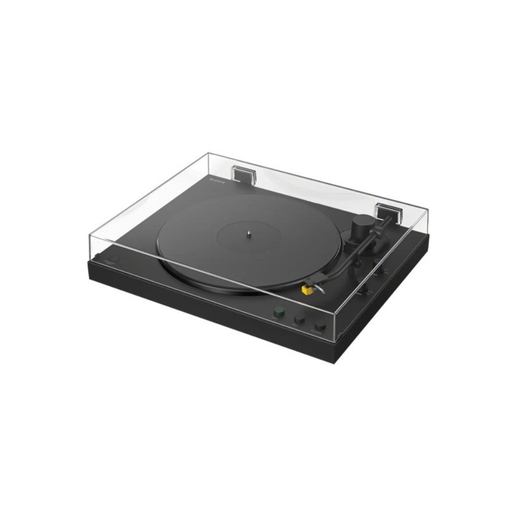 No image available
A Bluetooth turntable to compare if you're considering wireless playback; check that your speakers have a compatible Bluetooth receiver.
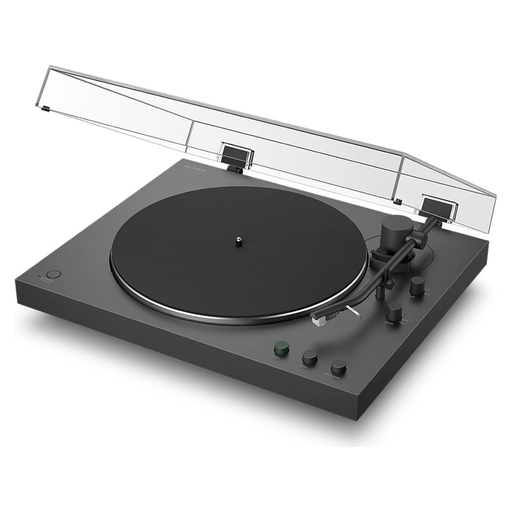 No image available
According to Sony, this automatic turntable plays 7-inch vinyl singles at 33⅓ or 45 rpm, and can be used via Bluetooth or a wired connection.
Sony lists automatic start and return, as well as a phono/line output. The specified speeds don't include 78 rpm.
No, check the speed on the record or sleeve. According to Sony, the Sony PS-LX3BT supports 33⅓ and 45 rpm. You'll need a suitable turntable to play a 78 rpm record, and shellac records also need a suitable stylus.
Active speakers have a built-in amplifier, but their connection must be compatible with the turntable's output. A line output can be connected to a suitable audio input; a phono output needs a phono preamplifier. Passive speakers also need an amplifier, as Audio-Technica explains.
Place the turntable on a flat, stable surface and not right next to a speaker. In its installation instructions, Audio-Technica warns about vibrations and acoustic pressure when a turntable is positioned next to speakers.
78 rpm alone isn't enough: shellac records also need a suitable stylus. Audio-Technica warns that a stylus for standard LP vinyl isn't suitable for an old shellac record.