
Listener with existing speakers
You want to connect folk LPs to active speakers or an existing amplifier. Check that the turntable’s phono or line output matches the input available.


First, choose a turntable that matches the input on your speakers or amplifier. A built-in phono preamp is useful for a line input, while a Bluetooth speaker requires a turntable with a Bluetooth transmitter. Then decide whether you want automatic operation or prefer to move the tonearm yourself, and set aside a level spot away from speaker vibrations. None of these features on its own proves that a turntable will sound better with folk LPs.
You want to connect folk LPs to active speakers or an existing amplifier. Check that the turntable’s phono or line output matches the input available.
You want to use a Bluetooth speaker or headphones. Check that the turntable transmits Bluetooth, rather than only receiving it.
You want to operate the tonearm yourself and are mindful of having a level, stable surface and keeping the stylus maintained.
Start with the input on your speakers or amplifier and decide whether you want to listen over a cable or via Bluetooth. Then choose the controls that suit your listening habits and check that you have a suitable spot for the turntable.
| What to consider | What should you check? | Who is this important for? |
|---|---|---|
| Connections and audio setup | Compare the phono or line input on your amplifier or active speakers with the turntable’s output. Check whether the preamp can be switched and is set correctly. | If I want to keep using my existing equipment, I’ll start by checking the connections. Around 40% of consumers say a compatible connection is their top buying priority. |
| Controls | Check which operations are automatic, such as starting and stopping, and whether you need to move the tonearm yourself. | For short listening sessions while I’m working, I might want to start a record with as few steps as possible; other listeners prefer to operate the tonearm themselves. Around 30% of consumers prioritise ease of use when starting and stopping. |
| Wireless listening | Check that the turntable transmits Bluetooth and that your speaker or headphones can receive it. Also consider whether you want the option of a wired connection. | If I want to avoid cables in my study, my turntable needs to connect to my Bluetooth receiver. Around 20% of consumers give wireless listening top priority. |
| Positioning and maintenance | Measure the available space, allow room for the dust cover, and place the turntable on a level surface away from speaker vibrations. Check which replacement stylus is compatible with the model. | If my desk and speakers are close together, I’ll want a spot where the turntable can sit level and won’t be directly exposed to vibrations. Around 10% of consumers prioritise positioning and stylus maintenance. |
A standard turntable needs suitable speakers or an amplifier with speakers. The Consumers’ Association describes this as a separate listening setup.
First, check the inputs and speakers you already have. Then compare what else you need with a turntable that has built-in speakers.
Pro-Ject describes the E1.2 Phono and E1.2 BT as separate versions with different connection options.
Check the full model name and make sure the version transmits Bluetooth or has the wired output that suits your equipment.
For installing the AT-LP70XBT, Audio-Technica recommends a level spot away from speakers that could cause vibrations.
Plan where the turntable and dust cover will go before you buy, and take the position of your speakers into account.
Additional commercial cover is separate from your statutory rights. The Dutch government advises that you should contact the seller if a product is faulty.
Read exactly what additional cover includes, and contact the seller if a product is faulty.
Denon describes the DP-300F as a wired, fully automatic belt-drive turntable with a switchable phono preamp.
Sony lists the PS-LX3BT and PS-LX5BT as fully automatic turntables with a Bluetooth transmitter and a phono/line selector.
Audio-Technica describes the AT-LP70XBT as an automatic turntable with Bluetooth and a switchable preamp.
Pro-Ject describes the E1.2 Phono as a wired version with a switchable phono preamp. The E1.2 BT is a separate Bluetooth version.
The Dutch specifications for the Technics SL-1500C describe a direct-drive turntable.
These Joybuy products are fully automatic Sony turntables with a Bluetooth transmitter and wired connection options. They’re suited to listeners who want to listen wirelessly while also having the option of a phono or line connection.
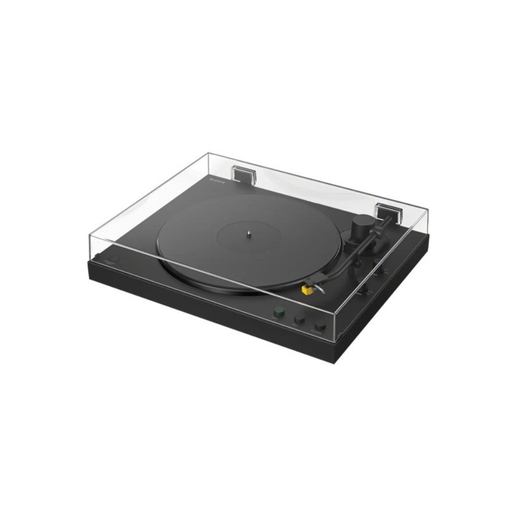 No image available
Suited to listeners who want automatic playback via a Bluetooth receiver or a wired audio setup.
The product description lists Bluetooth, a PHONO/LINE switch and support for 33⅓ and 45 rpm. Sony describes the PS-LX5BT as fully automatic.
Before buying, check that the version on offer meets the applicable product requirements and carries the required marking.
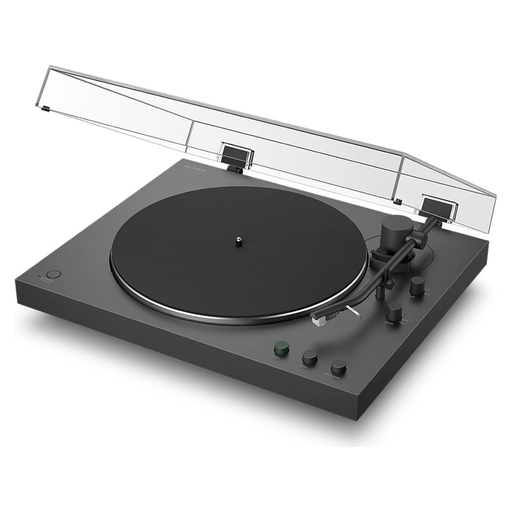 No image available
Suited to listeners who want automatic operation alongside listening through a Bluetooth receiver or a wired connection.
The product description lists Bluetooth, a PHONO/LINE switch and support for 33⅓ and 45 rpm. Sony specifies automatic start and stop for the PS-LX3BT.
Before buying, check that the version on offer meets the applicable product requirements and carries the required marking.
With a standard turntable, yes: connect active speakers or use an amplifier with speakers. Check that the phono or line input matches the turntable’s output and settings. The Consumers’ Association describes an all-in-one player as a different setup.
Place it on a level surface, away from speakers that transmit vibrations. This is Audio-Technica’s installation advice for the AT-LP70XBT, not a legally required distance.
Check which replacement stylus is compatible with the exact version and whether you need speakers or a phono preamp. Audio-Technica lists a replacement stylus from the VM95 series for the AT-LP70XBT; this doesn’t automatically apply to other models.
According to the Dutch government, there is no fixed statutory warranty period in the Netherlands: you’re entitled to a product that meets what you could reasonably expect, and the seller is your point of contact if something goes wrong. For distance sales, the cooling-off period is usually 14 days, according to the Dutch government; check the terms that apply to your purchase.
The Netherlands Food and Consumer Product Safety Authority (NVWA) states that electrical products covered by the applicable rules must carry the required CE marking. According to the NVWA, a product with Bluetooth is covered as a whole by the Radio Equipment Directive. Check the product information for the exact version on offer; these general rules don’t automatically confirm that every product on offer complies.