First, choose a stable spot where the turntable is not directly next to the speakers on the same piece of furniture. Audio-Technica warns that vibrations and acoustic pressure can affect the turntable. Then choose based on your speakers, amplifier, preferred controls and maintenance needs. Automatic operation makes it easier to play a record, but doesn’t in itself say anything about sound quality. If you’re considering a specific electrical model, also check that the version has a CE marking; the Dutch government states that electrical equipment sold in the EU must carry one.
Who this choice is relevant to
Listener with speakers positioned against a wall
Wants to place the turntable on a stable surface, separate from the speakers, to limit the transfer of vibrations. Audio-Technica’s manual warns against placing it next to speakers; Genelec also discusses how a wall can affect the sound of specific studio monitors.
Careful listener of classical LPs
Pays attention to speed variation, the cartridge and the stylus, especially during sustained notes and quiet passages. Audio-Technica explains that wow and flutter describe variations in pitch; Ortofon highlights the importance of maintaining the styli used with its cartridges.
Listener with an existing stereo system
Wants to know whether the turntable, speakers and amplifier will work well together, and whether a phono preamp is needed. Audio-Technica explains the connection options, while the Consumers’ Association notes that a turntable needs a preamp.
What to consider when choosing
Start by finding a suitable spot for the turntable, then check the connections and compare the features for playback, operation and maintenance.
| What to consider |
What to look for when buying |
Who this matters to |
| Vibrations and placement |
Check whether the turntable can sit securely, away from the speakers. Follow the guidance for your speaker model on how far it should be from the wall. |
If I need to place the turntable close to my speakers, I want to minimise vibrations as much as possible. Around 33% of consumers say placement is their main concern when buying. |
| Consistent playback |
Compare speed and wow-and-flutter specifications only when they use the same measurement basis. Also check the stylus type and the speeds your records require. |
For classical LPs, I want to focus on consistent playback and the condition of the stylus and records. Around 27% of consumers prioritise smooth, uninterrupted playback. |
| Compatibility with your system |
Check whether your speakers are active or passive, which inputs your amplifier has and whether you need a phono preamp. |
If I want to keep using my existing speakers and amplifier, the turntable’s output needs to match their inputs. Around 20% of consumers give compatibility their highest priority. |
| Operation and maintenance |
Check whether the turntable starts and stops automatically, whether its stylus can be replaced and what maintenance instructions apply. |
If I want to keep the effort involved in playing records and maintenance to a minimum, ease of use and stylus care are key. Around 20% of consumers put these first. |
Common buying mistakes
-
Placing the turntable directly next to the speakers on the same piece of furniture
Speaker vibrations can affect the stylus; claims about vibration damping don’t make careful placement any less important.
First, find a stable spot for the turntable away from the speakers. Then decide which model best suits your system.
-
Confusing a phono preamp with an amplifier for passive speakers
A turntable with a phono preamp doesn’t automatically provide the amplification passive speakers need. PHONO and LINE are also different signal levels.
Check the inputs and the type of speakers you have. Don’t connect a LINE output to a PHONO input.
-
Treating an older test table as a current verdict on a model
An older version listed in a test table doesn’t necessarily tell you anything about the current version.
Check the exact model version and the product information for the version you’re considering.
Brands to consider
Audio-Technica
Audio-Technica describes the AT-LP3XBT as a fully automatic turntable with Bluetooth, a switchable phono preamp and a replaceable stylus.
- The range of connection options is useful if you want to choose between an analogue connection and Bluetooth.
- The specifications don’t prove that the turntable can be placed right next to speakers without care, or that it sounds better than other models.
Sony
Sony describes the PS-LX3BT as an automatic turntable with Bluetooth and a switchable PHONO/LINE output.
- Sony lists 33⅓ and 45 rpm speeds for this model.
- Sony specifies a fixed RCA cable, so check that this connection suits your setup.
Denon
Denon describes the DP-300F as a fully automatic turntable with a switchable phono preamp.
- The combination of automatic operation and a switchable output is useful to compare with your existing system.
- Denon’s claims about sound quality aren’t an independent listening comparison for classical music.
Rega
The manual Planar 1 is an option if you prefer to operate the turntable yourself and can use a separate phono stage.
- Rega lists a pre-fitted cartridge; the manual explains how to connect it to a suitable phono stage.
- Bear in mind that it’s manually operated and requires phono amplification.
Joybuy turntables for this listening setup
This selection includes a standalone Bluetooth turntable and models with built-in speakers. If your speakers are positioned against a wall, pay particular attention to whether you can place the turntable and the speakers you use separately. The Dutch government states that electrical equipment sold in the EU must carry a CE marking; check that the specific version has one.
 No image available
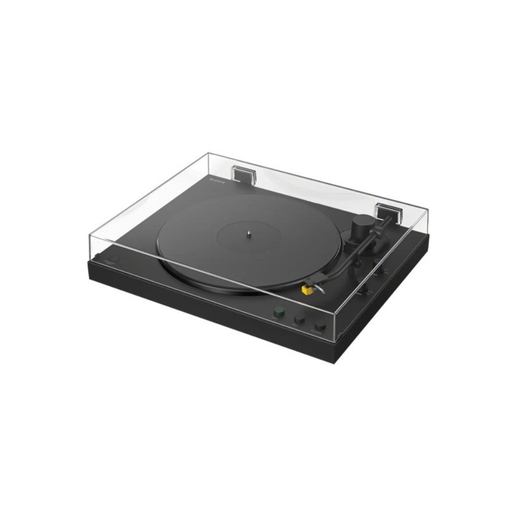
Sony PS-LX5BT
A standalone turntable to consider if automatic operation and a range of connection options suit your system.
The product description lists Bluetooth, a switchable PHONO/LINE output, an MM cartridge, and 33⅓ and 45 rpm speeds.
The product description gives speed variation as 0.1%; this isn’t an independent listening test.
View at Joybuy
 No image available
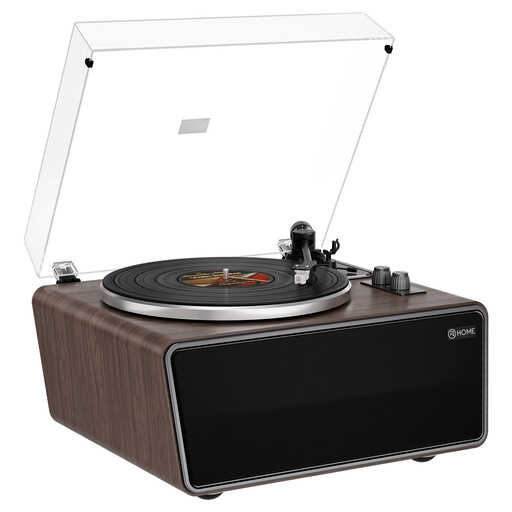
XJ-HOME XJ-H01 all-in-one turntable with 4 speakers and AT-3600L cartridge
The built-in speakers can’t be placed separately from the turntable, which is worth considering if you want to use speakers positioned against a wall.
The product description lists an AT-3600L cartridge, belt drive, and 33⅓ and 45 rpm speeds.
It also lists RCA Phono/Line outputs for external speakers.
View at Joybuy
 No image available
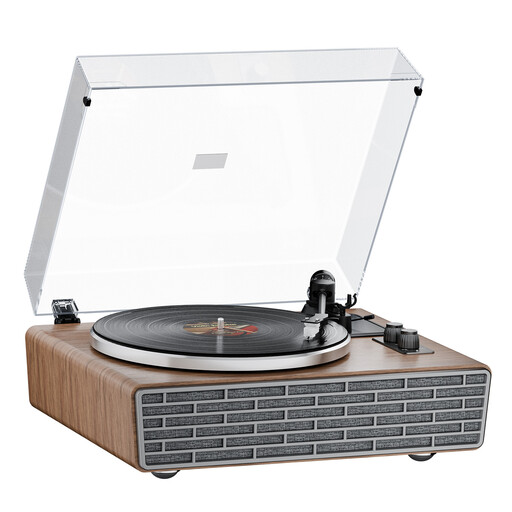
XJ-HOME XJ-H02 Retro Walnut Bluetooth turntable with 4 speakers
The four built-in speakers are housed in the turntable, so using them doesn’t allow you to place the turntable and speakers separately.
The product description lists Bluetooth, belt drive, an AT cartridge, and 33⅓ and 45 rpm speeds.
It also lists RCA Phono/Line outputs for external equipment.
View at Joybuy
 No image available
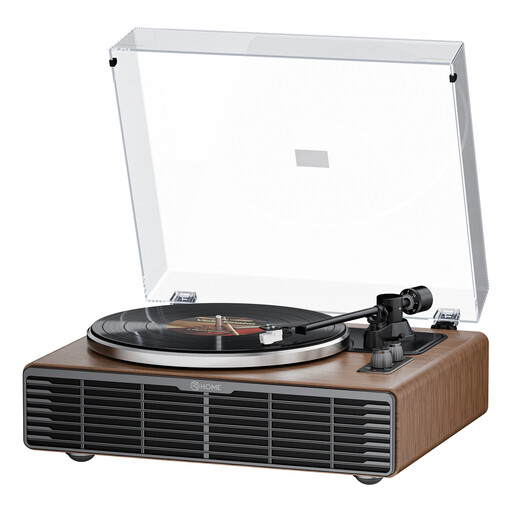
XJ-HOME XJ-H03 Walnut Bluetooth turntable with 4 speakers and AT3600L cartridge
The built-in speakers can’t be separated from the turntable; bear this in mind if you want to use them close to a wall.
The product description lists belt drive, an AT3600L cartridge, and 33⅓ and 45 rpm speeds.
It also lists RCA Phono/Line outputs for an amplifier or active speakers, and a transparent dust cover.
View at Joybuy
Frequently asked questions
Do speakers need to be further from the wall for good LP playback?
Not necessarily: the effect of a wall depends on the speakers. Do keep the turntable away from direct speaker vibrations, and follow your speakers’ manual for the space they need around them.
Can I connect a turntable directly to my speakers?
You can with suitable active speakers and a compatible LINE output. Passive speakers also need an amplifier; a PHONO output requires a suitable phono preamp. Audio-Technica makes the same distinction in its connection guidance.
Does an electric turntable need a CE marking in the Netherlands?
Yes. According to the Dutch government, electrical equipment sold in the EU must carry a CE marking. Check the marking on the specific version you’re considering.
How should I care for the stylus and my records?
Follow the instructions for the cartridge fitted to your turntable. Ortofon recommends using a suitable fibre brush on its own styli, brushing in the specified direction, and cleaning records regularly. Don’t automatically apply this method to every other stylus type.
What are the warranty and cooling-off period rules in the Netherlands?
There’s no fixed statutory warranty period for a consumer purchase; what you can expect from a product depends on the product and the circumstances. For eligible online purchases from a business, you generally have 14 days to change your mind. The Dutch government explains the conditions and exceptions that apply.


