
Attentive listener of classical LPs
If you want to choose the cartridge and make your own adjustments, look for replaceable parts and adjustment options. Audio-Technica describes these features for the AT-LP120XUSB.


When choosing a turntable for classical LPs in an open-plan living space, start by thinking about where it will go. Don’t place it right next to your speakers: Audio-Technica warns that vibrations can affect the stylus and cause records to skip. Then decide whether you’d prefer a manual turntable, which lets you make your own adjustments, or an automatic one for easy playback. Check that the phono preamp, amplifier and speakers are compatible. An all-in-one player saves you from buying separate equipment, but Which? warns that these players often sound worse than conventional turntables.
If you want to choose the cartridge and make your own adjustments, look for replaceable parts and adjustment options. Audio-Technica describes these features for the AT-LP120XUSB.
If you need to set up your turntable and speakers in a shared space, work out in advance where each can go. Audio-Technica warns that vibrations from speakers can affect the stylus.
If you want to keep the number of steps involved in playing a record to a minimum, compare automatic operation with manually cueing the tonearm. Sony describes the PS-LX3BT as fully automatic; Denon describes the DP-300F as having automatic operation.
Start with the space you have and the connections on your existing system. Then decide how much manual operation and adjustment you’re happy with.
| What to consider | What should you check? | Who is this for? |
|---|---|---|
| Cartridge and setup | Check whether the cartridge or stylus can be replaced, and what adjustment options the tonearm offers. Follow the setup instructions for your chosen cartridge. | If I want to choose or set up my own cartridge, I’ll look at the tonearm’s adjustment options. Around 26% of consumers give choosing and setting up the cartridge their top priority. |
| Vibrations and placement | Decide where the turntable and speakers can go separately, and what cable routing you’ll need. Audio-Technica warns that vibrations from speakers can affect the stylus and cause records to skip. | In an open-plan living space, I want to find a practical spot for both the turntable and the speakers. Around 26% of consumers prioritise suitable placement and reducing vibrations. |
| Connections | Check whether your amplifier has a phono input and whether your speakers are active or passive. Passive speakers need an amplifier; also check whether the turntable has a built-in phono preamp. | If I want to connect the turntable to my existing system, I need to know which input and amplification it requires. For around 21% of consumers, compatible connections are the top priority. |
| Operation | Compare automatic start and return with manual operation. Also check whether Bluetooth is a connection option you’d like. | If you want to start and stop records easily, automatic operation may matter more than positioning the tonearm yourself. Around 16% of consumers give ease of use their top priority. |
| Equipment and maintenance | Work out which components your existing system already has and which replacement stylus is compatible with the fitted cartridge. A turntable with built-in speakers can save you from buying separate components, but Which? says all-in-one players often have a sound-quality disadvantage compared with conventional turntables. | If I want to put together a complete working setup, I’ll take the necessary equipment and maintenance into account. Around 11% of consumers prioritise the complete setup and its upkeep. |
A turntable doesn’t automatically give you a complete listening setup. You’ll also need phono pre-amplification and amplification for your speakers.
Make a note of the inputs on your amplifier and whether your speakers are active or passive. Then compare the turntable’s connections with those on your existing equipment.
Built-in speakers save you from buying separate equipment, but Which? warns that all-in-one turntables often sound worse than conventional turntables.
Weigh the convenience of a single device against a conventional turntable with speakers you can position separately.
A playback speed of 78 rpm doesn’t, by itself, confirm that the stylus is suitable for shellac records. Ortofon describes shellac records as requiring a larger stylus profile.
If you have a collection of 78 rpm shellac records, check separately that both the turntable and the stylus are suitable.
The AT-LP120XUSB is a manual direct-drive turntable with adjustment options.
Sony describes the PS-LX3BT as a fully automatic turntable with Bluetooth.
According to Denon, the DP-300F combines automatic operation with a switchable phono preamp.
According to Technics, the SL-1500C is a direct-drive turntable supplied with a cartridge.
The LS-50WD is an all-in-one option with built-in speakers and an RCA line output.
This Joybuy selection features Sony turntables with automatic operation, Bluetooth and wired connection options. They’re suited to anyone who wants to play records easily and choose a connection that works with their existing system.
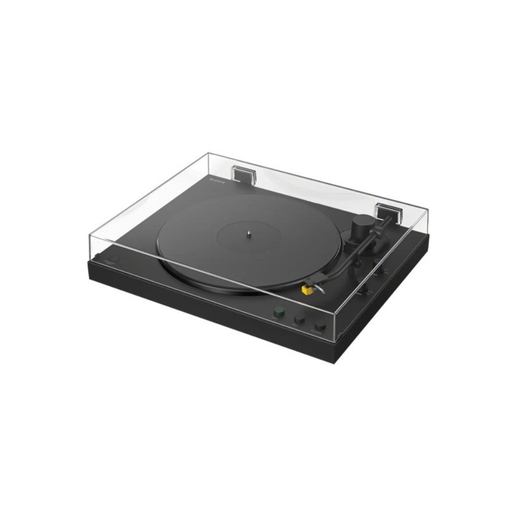 Image unavailable
Ideal if you want automatic operation and the choice of a wired connection or Bluetooth.
The product description lists an MM cartridge, belt drive and a tracking force of 2.0 g ± 0.5 g.
Listed playback speeds: 33⅓ and 45 rpm. Check the applicable safety information for the specific item, and whether it requires a CE marking.
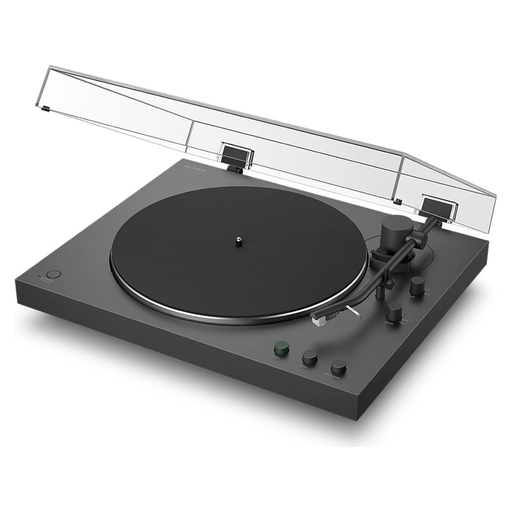 Image unavailable
Ideal if you want automatic playback and the option to use Bluetooth or a wired connection.
The product description lists an MM cartridge, belt drive and a tracking force of 3.5 g ± 0.5 g.
Listed playback speeds: 33⅓ and 45 rpm. Check the applicable safety information for the specific item, and whether it requires a CE marking.
Only if neither the turntable nor the connected amplifier has suitable phono pre-amplification. If your turntable’s built-in preamp is switched on, use the appropriate line input and check that the connections on your chosen equipment are compatible.
Don’t place external speakers right next to the turntable. Audio-Technica warns that vibrations can affect the stylus and cause records to skip, so work out what distance and cable routing are practical in your living space.
No. Products sold on the EU market must meet the applicable product safety requirements, including CE marking where required. Check the details of the specific item being offered; a general description of the brand or model doesn’t confirm that the item on offer complies.
According to the Dutch government, there’s no fixed statutory warranty period in the Netherlands: you’re entitled to a product that works properly, and the seller is your point of contact if there’s a fault. For online purchases from a business, a 14-day cooling-off period applies in many cases, subject to relevant conditions and exceptions.