
Listeners looking for quiet during soft passages
For classical LPs, you want to listen out for audible hum, mechanical noise and stable pitch. That’s why the setup and connections also matter when choosing a turntable.


Start by checking that your turntable and audio system work together: make sure you have suitable phono pre-amplification, further amplification, and speakers or headphones. Then compare the controls and stated speed stability, but don’t treat manufacturer specifications as a listening test. Automatic playback and Bluetooth can make things more convenient, while manual operation calls for more hands-on involvement.
For classical LPs, you want to listen out for audible hum, mechanical noise and stable pitch. That’s why the setup and connections also matter when choosing a turntable.
You already have speakers or an amplifier and want to know in advance whether you need a phono input, line input or separate phono preamp.
You’d rather have automatic operation or a practical wireless connection, without assuming that these features alone determine sound quality.
Decide which factors matter most for your listening setup: quiet passages, connections, ease of use or maintenance.
A good fit if: you want to operate the tonearm yourself and already have a suitable phono input or separate phono preamp.
Trade-off: you’ll need to check the setup and adjustments yourself. Specifications are no substitute for an independent listening test.
A good fit if: you want fewer steps and listen through a suitable amplifier or active speakers.
Trade-off: check that the phono or line setting matches the input on your audio system.
A good fit if: wireless listening through a compatible speaker or headphones is important to you.
Trade-off: Bluetooth alone doesn’t prove that quiet classical passages will sound better.
| What to consider | What to look for when buying | Who is this important for? |
|---|---|---|
| Quiet operation and pitch stability | Check the measurement method for wow and flutter, and consider placement, mechanical noise and the phono connection. | I want to hear soft passages without hum or audible changes in pitch distracting me. Around 33% of consumers put quiet operation and pitch stability first. |
| Compatibility with your audio system | Note the inputs on your amplifier or active speakers, and check whether the turntable outputs a phono or line signal. | I want to know in advance which signal path will work with my existing amplifier or speakers. Around 27% of consumers give connection compatibility top priority. |
| Ease of use | Check whether the tonearm starts and returns automatically, and whether the wireless equipment you plan to use is compatible. | If I want as few steps as possible at the beginning and end of an LP, I look for automatic operation or Bluetooth. Around 20% of consumers make ease of use their top priority. |
| Setup and maintenance | Look up the recommended tracking force for the specific cartridge and check the maintenance instructions and replacement stylus type. | I want to know how to care for the stylus and records according to the instructions. Around 20% of consumers put setup and maintenance first. |
A phono preamp only handles one part of the signal chain. You’ll also need a suitable amplifier or active speakers to hear sound.
First, make a note of the inputs and components you already have. Then check whether the turntable should be set to phono or line for your system.
Audio-Technica describes wow as slow and flutter as fast variations in pitch. A stated figure alone doesn’t tell you how the complete system will sound or how much hum you’ll hear.
Only compare figures when the measurement basis is clear, and also check the setup, connections and the rest of the audio chain.
On 12 March 2025, the Dutch Consumers’ Association described the sound quality of all-in-one and suitcase models as often being inferior to that of conventional turntables, although they can be easier to connect.
Weigh the convenience of built-in speakers against your preference for listening to soft passages through a separate audio system.
A review listing may refer to an older version, so its connections or model features won’t necessarily match the version you’re looking at.
Check the full model name and the specifications for the exact version before making your choice.
The AT-LP70XBT is an example of a fully automatic turntable with Bluetooth and a switchable phono preamp.
The DP-300F is an example of a fully automatic, wired setup with a switchable phono preamp.
The Debut EVO 2 is a manual option, while the Automat A1 is a fully automatic model.
The Planar 1 and Planar 1 Plus differ, among other things, in whether they have phono pre-amplification.
The PS-LX5BT is a fully automatic turntable with wired and wireless connection options.
This selection focuses on automatic turntables with Bluetooth and models with built-in speakers. Before using one with external equipment, check which connection is right for your audio system.
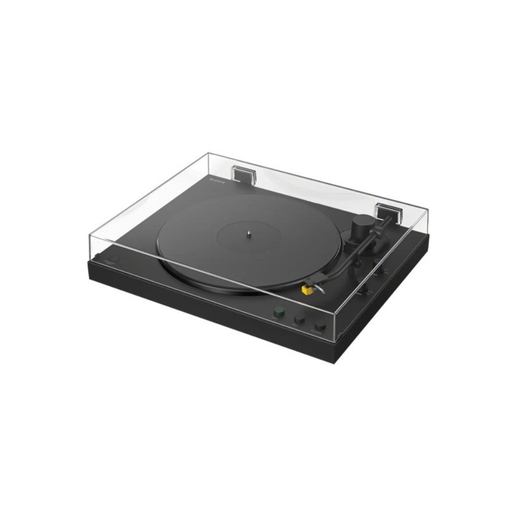 No image available
A fully automatic option to compare if automatic playback and wireless listening matter to you.
The product information lists belt drive, an aluminium platter, automatic tonearm return and Bluetooth. The built-in phono equaliser has a PHONO/LINE switch; 33⅓ and 45 rpm are listed.
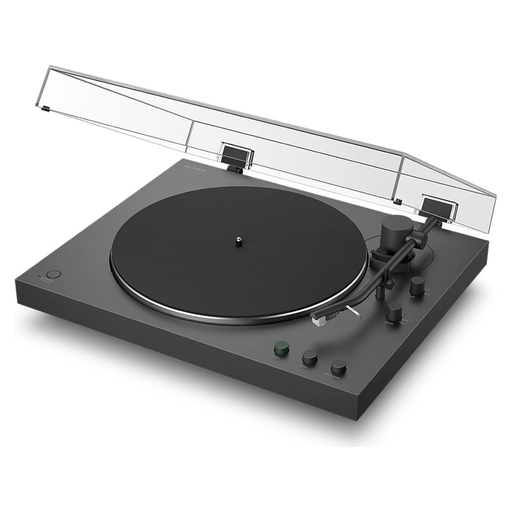 No image available
A fully automatic option if you want to listen wirelessly and also check that a wired connection is available.
The product information lists belt drive, an aluminium platter, automatic tonearm return and Bluetooth. The built-in phono equaliser has a PHONO/LINE switch; 33⅓ and 45 rpm are listed.
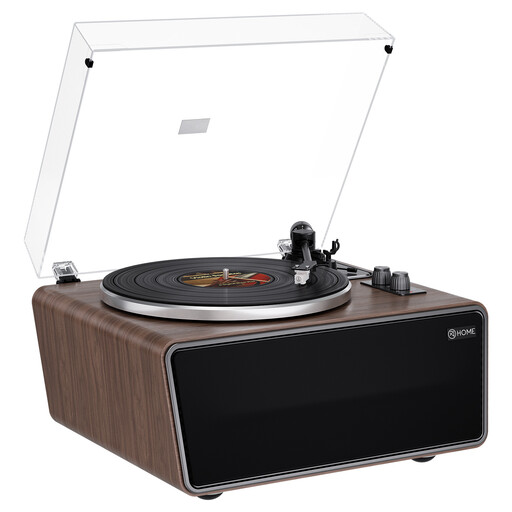 No image available
Worth considering if built-in speakers matter to you. RCA outputs are listed for connecting external speakers.
The product information lists four built-in speakers, Bluetooth, belt drive and 33⅓/45 rpm. It also lists an AT-3600L cartridge and RCA outputs.
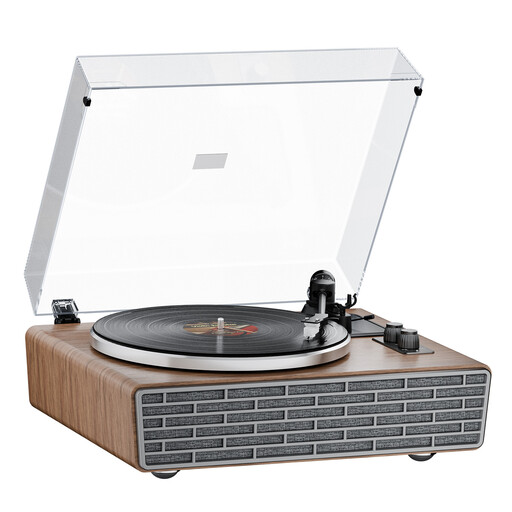 No image available
An option if you want built-in speakers and would also like to use Bluetooth or an RCA connection.
The product information lists four built-in speakers, Bluetooth, belt drive and an AT3600L cartridge. It also lists 33⅓/45 rpm and RCA Phono/Line outputs.
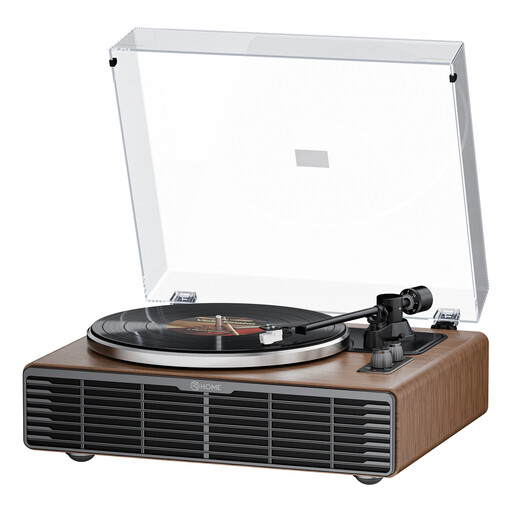 No image available
A model to compare if you want built-in speakers and also need an external RCA connection.
The product information lists four speakers, belt drive and an AT3600L cartridge. According to the product information, the turntable supports 33⅓/45 rpm and has an RCA Phono/Line output.
Yes. Check that the complete setup has phono pre-amplification, a suitable amplifier or active speakers, and the right input. A built-in phono preamp doesn’t automatically replace speakers.
First, check that the phono or line connection is set correctly, then look at the wiring and any earth connection on the components you’re using. Pro-Ject lists wiring and connections as common causes of hum; this doesn’t diagnose a specific device.
Follow the instructions for your specific cartridge when setting the tracking force. Ortofon recommends gently removing dust from the record before playing it, using a fine anti-static brush or cloth.
No. According to the Dutch Government, there is no fixed two-year period for the legal guarantee in the Netherlands. What you can expect from a product depends, among other things, on the product and the information provided. If something is wrong, contact the seller.
According to the Dutch Government, for many online distance purchases from a business, you have a 14-day cooling-off period. This rule doesn’t apply in the same way to an online purchase from a private seller, so check the terms of your specific purchase.