
Attentive classical music listener
You want to listen to long, sustained notes without distracting variations in speed, and are happy to take the time to set up and adjust your turntable.


Start by finding a stable spot with minimal vibration, then check that the turntable will connect to your existing audio system. A manually adjustable model gives you more control over the tonearm and cartridge; a fully automatic model takes less effort to use, but won’t on its own prevent vibrations from the floor or speakers.
You want to listen to long, sustained notes without distracting variations in speed, and are happy to take the time to set up and adjust your turntable.
You notice movement in the floor or furniture, so you need to think carefully about where to position your turntable and speakers.
You prefer automatic start-up and a straightforward connection to your existing system.
First decide where your turntable can stand securely and how you’ll connect it to your system. Then choose how much hands-on control you’d like.
| What to consider | What to look for | Who should consider this? |
|---|---|---|
| Consistent playback and adjustability | Check the speed control and whether you can adjust the tracking force and anti-skate. | If I listen closely to long notes, I want a turntable that can be set up to suit my needs. Around 33% of consumers rank consistent playback and adjustability as their top priority. |
| Vibrations and positioning | Assess the surface and consider where the speakers will go. Check the wall and its load-bearing capacity before mounting a wall bracket. | If my floor or furniture vibrates, I first look for a stable spot for the turntable. Around 27% of consumers put vibration control first. |
| Connection to your system | Check whether your amplifier has a PHONO input and whether your speakers are active or passive. | If I want to keep using my existing amplifier and speakers, the signal path needs to be compatible. Around 20% of consumers make system compatibility their top priority. |
| Controls and maintenance | Check whether the turntable starts and returns automatically, which stylus is compatible and what the manufacturer recommends for maintenance. | If I want to keep hands-on operation to a minimum, I look for automatic controls and check what stylus maintenance is needed. Around 20% of consumers put ease of use first. |
Movement from furniture or vibrations from nearby speakers can affect the stylus. A damping component won’t necessarily eliminate every vibration.
Decide where the turntable and speakers will go before you buy. Check the wall construction and its load-bearing capacity before choosing a wall bracket.
An unsuitable signal path can result in low volume or distortion. Passive speakers also need an amplifier.
Check your amplifier’s connections and the exact model. If you’re using a built-in phono preamp, don’t connect it to a PHONO input as well.
A very similar model name doesn’t guarantee that the features or design are the same.
Compare the full model number and the specifications of the version you want to buy.
The AT-LP120XUSB is a manually adjustable model, while the AT-LP70XBT is designed for automatic and wireless use.
The Debut Carbon EVO is a manual turntable with electronically switchable speed and damped, adjustable feet.
The DP-300F is a fully automatic model with a switchable built-in phono preamp.
According to Rega, the Planar 1 Plus has a built-in MM phono preamp for connection to a suitable line input.
The PS-LX310BT is a fully automatic model with Bluetooth and a PHONO/LINE switch.
These product choices focus on LP playback. The models listed support 33⅓ and 45 rpm and offer different control and connection options.
 No image available
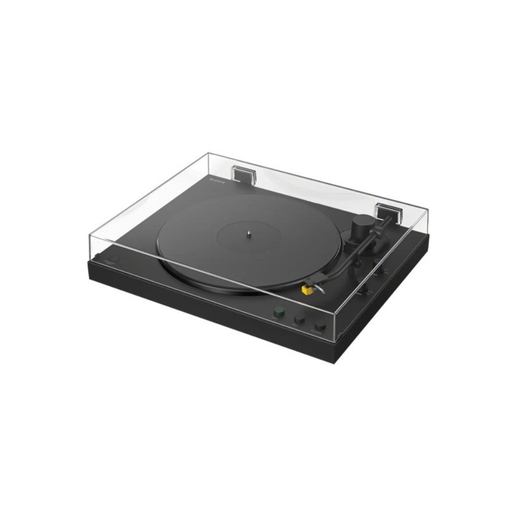
An option if you want automatic operation and the choice of a Bluetooth or wired connection.
The product description lists automatic belt drive, Bluetooth, PHONO/LINE and speeds of 33⅓ and 45 rpm. It also mentions a rigid chassis and internal damping; these are product claims, not independent measurements.
 No image available
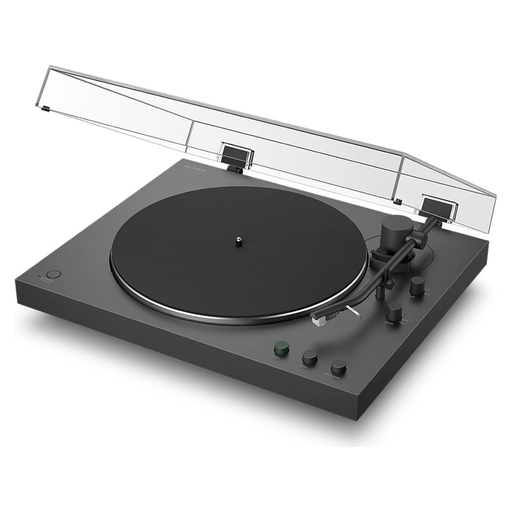
An option if you want automatic start-up and the choice of listening wirelessly or via PHONO/LINE.
The product description lists automatic belt drive, Bluetooth, a built-in phono equaliser with a PHONO/LINE switch, and speeds of 33⅓ and 45 rpm.
 No image available
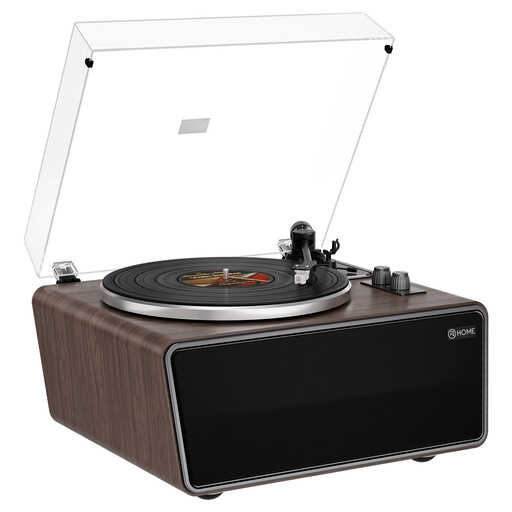
An option if you’re looking for built-in speakers and connections for external equipment.
The product description lists an AT-3600L cartridge, an adjustable counterweight, four built-in speakers and Phono/Line RCA outputs. The listed speeds are 33⅓ and 45 rpm.
 No image available
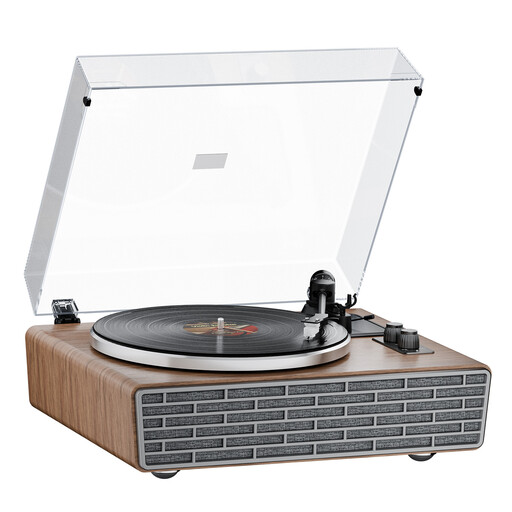
An option if you want Bluetooth, built-in speakers and connections for external audio equipment.
The product description lists belt drive, an AT-3600L cartridge, four built-in speakers and Phono/Line RCA outputs. The listed speeds are 33⅓ and 45 rpm.
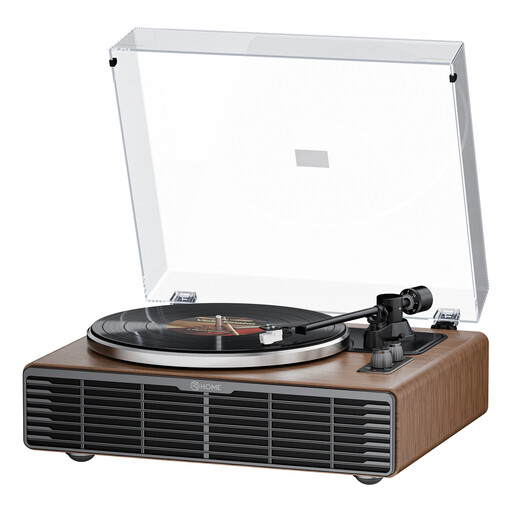 No image available
An option if you want to use built-in speakers and connect external equipment.
The product description lists belt drive, an AT3600L cartridge, four speakers and RCA Phono/Line outputs. The listed speeds are 33⅓ and 45 rpm.
First check whether your speakers are active or passive, and whether your amplifier has a PHONO or line input. Passive speakers need an amplifier. If your turntable has a built-in phono preamp, use the appropriate line connection rather than a PHONO input as well.
Check whether the floor, furniture or nearby speakers are causing the turntable to vibrate, then make sure it’s stable and level. A wall bracket may help with floor vibrations, provided it’s suitable for the wall and its load-bearing capacity. Pro-Ject describes different brackets for different types of wall.
Remove dust from the stylus according to the manufacturer’s instructions. If your tonearm is adjustable, set the tracking force and anti-skate according to the cartridge’s specifications. For a belt-drive model, follow the belt maintenance instructions.
For online purchases from a business, you’ll often have 14 days to change your mind; the Dutch government lists some exceptions. In the Netherlands, there’s no fixed term for the statutory guarantee: you’re entitled to a product that works properly, and you can report a fault to the seller. A manufacturer’s warranty doesn’t replace your statutory rights.