
Careful listener of classical LPs
Wants to play records with care, so pays attention to the tonearm, cartridge, correct speed and a stable surface for the turntable.


Choose a turntable that supports the speeds of your LPs and connects to your phono or line input. Also consider the amplification and speakers your living room needs. A built-in phono preamp or automatic tonearm lift can make certain tasks easier, while a manual model or one without a built-in preamp may need more adjustment or extra equipment. The turntable alone won’t determine how the whole room sounds.
Wants to play records with care, so pays attention to the tonearm, cartridge, correct speed and a stable surface for the turntable.
Needs to work out how to connect the turntable to phono preamplification, an amplifier and speakers. Consumentenbond points out that a standard turntable needs to be connected to an amplifier and speakers.
Wants to know how many steps are involved in changing speed and lifting or returning the tonearm at the end of a record.
First work out how the turntable will connect to your existing system. Then compare the controls and any additional components you may need.
| What to consider | What should you check? | Who should consider this? |
|---|---|---|
| Careful playback | Check the speeds of your records, the supplied cartridge, the tonearm lift and the cartridge adjustment instructions. | If I want to play classical LPs with care, I look at the cartridge and tonearm combination and make sure the speed is right. Around 36% of consumers put these considerations first. |
| Living-room connections | Check whether you have active or passive speakers, which amplifier and PHONO or LINE/AUX input are available, and where the turntable can sit securely. | I want the turntable to work well with the amplification and speakers I already own, and to be able to place it somewhere suitable. Around 29% of consumers prioritise a complete room setup. |
| Ease of use | Check how the specific model changes speed and whether the tonearm is returned manually or lifted automatically. | If I want fewer steps when changing speed or reaching the end of an LP, I compare the controls on each model. Around 21% of consumers focus mainly on this. |
| Total cost | Check which phono preamp, amplifier, speakers and replacement stylus you already have or still need. | I want to know in advance which components I’ll need in addition to the turntable, so I can assess the complete setup. Around 14% of consumers prioritise the total cost. |
A standard turntable is just one part of an audio system. Passive speakers also need an amplifier; Consumentenbond describes this connection as part of using a standard turntable.
Before choosing a model, list your equipment and inputs, then check which components you still need.
A phono preamp adjusts the signal for a line input, but it doesn’t replace the amplification that passive speakers need.
Check both the turntable’s PHONO/LINE setting and the type of speakers you have, as well as the amplifier available.
A spot with strong vibrations can affect playback. A large living room doesn’t, in itself, determine a minimum turntable specification.
Choose a firm, level surface and, where possible, keep the turntable away from speaker vibrations. Assess the setup in your own room.
Consumentenbond’s historical table includes Rega models from 2016, among others. These aren’t necessarily the same versions as the models currently on sale.
Check the exact model and cartridge version before using an older listing to assess a turntable currently on sale.
The Debut EVO 2 is a manual option for anyone putting together a separate hi-fi system.
The Planar 2 is a manual option for a system with suitable phono preamplification.
The AT-LP120XUSB is a manual, direct-drive option with a switchable phono preamp.
The SL-1500C is a direct-drive option with a built-in phono equaliser and tonearm lift.
The DP-400 is a semi-automatic, belt-drive turntable with a built-in phono preamp.
These Joybuy picks play records at 33⅓ and 45 rpm. Check each model’s speaker compatibility, connections and controls to see how they fit your system and listening space.
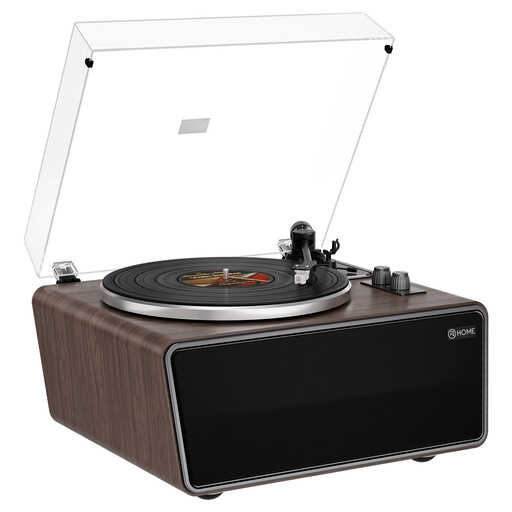 No image available
An option if you’re looking for a turntable with built-in speakers and a phono preamp.
The description lists 33⅓ and 45 rpm, an AT-3600L cartridge and a tonearm with adjustable counterweight. Check that the built-in speakers suit your listening setup; the number of speakers alone doesn’t tell you how well they’ll suit a large living room.
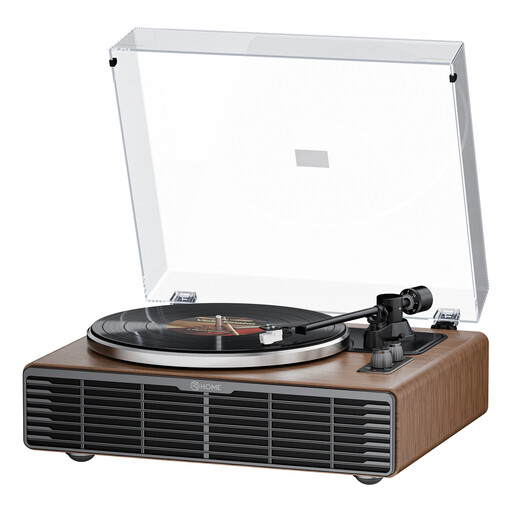 No image available
A good fit if Bluetooth and built-in speakers matter to you as well as playing LPs.
The description lists 33⅓ and 45 rpm, an AT3600L cartridge, four speakers, RCA Phono/Line outputs and a dust cover. Check that the available output is compatible with your amplifier or speakers.
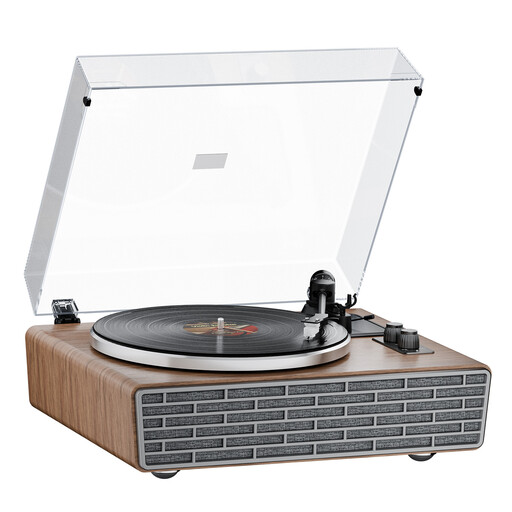 No image available
An option to compare if you’re looking for Bluetooth and built-in speakers.
The description lists 33⅓ and 45 rpm, an AT-3600L cartridge, four built-in speakers and RCA Phono/Line outputs. It also mentions a tonearm with a counterweight; check the connections and setup for your own system.
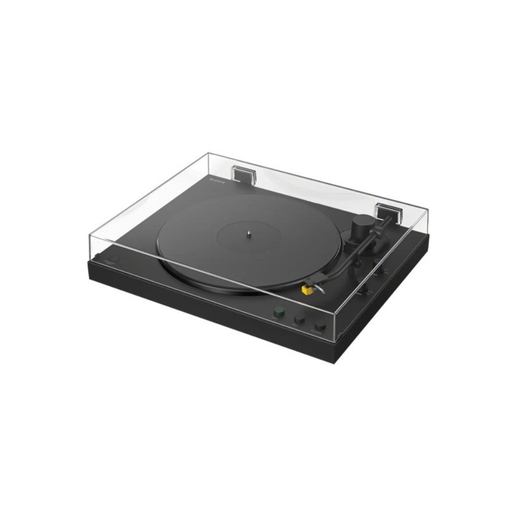 No image available
An option to consider if you’re looking for automatic operation.
The product description lists fully automatic operation, a PHONO/LINE switch, belt drive, an aluminium tonearm and an MM cartridge. It also lists 33⅓ and 45 rpm; check which input you use on your system.
It depends on your speakers and the signal chain. Active speakers have amplification built in; passive speakers need an amplifier. Also check that the phono signal passes through a built-in or separate phono preamp before reaching a line input.
Choose a firm, level surface and, where possible, avoid placing it right next to speakers. This helps limit strong vibrations around the turntable, but isn’t a guaranteed solution for every room.
Follow the manual for your exact turntable and the recommended tracking force for the cartridge you’re using. For example, the Rega manual gives instructions for the supplied Carbon cartridge; don’t automatically apply those settings to a different cartridge.
Check whether you already have phono preamplification, an amplifier and speakers, and which replacement cartridge is compatible with the exact model. According to the Rijksoverheid, if a product is faulty, the seller must offer an appropriate solution under the statutory guarantee; there is no fixed statutory guarantee period.
According to the Rijksoverheid, in many cases you have 14 days to change your mind when buying from a business at a distance, but there are exceptions. An online purchase from a private individual isn’t covered by the same distance-selling rules.