
Attentive classical music listener
Listens to whole sides of LPs while seated and is mainly looking for a suitable combination of turntable, stereo speakers and living room positioning.


First, choose a turntable that matches the phono or line input on your amplifier or active speakers. Then decide whether you want to operate the tonearm manually. For classical LPs in a large living room, your speakers, their positioning and the room acoustics all matter too. As the Consumentenbond and Genelec explain, a different turntable won’t automatically fix an unsuitable listening setup. A replaceable stylus gives you scope to make changes, while automatic operation can make listening easier.
Listens to whole sides of LPs while seated and is mainly looking for a suitable combination of turntable, stereo speakers and living room positioning.
Already has an amplifier or active speakers and wants to know which phono or line connection will work with them.
Wants to play classical LPs regularly without having to move the tonearm manually to the start and end of each side.
First, check that the connections work with your existing system and decide whether you want to operate the tonearm yourself. Then assess the speakers and listening position as part of the overall setup. According to the Consumentenbond, a standard turntable needs speakers and amplification, while Genelec explains that positioning and room acoustics also affect what you hear.
| What to consider | What should you check? | Who is this important for? |
|---|---|---|
| Playback and setup | Consider the speakers, the space available for stereo positioning and where you listen. | If I listen to whole LP sides in a large living room, I want the speakers and listening position to work well together. Around 36% of consumers put playback and setup first. |
| Connection | Check whether your amplifier has a PHONO or line input, and which output the turntable offers. | If you want to connect the turntable to an existing amplifier or active speakers, matching inputs are particularly important; around 29% of consumers put connection first. |
| Operation | Check whether the tonearm is operated manually, starts automatically or only lifts at the end of a side. | If I’d rather not move the tonearm myself each time, I look for controls that suit my listening routine. This is a top priority for around 21% of consumers. |
| Maintenance and upgrades | Check which stylus or cartridge is compatible with the exact model and what settings need adjusting when you replace it. | If stylus replacement or future upgrades matter to you, find out what the specific model supports; around 14% of consumers prioritise this. |
A turntable with speakers doesn’t remove the effect of your listening position, speaker placement or room acoustics.
Consider the complete playback setup and think about where the speakers and listening position can go in the room.
If you want to use a separate system, you may also need a suitable amplifier and a pair of speakers.
Phono pre-amplification is needed, but not every turntable or amplifier has it built in.
Check the available input and the setting of the switchable phono pre-amplifier before connecting your turntable.
If neither device provides the phono pre-amplification you need, you’ll need a separate phono pre-amplifier.
According to Audio-Technica, the correct speed alone isn’t enough for shellac records; you’ll also need a suitable 78 rpm stylus.
Check the record material and use the appropriate stylus.
Shellac records may require a separate, compatible stylus or cartridge.
The AT-LP120XUSB is a manual direct-drive turntable with a switchable phono pre-amplifier and replaceable VM95 styli.
The Debut EVO 2 is a manually set-up turntable with belt drive and an MM cartridge.
The SL-1500C combines direct drive, a supplied cartridge, a built-in phono equaliser and an automatic tonearm lift.
The DP-300F is a fully automatic turntable with a switchable phono pre-amplifier.
The PS-LX3BT offers fully automatic playback, built-in phono pre-amplification and Bluetooth for anyone who wants to use that connection.
These product options are turntables with built-in speakers. If you’re using one in a large living room, consider your listening position too, and check that the listed connections work with your system.
 No image available
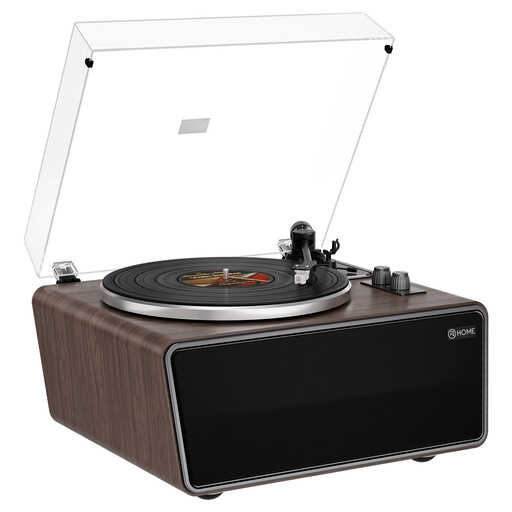
The built-in speakers may suit you if you’re looking for a single device with speakers. For a large living room, consider your listening position too.
The product title lists four built-in speakers, an AT-3600L (MM) cartridge and a phono pre-amplifier.
 No image available
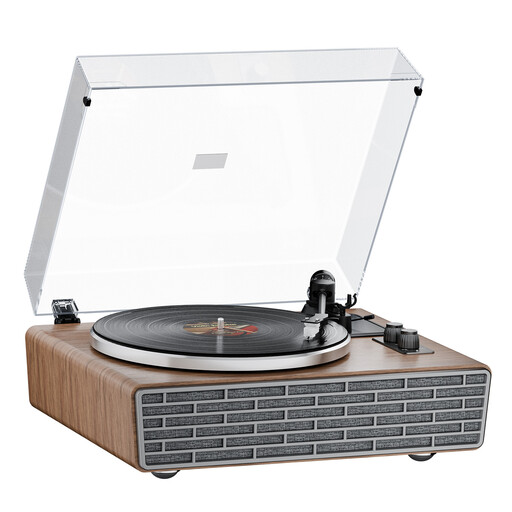
This model may suit you if you’re looking for a turntable with built-in speakers and Bluetooth. Check first that these connection options work with your listening setup.
The product title lists four built-in speakers, belt drive, an AT cartridge and a transparent dust cover.
 No image available
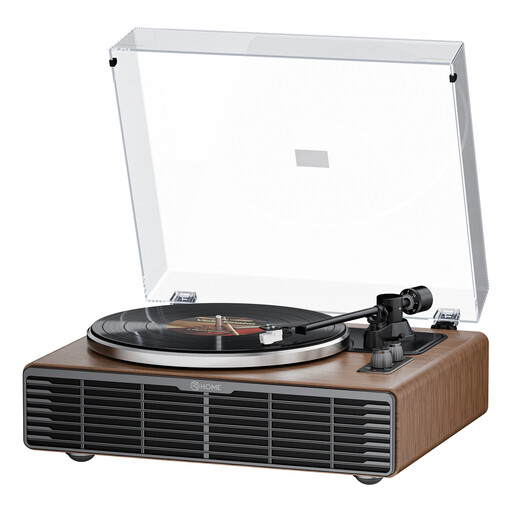
This model may suit you if you want built-in speakers and also want to check the listed RCA output against your system.
The product title lists four speakers, belt drive, an AT3600L cartridge and an RCA Phono/Line output.
No, but phono pre-amplification is necessary. It may be built into the turntable, the amplifier or a separate device. Before connecting anything, check the turntable’s output and the input on your system.
Start with the stereo speakers and listening position. Genelec explains that factors including distance from walls, left-right symmetry and reflective surfaces affect what you hear. The right positioning depends on the room, and studio monitor guidelines don’t guarantee the same results at home.
Not necessarily. Audio-Technica recommends a suitable 78 rpm stylus for shellac records. Check the record material and the stylus you need before playing it.
For consumer purchases, the product must comply with the agreement, and the retailer is your point of contact if something goes wrong. According to the Dutch Government, there is no fixed statutory guarantee period that applies to all products in the Netherlands. For eligible online consumer purchases, you generally have a 14-day cooling-off period. Check the terms and exceptions that apply to your purchase.