
People drying small loads
You usually dry part of a load and want to choose a capacity and programmes that suit your needs. Milieu Centraal often recommends 6 or 7 kg as sufficient for someone living alone or using the dryer infrequently.


Start with how much laundry you actually dry and the space you have: a 6 or 7 kg dryer may suit smaller, less frequent loads, while a larger model with a clearly stated small-load function is another option. Also check the dimensions and installation instructions, condensation efficiency and energy use per 100 eco cycles. A short programme isn’t automatically suitable for every fabric or load.
You usually dry part of a load and want to choose a capacity and programmes that suit your needs. Milieu Centraal often recommends 6 or 7 kg as sufficient for someone living alone or using the dryer infrequently.
You need to check whether the dryer can stand on its own or be safely stacked on a compatible washing machine, and whether there’s enough room to open the door and carry out maintenance. Bosch recommends placing the dryer on top of the washing machine, not the other way round.
You want to dry clothes indoors without making a poorly ventilated room unnecessarily damp. The Consumers’ Association warns that damp air in a room like this can encourage mould growth.
Measure the available space and work out the size of your usual load before comparing models. Then look at moisture management, energy use and the conditions for small-load programmes.
The percentages below show which buying concern may be a priority for consumers making this choice; the Consumers’ Association specifically warns about damp in poorly ventilated laundry rooms.
| What to consider | What should you check? | Who is this most relevant to? |
|---|---|---|
| Capacity and installation | Compare the drum capacity with your usual load, and check the appliance dimensions, door clearance and whether a compatible stacking kit is available. | If I mainly dry small loads, I want to know whether the drum and the installation will suit them. Around 33% of consumers prioritise suitable capacity and installation. |
| Damp in the laundry room | Check the condensation efficiency and the room’s ventilation. | In a small or poorly ventilated room, I want to prevent moisture building up. Around 27% of consumers give moisture management top priority. |
| Energy use | Compare the kWh per 100 eco cycles on the same programme basis, and factor in how often you dry clothes. | If the dryer runs regularly, I want to compare its energy use with how often I use it. Around 27% of consumers prioritise energy use. |
| Drying time and laundry | Check the permitted load and fabrics for the short programme, and follow the care labels. | When I want to dry small loads quickly, the programme still needs to suit the amount and type of fabric. Around 13% of consumers give a suitable quick programme top priority. |
As well as the energy rating, you can compare energy use per 100 drying cycles using the eco programme on the energy label, as Energielabel.nl explains. This figure doesn’t predict the energy use for your small load or a short programme.
Capacity and external dimensions are two different things. If you plan to stack the appliances, you’ll also need to check they’re compatible.
Measure the space and the doorway the appliance needs to pass through. Before buying, check the installation instructions and make sure a stacking kit is suitable for these exact appliances.
If safe stacking is required, you may also need a compatible stacking kit or an installation service.
The energy rating doesn’t give you all the information you need to compare models. The label also shows energy use in kWh per 100 eco cycles, but this isn’t an exact measure of how much energy your small loads will use.
Compare the kWh figures on the same programme basis and factor in how often you use the dryer.
Ventilation matters even with a condenser dryer. The Consumers’ Association warns that damp air in a poorly ventilated laundry room can encourage mould growth.
Check the model’s condensation efficiency and assess the ventilation in the space where you plan to put it.
Load size and fabric requirements can vary from one model and programme to another.
Check the programme load limits for the specific model and the garment care labels before making drying time your deciding factor.
These examples show the model-specific features you can compare. They aren’t an assessment of the brand as a whole and don’t indicate availability.
The BM3T3722B is a 7 kg heat pump tumble dryer for anyone comparing a smaller capacity with the space available for installation.
The WQG133DBNL is an 8 kg heat pump tumble dryer with features specifically described for smaller loads.
The 7000 SensiDry TR7E86BB4 is an 8 kg heat pump tumble dryer with a programme for smaller loads described by AEG.
The TWC640WP is an 8 kg heat pump tumble dryer for anyone weighing up the controls and features against the space available.
This selection features 8 or 9 kg heat pump tumble dryers. Compare their dimensions and programme requirements with your usual small load and the space available.
 Image unavailable
An option to compare with your small loads if you’re looking for an 8 kg heat pump tumble dryer with several short programmes.
The product information lists six short programmes, Wi-Fi (hOn) and an energy rating of C. The instructions require ventilation and at least 5 cm of clearance around the appliance.
 Image unavailable
This 8 kg heat pump tumble dryer is worth considering if you want to check its stated dimensions against your available space first.
The product information lists dimensions of 85 × 60 × 60 cm, 15 programmes, a sensor and a drum volume of 90 litres. The instructions require a stable, level surface and adequate ventilation.
 Image unavailable
An 8 kg heat pump tumble dryer to compare if you’re weighing up different drying times for small loads.
The product information lists Auto Dry, Quick Dry, Time Dry and a 3-in-1 filter. Check the programme descriptions for the load you want to dry.
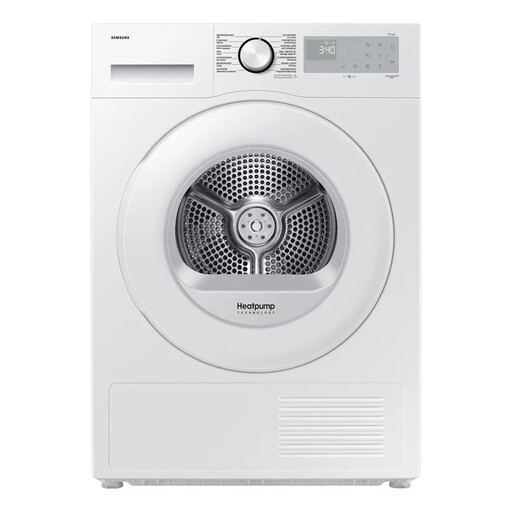 Image unavailable
With a capacity of 9 kg, this model is mainly worth comparing if you want room for larger loads as well as small ones, and have enough space to install it.
The product information lists 105 kWh per 100 cycles, condensation efficiency class B and dimensions of 85 × 60 × 60 cm. The instructions require a level surface and adequate ventilation.
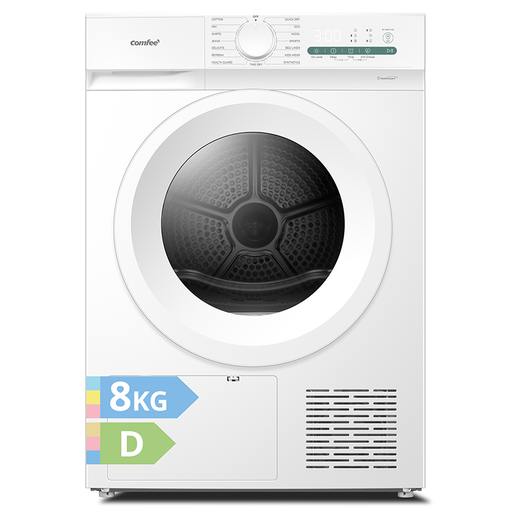 Image unavailable
An 8 kg heat pump tumble dryer to consider if you want to compare several programmes and drying levels.
The product information lists UV light, a two-layer fluff filter and three adjustable drying levels.
Only if the appliances and stacking kit are suitable for that combination. Bosch recommends placing the dryer on top of the washing machine, not the other way round. Check the instructions for both models before stacking them.
Keep the filter and water tank accessible. Bosch recommends cleaning the fluff filter after every use on dryers without Auto Clean; follow your model’s manual for the heat exchanger and other parts.
No. According to ACM ConsuWijzer, your statutory rights are separate from a retailer’s or manufacturer’s warranty. If a product used normally develops a fault sooner than you could reasonably expect, the retailer is responsible for providing an appropriate solution at no extra cost. There isn’t one fixed statutory warranty period for every tumble dryer.
No, not across the board. The European Commission says the new EU requirements apply to new appliances placed on the market from 1 July 2025, not to existing shop stock that was already on the market before that date. Milieu Centraal also says that mini dryers with a capacity of up to and including 3 kg are exempt from the new minimum energy performance requirement.