Who is this relevant to?

You often have a small cotton load

You don’t want to wait until the drum is full, and you’re looking for a cotton programme that senses when clothes are dry. The Consumers’ Association sets out test criteria for cotton; a half-load option on its own is no guarantee of a shorter or more energy-efficient cotton programme.

You dry clothes often and want to factor in energy use

You want to compare ongoing electricity use across the programmes you actually use. Check the current EU energy label, and only compare consumption figures when the programme and load are the same; since 1 July 2025, the EU has used the A–G scale for household tumble dryers.

You have a small utility room

You’re considering the dimensions, condensation and ventilation, as well as how the condensed water is drained. Milieu Centraal highlights that ventilation helps remove moisture from indoor air.

What matters when drying small cotton loads?

Heat pump dryer with a small-load option

A good fit if: you often want to dry a small cotton load straight away. Check that moisture sensing and the half-load option are available for cotton too.

Keep in mind: a quick programme for synthetics or lightweight fabrics won’t tell you how long cotton takes to dry.

Heat pump dryer with a sensor

A good fit if: you can sometimes combine small loads. Compare the results for cotton, energy use and where you’ll put the dryer.

Keep in mind: check the programme duration for the load you use; the maximum capacity won’t tell you how long it takes.

Washing line or clothes airer

A good fit if: you don’t need the laundry to be dry straight away and you have the time and space.

Keep in mind: drying clothes indoors adds moisture to your home; Milieu Centraal recommends ensuring adequate ventilation.

What to consider What to look for Who should consider this?
Cotton on small loads Check the cotton programme, the required dryness level and moisture sensing. See whether a half-load option is explicitly available for cotton. If I want to dry small cotton loads straight away, I need to know whether the programme is designed for them; around 31% of consumers prioritise evenly dried cotton.
Electricity use Compare the current energy label and consumption figures for the same programme and a similar load. If I dry clothes often, I want to compare the energy use of my usual programme; around 25% of consumers prioritise ongoing electricity use.
Moisture and where the dryer will go Check condensation efficiency, the appliance and installation dimensions, ventilation options and whether it can be connected to a drain. In a small utility room, I want to know whether the dryer will fit and how moisture and condensed water are dealt with; around 25% of consumers prioritise moisture control and placement.
Drying time and maintenance Compare the cotton programme duration for a suitable load, and check how to maintain the fluff filter and water tank. If I dry clothes often, I want to plan my laundry without overlooking regular maintenance; around 19% of consumers prioritise time and maintenance.

Common buying mistakes

  • Assuming a 40-minute programme is for cotton

    Bosch describes the programme mentioned for the WQG233DLNL as being for small loads of synthetics and lightweight fabrics. So its duration doesn’t tell you how long a cotton load takes.

    Check the programme description and compare the cotton programme duration separately.

  • Assuming the energy-label figure applies to every small load

    The Consumers’ Association tests energy use on specific programmes and loads. The label figure won’t necessarily match the energy used for your small cotton load.

    Only compare figures for the same programme, a similar load and the same dryness level.

  • Assuming a self-cleaning condenser means no maintenance

    A self-cleaning condenser doesn’t mean you can ignore the fluff filter. The Consumers’ Association recommends cleaning the filter after every drying cycle.

    Check how to access the filter and water tank, and follow the manual for condenser maintenance.

  • Looking only at the dimensions

    Condensation efficiency and ventilation also matter when you’re putting a dryer indoors. Milieu Centraal highlights the importance of ventilation to remove moist air.

    Check the installation instructions and make sure the room can be ventilated properly.

Brands and models to compare

Bosch

The WQG233DLNL is an 8 kg heat pump dryer worth comparing if you’re looking for moisture sensing and an option for small loads.

  • Bosch lists moisture sensing and a half-load option for this model.
  • According to Bosch, the 40-minute programme mentioned is for small loads of synthetics and lightweight fabrics, not an indication of drying time for cotton. No self-cleaning condenser is listed for this model.

LG

The RHX1008NWH is an 8 kg heat pump dryer worth comparing if sensor control and condenser maintenance are important to you.

  • LG lists Sensor Dry and a self-cleaning condenser for this model.
  • These features don’t prove that small cotton loads will dry better or that the fluff filter needs no maintenance.

AEG

The T73DR8P4O is an 8 kg heat pump dryer with stated programme durations for the eco programme.

  • AEG lists a duration of 2:49 for a full load and 1:40 for a partial load on the eco programme.
  • These times apply to that eco programme; they aren’t fixed drying times for a small cotton load on a different programme.

Beko

The BM3T3823WMM is an 8 kg heat pump dryer with a drying sensor; its stated dimensions may be useful if you have a compact utility room.

  • Beko lists a depth of 54,5 cm and a noise level of 64 dBA.
  • Beko lists energy class D on the EU scale that has applied since 1 July 2025. These model specifications aren’t an independent measure of its performance on small cotton loads.

Tumble dryers at Joybuy

This selection features heat pump dryers for anyone who values sensor-controlled drying and finding the right option for cotton. Check whether each model’s programme for small cotton loads suits the way you do your laundry.

Candy BR 8N3BX-S heat pump dryer, 8 kg, energy class C

Candy BR 8N3BX-S, 8 kg

The listed moisture sensor makes this model worth considering if you’re looking for automatic moisture control; check which cotton programme is suitable for small loads.

Heat pump dryer; 8 kg; energy class C; Wi-Fi (hOn).

View at Joybuy

Haier HD80-C367U1-DF heat pump dryer, 8 kg, energy class C

Haier HD80-C367U1-DF, 8 kg

The listed moisture sensor and cotton capacity are worth considering if you dry cotton; compare the programme and load with your usual small washes.

Heat pump dryer; 8 kg; energy class C.

Stated condensation efficiency is 91%, class B.

View at Joybuy

Midea MD205H80WB/W-NL heat pump dryer, 8 kg, energy class C

Midea MD205H80WB/W-NL, 8 kg

The listed sensor control is worth considering if you’re looking for automatic drying; check which fabrics the Quick Dry programme is designed for.

Heat pump dryer; 8 kg; energy class C; 30-minute Quick Dry programme.

View at Joybuy
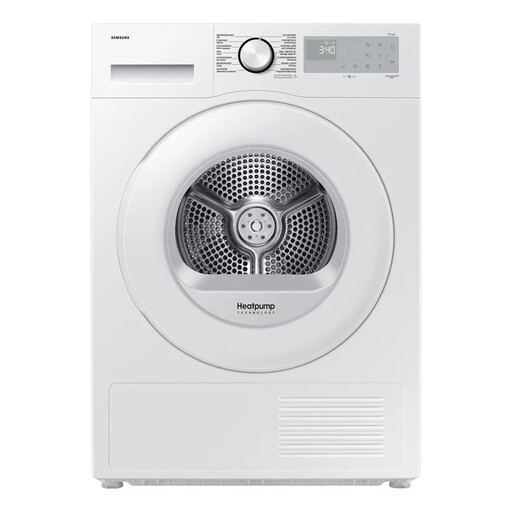
Samsung DV9UDG52A0THEN freestanding heat pump dryer, 9 kg

Samsung DV9UDG52A0THEN, 9 kg

The stated Optimal Dry system monitors the laundry; check which cotton programme and load suit small washes.

Freestanding heat pump dryer; 9 kg; energy class C.

The stated condensation class is B.

View at Joybuy
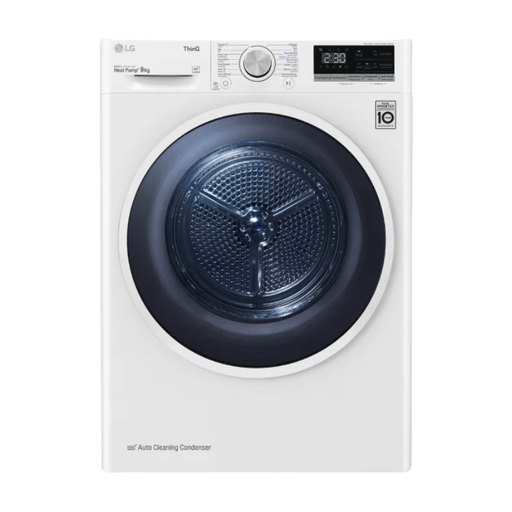
LG RH90V5AV6N heat pump dryer, 9 kg, with Sensor Dry and a self-cleaning condenser

LG RH90V5AV6N, 9 kg

Sensor Dry and the self-cleaning condenser are worth considering if you’re looking for these features; the fluff filter still needs maintenance.

Heat pump dryer; 9 kg; Sensor Dry; self-cleaning condenser.

View at Joybuy

Frequently asked questions

Does a 40-minute programme mean my cotton load will be dry in 40 minutes?

No, you can’t assume that. Bosch describes the WQG233DLNL programme as being for small loads of synthetics and lightweight fabrics. For cotton, compare the relevant programme and its drying time.

What do I need to maintain after every drying cycle?

Clean the fluff filter after every cycle and empty the water tank, unless the dryer is connected to a drain. The Consumers’ Association recommends cleaning the filter after every drying cycle; follow the model’s manual for condenser care.

Do I need an exhaust hose to the outside for a utility room in winter?

A heat pump dryer doesn’t automatically need an exhaust outlet to the outside. Do pay attention to condensation efficiency and ventilation; Milieu Centraal recommends ventilating the room to remove moist air. A connection to a drain carries away condensed water, but check that the model and room are suitable for this.

Which energy label should I compare when buying?

Compare the A–G label introduced for household tumble dryers on 1 July 2025, as explained by the European Commission. An older rating such as A+++ isn’t directly equivalent to a class on the updated scale. The label is useful for comparisons, but it doesn’t show how much energy your small cotton load will use.

Does a two-year manufacturer’s warranty cover the full statutory guarantee in the Netherlands?

No. According to the Dutch government, there is no fixed statutory guarantee period in the Netherlands; you’re entitled to a product that is fit for purpose, based on what you could reasonably expect. If something goes wrong, contact the seller. A manufacturer’s warranty or extended warranty is in addition to your statutory rights.
