
Regular towel dryer
You dry towels often or in large quantities and want the drum capacity and energy use to suit the loads you actually run.


For drying towels regularly in a shared utility room, choose a heat pump tumble dryer with a capacity suited to your usual load. Milieu Centraal recommends 8 or 9 kg for more frequent use. Then compare the current energy label, including energy consumption, noise and condensation efficiency, and check the room’s ventilation and drainage options. You don’t necessarily need extra capacity if you usually dry smaller loads.
You dry towels often or in large quantities and want the drum capacity and energy use to suit the loads you actually run.
You share the space and want to take noise and moisture into account, so your use causes as little disruption as possible.
You agree with other users on who empties the reservoir and cleans the filter, and whether the condensate can be drained away.
| What to consider | What should you check? | Who should pay particular attention? |
|---|---|---|
| Capacity and drying results | Load capacity and a suitable programme for towels; check that the drying level is right for your fabrics. | If I often dry larger loads of towels, I want a drum that suits them, not simply the highest capacity on paper. Around 25% of consumers put capacity and evenly dried towels first. |
| Moisture in the room | Condensation efficiency on the energy label, ventilation, and how easy it is to access the reservoir or drain. | In a shared or poorly ventilated utility room, I want to limit how much moisture gets into the space. Around 25% of consumers prioritise keeping moisture to a minimum. |
| Noise | The stated noise level in dB(A) and the dryer’s location in relation to other users. | If others use the utility room or an adjoining room, I want to consider noise alongside capacity and drying results. Around 19% of consumers put keeping a shared space quiet first. |
| Energy use and drying time | Compare kWh per 100 eco cycles and the eco cycle duration; also consider the programme you actually use. | If I dry regularly, I want to weigh up electricity use against how long the shared dryer will be occupied. Around 19% of consumers prioritise running costs and drying time. |
| Shared maintenance | Check how to access the filter and reservoir, what maintenance instructions apply, and whether a drain connection is possible. | If several people use the dryer, I want everyone to know who looks after the filter and reservoir after each cycle. Around 12% of consumers put easy shared maintenance first. |
The energy consumption figure and programme duration on the energy label relate to the eco programme. Results may differ with the programme you use to dry towels.
Compare the energy class, kWh per 100 eco cycles and eco cycle duration on the same label basis. Where available, also check information about the programme you intend to use.
An eco programme may take a different amount of time from the programme that suits your needs.
Condensation efficiency varies by model. In a poorly ventilated room, humid air can cause problems.
Check the condensation efficiency on the energy label and assess the ventilation in the area where you plan to put the dryer.
A condensate drain requires a suitable model and a suitable drainage point. Cabinet depth alone won’t tell you whether the appliance will fit in the space available.
Before ordering, check the installation instructions for the exact model, the space needed for the door and the connection options.
A drain hose may be an extra part; you may also need to adapt the installation area.
The WQB246CENL is a Dutch-market model with a 9 kg capacity and a towel programme.
The TR868B4B is an 8 kg heat pump tumble dryer for those who find that capacity suitable.
The BM3T3823WMM is an 8 kg heat pump tumble dryer with a stated depth of 54.5 cm.
The TEA528WP 8kg Active is an 8 kg T1 heat pump tumble dryer.
This selection includes 8 or 9 kg heat pump tumble dryers for drying towels regularly. Check that each model’s capacity and practical connections suit your utility room.
 No image available
The 8 kg capacity is worth comparing if you dry towels regularly.
Listed specifications: energy class C, 91% condensation efficiency and 62 dB(A). The product information specifies R290, a flammable refrigerant, and installation in a well-ventilated room of at least 4 m²; follow the stated safety requirements. The door is not reversible.
 No image available
The 9 kg drum and stated towel programme are worth considering if you regularly dry larger loads of towels.
The product information lists a self-cleaning condenser and 61 dB. The stated energy class B is marked as “German panel”.
 No image available
An 8 kg capacity gives you a useful comparison point if you dry towels regularly and find this load size suitable.
Listed specifications: energy class E and 64 dB(A).
 No image available
The 8 kg capacity gives you a specific size to compare with your usual towel load.
Listed specification: energy class E. The product information mentions automatic moisture detection and a 3-in-1 filter.
 No image available
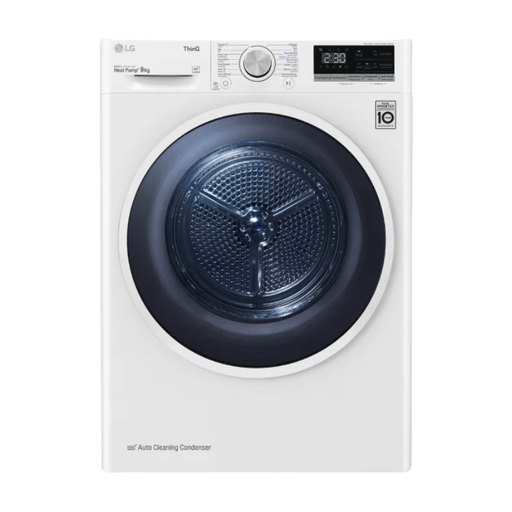
The 9 kg capacity is worth comparing if you often dry larger loads of towels.
Listed specifications: energy class D, 64 dB, condensation class B and a self-cleaning condenser.
Since 1 July 2025, the Dutch energy label for tumble dryers has run from A to G, according to Energielabel.nl and Kenniscentrum Duurzaam Leven. The label includes energy consumption per 100 eco cycles; don’t compare old A+++ ratings as if they were on the same scale.
A vented tumble dryer needs an external vent, while a condenser or heat pump tumble dryer does not need an external air vent, according to the European Commission. The collected water goes into a reservoir or, if the model and installation area are suitable, through a condensate hose to a drain; check the installation instructions.
Agree on who empties the reservoir and cleans the filter according to the instructions. Brandweer Nederland advises cleaning the filter after every drying cycle because built-up fluff is a fire risk; for models with a cleaning function, also follow the manufacturer’s instructions.
If a product does not meet the terms of the agreement, the seller in the Netherlands must offer a solution, according to the Dutch Government. There is no fixed statutory warranty period of two years. For distance purchases, you also usually have a 14-day cooling-off period; exceptions and conditions may apply.