
Commuter who needs towels ready again quickly
You want to know whether thick towels will be dry after a wet commute when you need to use them again. To find a dryer suited to your load, compare both the drying results and the programme duration.


If you regularly dry thick towels, a heat pump tumble dryer with a capacity suited to your usual load is one option. Assess drying results and drying time separately, rather than looking at the energy label alone. Also check the model’s dimensions, water drainage and maintenance instructions. Line drying may be enough if you don’t need the towels again straight away.
You want to know whether thick towels will be dry after a wet commute when you need to use them again. To find a dryer suited to your load, compare both the drying results and the programme duration.
You regularly dry several towels and want to weigh up capacity against electricity consumption over repeated use.
You want to know whether the dryer will fit, and whether you’ll need to collect condensed water in a tank or can connect the model to a suitable drain. Check the options available on the version you’re considering.
First, check that the dryer suits your towel load and the space where you’ll install it. Then compare drying results, time, energy use and how much maintenance you’re happy to do yourself.
| What to consider | What to check | Which consumers |
|---|---|---|
| Getting thick towels dry | Compare drying results and residual moisture. Check the care label, and dry thick towels separately from lighter clothes if necessary. | If I want thick towels to be dry all over when the programme ends, I look beyond the programme name. Around 28% of consumers prioritise drying results. |
| Using towels again in time | Compare drying times under the same test conditions and check what load a short programme is designed for. | When I need the towels again quickly, I want to know how long the right load takes and how dry it will be. Around 22% of consumers prioritise being able to reuse towels in time. |
| Electricity use when drying regularly | Compare current EU energy labels and consumption figures on the same basis; weigh running costs against the purchase price. | For regular drying, I want to consider electricity use as well as the purchase price. Around 22% of consumers prioritise running costs. |
| Installation and water drainage | Measure the space and access route. Check the dimensions and whether the model supports connection to a suitable drain. | If the laundry space is limited, I want to know in advance whether the appliance will fit and how the condensed water is drained. Around 17% of consumers prioritise installation and drainage. |
| Filter and maintenance | Check how to clean the lint filter and what instructions apply to the condenser and moisture sensor. | I want to know what maintenance is still needed after use, even if the model has a self-cleaning condenser. Around 11% of consumers prioritise maintenance. |
The programme name doesn’t automatically tell you what load it’s designed for or how much residual moisture will be left.
Check the maximum load and, where possible, compare drying results and programme duration under the same conditions.
If you need to run an additional drying cycle, it may also take more time and use more electricity.
The EU energy label scale for tumble dryers has changed, so the old and new ratings aren’t directly comparable.
Compare current labels and consumption figures on the same basis. The European Commission says the revised A to G scale applies to the display of tumble dryer labels from 1 July 2025.
Connections and condenser maintenance vary by model. A self-cleaning condenser doesn’t remove the need to clean the lint filter.
Check the manual for the exact version for details about drainage, any required hose and maintenance. Clean the lint filter as instructed.
The European Commission says the measures that apply from 1 July 2025 don’t apply retrospectively to appliances that were already placed on the EU market before that date.
Assess an existing dryer separately for its condition, safety and running costs before deciding whether it needs replacing.
These examples can help you compare model specifications with your own laundry, space and maintenance needs; they aren’t general assessments of the brands.
The Dutch BM3T3824W and BM3T3722W are heat pump tumble dryers with capacities of 8 kg and 7 kg respectively.
Bosch describes the WQG233DLNL as a Series 6 heat pump tumble dryer with an 8 kg capacity and continuous moisture monitoring.
Samsung describes the DV90DG52A0ABEN as a heat pump tumble dryer with a 9 kg capacity.
AEG lists the TR868B4B as an 8 kg heat pump tumble dryer with energy class B.
Siemens describes the WQ46B2CENL as a heat pump tumble dryer with a 9 kg capacity, moisture sensor and self-cleaning condenser.
These heat pump tumble dryers are examples to help you weigh up capacity, sensor drying, programmes and maintenance for regular towel loads. Check which load each programme is designed for on the model you’re considering.
 No image available
The stated capacity may be useful for regular towel loads; match the load to the programme you choose.
The product description mentions a moisture sensor and a towel programme, but doesn’t provide comparable measured drying results for thick towels.
The title lists energy class C. According to the description, the 30-minute programme is intended for small amounts of lightly damp laundry, not a full load of towels.
 No image available
The stated 9 kg capacity may suit larger loads; check the programme limit for towels.
The product information mentions AutoDry and a towel programme. These are features, not measured drying results for a full load of towels.
The description lists a self-cleaning condenser, but also says the lint filter needs cleaning after every cycle.
 No image available
The stated capacity and sensor feature are worth considering when matching a regular towel load to a programme.
The product title lists energy class C; the description mentions sensor drying.
According to the description, the 30-minute programme is limited to small amounts of lightly damp laundry, not a full load of towels.
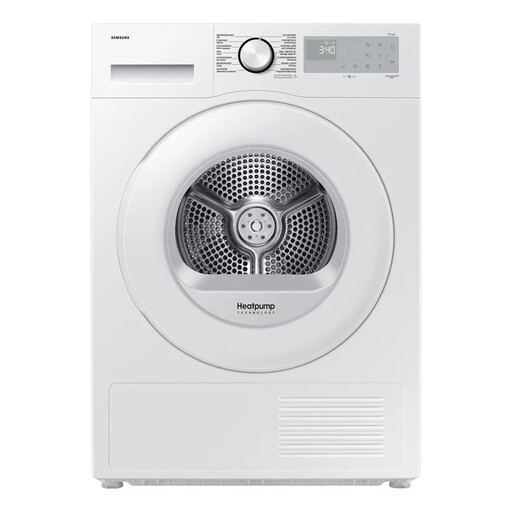 No image available
The stated 9 kg capacity may suit larger loads; check the load size for the programme you want to use.
The description mentions the Optimal Dry system and lists energy class C and 105 kWh per 100 cycles.
According to the product information, the lint filter needs cleaning after every drying cycle, and the condenser should be checked and cleaned regularly.
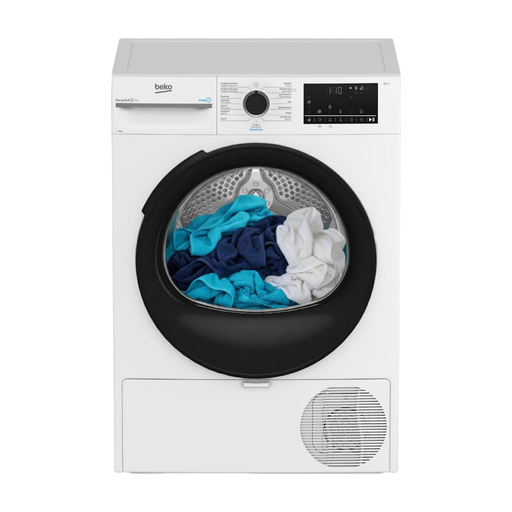 No image available
The stated 8 kg capacity may be useful for regular towel loads; check the load size for the programme you choose.
The title lists energy class C, and the product specifications state 95 kWh per 100 cycles.
The product description lists the dimensions and a remaining-time indicator; measure the available space and access route before buying.
Only if the care label allows tumble drying and you follow the use and safety instructions. Don’t put textiles that have come into contact with oil, solvents, wax, grease or paint in the dryer. Choose a programme suitable for the towels and check that they’re actually dry.
Many heat pump tumble dryers collect water in a tank. Some models can also be connected to a suitable drain; check the manual for the version you’ve chosen, and bear in mind that an extra hose may sometimes be needed.
Clean the lint filter as instructed, usually after every drying cycle, and empty the tank if it isn’t connected to a drain. Follow the model’s manual for the condenser and moisture sensor; a self-cleaning condenser doesn’t replace filter maintenance.
Not directly. The European Commission says that from 1 July 2025, the revised EU A to G scale is displayed on tumble dryer labels. So compare labels and consumption figures on the same basis.
No. According to the Dutch government, there is no fixed statutory warranty period in the Netherlands: what you can expect from a product of satisfactory quality depends, among other things, on the product and the circumstances. If there’s a fault, contact the seller; a manufacturer’s warranty is in addition to your statutory rights.