If you regularly share drying loads, it’s worth comparing heat pump tumble dryers. According to Milieu Centraal, they generally use less electricity than older models without a heat pump, but usually cost more to buy. Bear in mind that heat pump tumble dryers can take longer to dry clothes, according to the Consumentenbond. If you only dry clothes occasionally, an airer may be enough, provided your home has sufficient space and ventilation.
Who is this relevant for?
Housemates with lots of shared laundry
The right capacity and clear agreements can make regular drying loads easier to manage. The Consumentenbond recommends cleaning the fluff filter after every drying cycle, so agree on who will take care of the maintenance.
Students who share electricity costs
Milieu Centraal points out that heat pump tumble dryers are cheaper to run, but generally cost more to buy. So compare the current energy label with your expected use and electricity tariff.
People with little space for laundry
Measure the space available and check the installation instructions, condensate drainage and stated noise level. The Consumentenbond notes that condensation performance can vary between tumble dryers.
What should you consider when choosing?
Shared heat pump tumble dryer
Suitable if: housemates regularly dry cotton laundry and there’s a suitable place for the appliance.
Bear in mind: it generally costs more to buy than older drying technologies and may take longer to dry clothes; filters and condensate need regular maintenance.
Airer with sufficient ventilation
Suitable if: you don’t dry clothes very often and there’s enough space and ventilation to dry laundry indoors.
Bear in mind: drying clothes indoors adds moisture to the air; insufficient ventilation can lead to damp and mould.
Keep your existing tumble dryer or consider buying second-hand
Suitable if: you already have a condenser or vented tumble dryer, or you’re considering a second-hand appliance.
Bear in mind: according to Milieu Centraal, older models without a heat pump generally use more electricity than heat pump tumble dryers; assess running costs, condition and maintenance separately.
| What to consider |
What should you check? |
Who is this important for? |
| Electricity use and costs |
Compare the current A–G label and energy consumption on the same basis; calculate costs using your own electricity tariff and usage. |
If we use the tumble dryer together often, I want to know how its energy use will affect our shared bill. Around 33% of consumers are most concerned about running costs. |
| Capacity and agreements |
Compare the maximum load capacity with the loads you actually plan to dry together, and agree on who will look after the filter and condensate container. |
If housemates want to use the dryer one after another, I want its capacity and maintenance arrangements to suit our laundry routine. Around 27% of consumers focus mainly on shared capacity and usage agreements. |
| Installation, condensate and moisture |
Measure the space and access route; check the installation instructions, condensate drainage and ventilation. |
With limited space, I want to know in advance whether the tumble dryer will fit and how the condensate will be drained. Around 20% of consumers prioritise installation and moisture. |
| Noise and drying time |
Compare stated noise levels on the same basis and check the length of the cotton programme, not just a quick programme. |
If the tumble dryer is close to a living room or bedroom, I want to take noise and cycle planning into account. Around 20% of consumers prioritise quiet operation and cycle times. |
Since 1 July 2025, the current A–G energy label scale has applied to household tumble dryers sold in shops and online, according to the European Commission. So don’t compare old A+++ labels directly with the current letter grades.
Common buying mistakes
-
Comparing an old A+++ label directly with the current A–G label
The scale changed on 1 July 2025. The European Commission says that since then, shops and online retailers have had to display the new A–G scale for household tumble dryers.
Use the current EU label and compare energy consumption on the same labelling basis.
-
Looking only at the purchase price
According to Milieu Centraal, a heat pump tumble dryer is generally cheaper to run than older models without a heat pump, but usually costs more to buy. Your decision will also depend on how often you dry clothes and your electricity tariff.
Compare the purchase price with your household’s expected usage and electricity tariff.
-
Assuming a tumble dryer will automatically solve damp problems
Drying clothes indoors adds moisture to the air. The Consumentenbond also warns that some tumble dryers release moist air into the room.
Check the ventilation, condensation performance and installation requirements before putting a tumble dryer in a small utility room.
-
Buying a shared appliance without agreeing on maintenance
The fluff filter and, depending on the model and connection, the condensate container need regular attention. The Fire Service recommends removing fluff from the filter after every use.
Agree on who will clean the filter after every cycle and empty the condensate container when needed.
Brands to compare for this choice
Beko
The BM3T3824W is a heat pump tumble dryer with an 8 kg drying capacity and a drying sensor. These specifications may be useful for shared use.
- Beko lists this model as energy class C on the 2025 EU scale, with a noise level of 64 dBA.
- These figures are model specifications, not an independent assessment of how it performs in a student house.
Bosch
The Serie 6 WQG233DENL is a heat pump tumble dryer with an 8 kg capacity. Its stated dimensions and noise level may be worth considering when choosing where to put it.
- Bosch lists dimensions of 842 × 598 × 613 mm and a noise level of 63 dB(A) re 1 pW.
- According to the product specifications, the condenser is not self-cleaning. A short programme doesn’t tell you how long a full load of cotton will take.
LG
The RH80V9AV4N is a heat pump tumble dryer with an 8 kg capacity. LG says this model’s Eco Hybrid feature lets you choose between faster drying and greater energy savings.
- According to LG, this model has a self-cleaning condenser and sensor drying.
- Follow the manual for maintenance. These features don’t provide an independent comparison for use in a student house.
Tumble dryers at Joybuy
This selection features heat pump tumble dryers for regular shared drying loads. Compare capacity, energy label, noise and maintenance with your available space and how you plan to use the appliance.
 No image available
Candy BR 8N3BX-S, 8 kg, energy class C
The stated capacity and delay start can help you plan shared drying loads.
Heat pump tumble dryer; 8 kg; energy class C; 15 programmes; moisture sensor; stated noise level 62 dB(A); delay start up to 24 hours.
Clean the filter after every cycle. If you’re not using a drain hose, you’ll need to empty the water container.
View at Joybuy
 No image available
Haier HD80-C367U1-DF, 8 kg, energy class C
The stated cotton capacity and moisture sensing are worth considering for shared loads of cotton laundry.
Heat pump tumble dryer; 8 kg for cotton; energy class C; 1.01 kWh per cycle; condensation efficiency class B; stated noise level 62 dB(A); moisture sensor.
A water container and drain hose are listed. If you don’t use the drain hose, you’ll need to empty the container; clean the fluff filter after every cycle.
View at Joybuy
 No image available
Sharp KDNHA8S6PWEBX, 8 kg, energy class E
The stated capacity and cotton programmes may be useful for regular shared drying loads.
Heat pump tumble dryer; 8 kg; energy class E; 15 programmes, including cotton programmes; sensor drying; stated noise level 64 dB(A).
The instructions recommend cleaning the filter, emptying the water container after use and cleaning the condenser regularly.
View at Joybuy
 No image available
TCL DP4408WE1NL, 8 kg, energy class E
Auto Dry with moisture detection is a stated feature to consider when choosing a tumble dryer for shared use.
Heat pump tumble dryer; 8 kg; energy class E; Auto Dry; 3-in-1 filter; timed drying.
View at Joybuy
 No image available
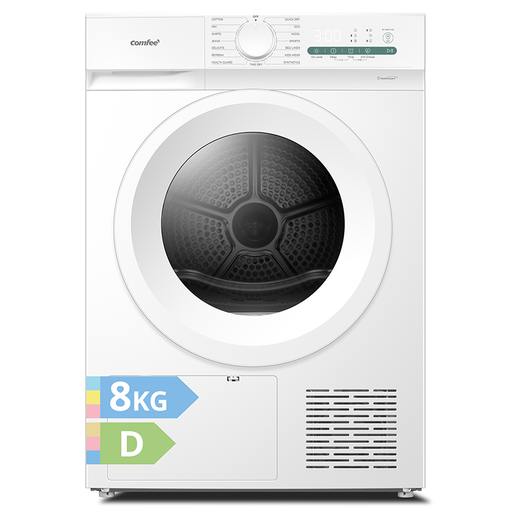
Comfee CD08EHP05W-HR, 8 kg, energy class D
The 8 kg capacity gives you a useful benchmark when comparing models for shared drying loads.
Heat pump tumble dryer; 8 kg; energy class D; three drying levels; LED display; refresh programme.
View at Joybuy
Frequently asked questions
Can cotton laundry always go in the tumble dryer?
No. Check the care label on each item and choose a suitable programme. Just because an item is made of cotton doesn’t mean it can always be tumble-dried.
What should we consider when installing a tumble dryer in a shared laundry room?
Measure the space available and position the tumble dryer securely, following the model’s instructions. Check how condensate is collected or drained, and keep any required air vents clear. Some models need an extra hose for a drain connection.
Who should clean the tumble dryer?
Agree who will clean the fluff filter after each cycle and, if applicable, empty the condensate container. The Fire Service recommends removing fluff from the filter after every use; check the manual for instructions on maintaining the condenser.
What warranty applies in the Netherlands if a tumble dryer breaks down too soon?
According to the ACM, the seller is responsible for the statutory guarantee if a product is faulty. In the Netherlands, there is no fixed statutory period of exactly two years. What you can expect depends, among other things, on the product and normal use. Any manufacturer’s warranty is in addition to this.
What energy label must a new tumble dryer display in a Dutch shop?
According to the European Commission, since 1 July 2025, shops and online retailers have had to display the A–G scale for household tumble dryers. So don’t compare an old A+++ label directly with the current letter grade.


