
Housemates sharing the bedding laundry
You want your usual shared load to fit, without choosing a larger drum based solely on the size of your household. The Consumentenbond advises matching the capacity to the load.


Start with the care label and the size of your usual load, then compare heat pump dryers by suitable capacity, energy use, noise and where they can be installed. For shared loads, 8 and 9 kg are useful capacities to compare, but a larger drum isn’t automatically a better fit if your washing machine or typical load is smaller. Also agree on who will check the filter and empty the condensate tank.
You want your usual shared load to fit, without choosing a larger drum based solely on the size of your household. The Consumentenbond advises matching the capacity to the load.
If you use the dryer regularly, you’ll want to consider its energy consumption alongside the purchase price. Milieu Centraal explains this trade-off for heat pump dryers.
You’ll need to consider the space available, noise, condensate and the maintenance involved in shared use. The Consumentenbond recommends cleaning the lint filter after every drying cycle.
The percentages below show possible main priorities among consumers choosing a dryer for tumble-dryer-safe bedding in a student house; each consumer has one main priority.
| What to consider | What should you look at? | Who is this most important to? |
|---|---|---|
| Suitable load size | Compare your usual laundry load and washing machine capacity with the stated capacity in kilograms of dry cotton. For a duvet, also check its care label and the manual for the exact model. | I want to know whether my usual laundry and permitted bedding will fit; the kilogram figure alone doesn’t tell me whether a bulky duvet will fit in the drum. Consumers whose main priority is a suitable load size make up around 33% of this group. |
| Energy consumption | Compare current energy labels and stated consumption on the same basis; work out running costs using your own electricity tariff and expected number of drying cycles. | If I use the dryer regularly, I want to weigh up its energy consumption against my electricity tariff and number of cycles. Consumers who prioritise running costs make up around 27% of this group. |
| Space and disruption | Measure the installation space and access routes. Compare the dimensions and stated noise level, and check the installation and ventilation instructions. | I need to fit the dryer into a shared space and want to check in advance that the space and noise level will suit our house. Consumers whose main priority is installation make up around 20% of this group. |
| Shared maintenance | Check how easy it is to access the filter and condensate tank, and whether the model can be connected to an existing drain. Follow the instructions for the specific model. | I want the filter, condensate tank and any drain to be easy for all housemates to maintain. Consumers who prioritise easy shared maintenance make up around 20% of this group. |
The Consumentenbond states that the stated capacity refers to dry cotton. GINETEX recommends following the tumble-drying symbol on the care label; a bedding programme doesn’t replace this check.
With heat pump dryers, both the purchase price and energy consumption can be important. Milieu Centraal recommends considering how you’ll use the appliance. Compare energy labels using the European Commission’s A–G scale, in effect since 1 July 2025, and don’t treat older labels as directly comparable.
The stated capacity refers to dry cotton. That figure alone doesn’t tell you whether a bulky duvet will physically fit or whether there’s a suitable drying programme.
Compare your usual load and washing machine capacity with the model specifications. Check the care label of each duvet and the dryer manual separately.
The European Commission requires tumble dryers sold in shops and online to display an energy label on the A–G scale, in effect since 1 July 2025. An old A+++ rating can’t be directly equated with a rating on the new scale.
Compare the current product information sheet and stated energy consumption on the same basis; work out running costs using your own electricity tariff and expected number of cycles.
A filter that isn’t cleaned and a full condensate tank make shared use less practical. The Consumentenbond and Brandweer Nederland recommend cleaning the lint filter after every drying cycle.
Check in advance whether the model can be connected to an existing drain, and agree on who will check the filter and condensate tank.
Depending on the model and installation space, a drain connection may require an extra hose or installation equipment.
The BM3T3824W is a useful comparison if you’re looking for an 8 kg heat pump dryer.
The WQG245D7NL is worth comparing if 9 kg capacity, a duvet programme and condenser maintenance are important to you.
The TR8ESSEN is an 8 kg heat pump dryer to compare if you also dry delicate laundry at home.
The DV9UDG52A0AHEN is a 9 kg model to compare if capacity and the layout of your laundry area are important.
These heat pump dryers offer useful points of comparison for shared loads of 8 or 9 kg. For bedding, always check the care label and the instructions for the exact model.
 No image available
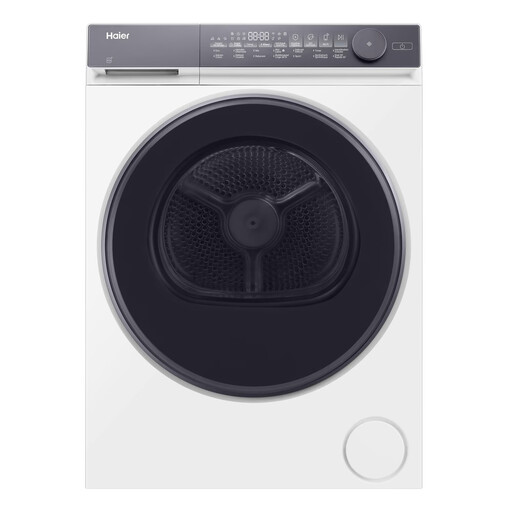
The 8 kg capacity offers a useful comparison for typical shared loads; check separately whether your bedding is suitable according to the manual.
The product name lists energy class C, AI Smart Move and Wi-Fi (hOn). The product information mentions moisture sensors, a wool drying basket and filter cleaning after every cycle.
 No image available
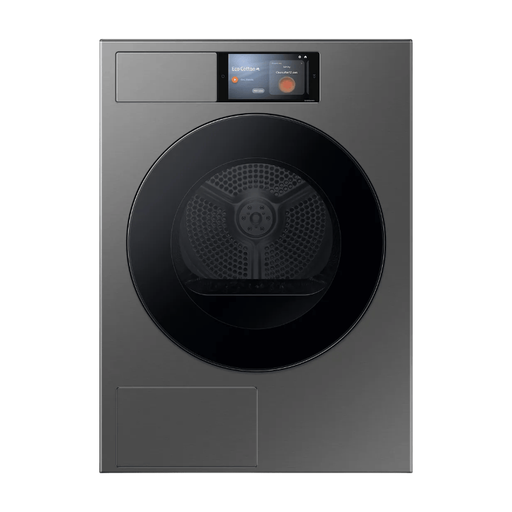
With a 9 kg capacity, this model offers a useful comparison for larger shared loads. For bedding, check that the care label and model-specific instructions allow tumble drying.
The product name lists energy class A, AI Home, AI Dry+ and Wi-Fi (SmartThings). The product information mentions a Bedding programme, filter cleaning after every cycle and a condensate tank.
 No image available
The 8 kg capacity can help you compare models for typical shared loads; the kilogram figure doesn’t confirm that a particular duvet will fit.
The product name lists energy class C, ION Fresh Air, Wi-Fi and Bluetooth. The product information mentions a moisture sensor, a wool drying basket and a drain hose as an alternative to emptying the water tank.
 No image available
The 9 kg capacity offers a useful comparison for larger loads. Check that the manual allows you to dry your bedding in this model.
The product name lists energy class B and an NL/FR control panel. The product information mentions AutoDry, a bedding programme, a self-cleaning condenser and a drain hose.
 No image available
The 9 kg capacity offers a useful comparison for larger shared loads; check separately whether the bedding you want to dry and the programme are suitable for this model.
The product name lists energy class B and a German control panel. The product information mentions AutoDry, Sensitive Drying, a self-cleaning condenser and a water drainage option.
No. Check the tumble-drying symbol and permitted care instructions for each item. Then follow the manual for the programme and load size; a programme name doesn’t prove that every duvet is suitable.
A heat pump dryer is a condenser dryer and doesn’t need an external vent hose. Condensate goes into a tank or, if the model and installation space allow, down a drain. Also follow the installation instructions.
Clean the lint filter after every drying cycle and empty the condensate tank as instructed, unless the model is connected to a suitable drain. Follow the manual for the exact model when maintaining the condenser.
Since 1 July 2025, tumble dryers sold in shops and online have used the EU A to G scale, according to the European Commission. Don’t compare ratings from the old and new scales directly; check the current product information sheet and compare energy consumption on the same basis.
No. According to the Dutch government, there’s no fixed period for the legal guarantee in the Netherlands. What you can expect from a product depends on factors including the product itself and the information provided at the time of sale. If a product is faulty, contact the seller. A manufacturer’s warranty or an extended warranty you’ve purchased is separate from this.