Only tumble dry sportswear if the care label allows it, and make sure the programme and temperature you choose are suitable for the garment. A sportswear programme doesn’t change that. If you share a utility room, also compare the stated noise level, condensation efficiency, dimensions and water drainage. If you tumble dry regularly, weigh up energy use per 100 eco cycles alongside programme duration.
Who is this relevant for?
Drying sportswear with care
You regularly dry technical or mixed-fabric sportswear, checking each garment’s care label and the appropriate setting. Bosch Netherlands explains that if the label says not to tumble dry, this applies even when the dryer has a special programme.
Sharing a utility room
You share the space or use adjoining rooms, so noise, vibration, moisture and where the machine will go all matter. The Dutch Consumers’ Association describes condensation efficiency as a measure of how well a dryer removes moisture from the air.
Comparing energy use if you tumble dry regularly
You run drying cycles regularly and want to consider capacity, drying time and electricity use. Milieu Centraal recommends checking the energy label when choosing a dryer; Energielabel.nl lists energy use per 100 eco cycles as a basis for comparison.
What should you look for when buying?
| What to consider |
What should you check? |
Who is this most relevant for? |
| Caring for sportswear |
Check the drying symbol and permitted temperature for each garment. Then compare the programme instructions and load limit for the exact model. |
If I’m drying sportswear with different care labels, I want to know whether tumble drying and the selected setting are suitable for each item. Around 29% of consumers prioritise whether garments are suitable for drying. |
| Noise and moisture in the room |
Compare the stated noise level in dB and the condensation efficiency. Measure the available space and check the floor, ventilation and any drainage hose. |
If other people use the utility room or adjoining rooms, I want to take noise and moisture into account and make sure the machine can be installed securely. Around 29% of consumers prioritise minimising disruption in a shared space. |
| Electricity use |
Compare kWh per 100 eco cycles on the same label basis; this figure does not automatically reflect the energy use of a sportswear programme. |
If I tumble dry often, I want to compare energy use on the label basis with how much I expect to use the machine. Around 24% of consumers prioritise running costs. |
| Small loads and drying time |
Check the duration and permitted load for the programme you want to use. A quick programme is only suitable for the fabrics and load size specified by the manufacturer. |
If I have a small load of sportswear or need it dried quickly, I want to know whether there’s a suitable programme available. Around 18% of consumers prioritise small loads and the time available for drying. |
Common pitfalls
-
Assuming a sportswear programme makes every garment suitable for tumble drying
A garment’s care label may prohibit tumble drying or specify a lower temperature, whatever the programme is called.
Sort garments by their drying instructions, then check the guidance for the exact model and programme.
-
Focusing only on noise in a shared utility room
Moisture in the room can also be a concern, and an uneven surface may cause vibration.
Compare condensation efficiency too, and check the floor, required clearance and ventilation.
-
Assuming the eco figure reflects the energy use or drying time for sportswear
The energy label and stated programme duration are based on the eco programme. Sportswear may need a different programme and take a different amount of time to dry. The European Commission states that the updated requirements have applied to new machines since 1 July 2025, but do not apply in the same way to dryers already placed on the market before then.
Compare models on the same label basis and check the manual for the load you actually want to dry.
Brands to compare
Bosch
The Serie 6 WQG235D9NL is a heat pump tumble dryer with a sportswear programme and features that could be useful in a shared utility room.
- For this exact model, Bosch lists an 8 kg capacity, 61 dB noise level, moisture sensor and self-cleaning condenser. It also mentions a half-load option and a condensate drainage kit.
- According to Bosch, the quick programme is for a small load of thin synthetic fabrics. Check the permitted treatment for each garment.
AEG
The 8000 AbsoluteCare TR86CBC87 is a model worth comparing for its programmes, noise level and moisture management.
- AEG lists an 8 kg capacity, 63 dB noise level, condensation efficiency class B and 85 kWh per 100 eco cycles for this model.
- AEG’s claims about fabric protection are manufacturer claims. Check the care label and programme details for the sportswear you want to dry.
Beko
The BM3T3823WMM is an 8 kg heat pump model to compare, including for its dimensions and basic features.
- For this exact model, Beko lists a drying sensor, energy class D on the new scale, 64 dBA and a depth of 54.5 cm.
- These specifications alone don’t tell you whether a particular sportswear programme or garment is suitable.
Miele
The T1 range includes models with different programmes; the TCL690WP is one example with a sportswear programme.
- Miele lists a 9 kg capacity, 62 dB noise level and a sportswear programme for the TCL690WP.
- Miele marks this exact model as no longer available. The listed features don’t automatically apply to other T1 models.
Samsung
The DV90DG52A0ABEN is a 9 kg model to compare for capacity and placement.
- For this model, Samsung lists energy class C, a reversible door and dimensions of 600 × 850 × 600 mm.
- For sportswear, check the care label and permitted settings for each garment; a general product feature doesn’t determine whether it’s suitable.
Products at Joybuy
These heat pump tumble dryers offer a range of listed capacities, programmes and features to compare for sportswear and synthetic garments that are suitable for tumble drying, and for use in a shared utility room. Check each garment’s care label and the instructions for the exact model.
 No image available
Bosch WQB245B40 Series 8, 9 kg
An option to compare if a sportswear programme and capacity matter to you; check garment care labels and programme instructions.
The product information lists a 9 kg capacity, a sportswear programme and a stated noise level of 61 dB.
Joybuy
 No image available
SHARP KDNHA8S6PWEBX, 8 kg
The listed programmes for synthetic and delicate fabrics are worth considering when comparing models; check whether they suit the care labels for your load.
The product information lists an 8 kg capacity, 64 dB noise level and energy class E.
Joybuy
 No image available
TCL DP4408WE1NL, 8 kg
Compare the listed Gentle Dry mode and moisture detection with the settings that are suitable for the garments you’re allowed to tumble dry.
The product information lists an 8 kg capacity, a 30-minute programme and automatic moisture detection.
Joybuy
 No image available
Midea MD205H80WB/W-NL, 8 kg
The product information lists a Sports programme; check that the care label allows tumble drying and that the setting is suitable for every load.
A 30-minute quick programme for small, slightly damp loads is also listed, along with a reversible door that can be adjusted to open in either direction during installation.
Joybuy
 No image available
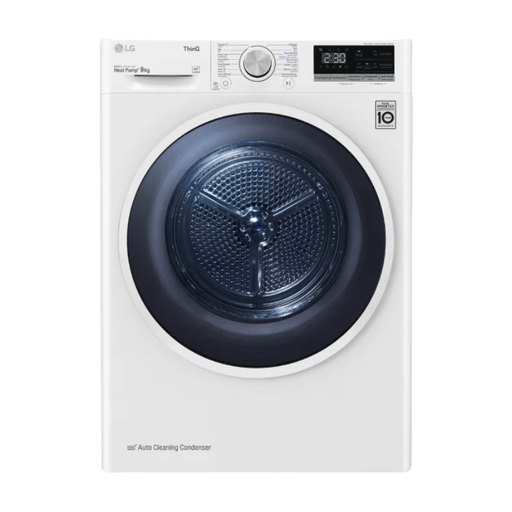
LG RH90V5AV6N, 9 kg
The listed sensor control and condensation efficiency are worth considering when comparing models for regular use in a shared space.
The product information lists a 9 kg capacity, 64 dB noise level, condensation efficiency class B and a self-cleaning condenser.
Joybuy
Frequently asked questions
Can all sportswear go in the tumble dryer on a sportswear programme?
No. Follow the care label on each garment. A crossed-out tumble-drying symbol means it must not be machine dried; if the label specifies a low temperature, choose a suitable setting. Milieu Centraal advises against tumble drying fleece.
How can I reduce disruption from a tumble dryer in a shared utility room?
Make sure the machine is stable and level, leave the required clearance and check that the door and any drainage hose will fit your setup. Compare the stated noise level and condensation efficiency before buying; in a poorly ventilated room, also consider moisture.
Who should maintain a shared tumble dryer after use?
Agree who will clean the lint filter after each cycle and, if there’s no water drain connected, empty the condensate tank. Follow the manual for the exact model when cleaning the heat exchanger; maintenance instructions may vary between models.
What costs and warranty rights should I consider when buying?
Alongside the purchase price, compare the energy use shown on the label on the same basis and check whether you’ll need installation accessories such as a drainage hose or stacking kit. ACM ConsuWijzer states that, under the statutory guarantee, the seller is responsible for a faulty product used normally; a shorter commercial warranty doesn’t remove that right.
Which energy label currently applies to tumble dryers in the Netherlands?
Since 1 July 2025, household tumble dryers have used the rescaled EU energy label, from A to G. The European Commission says the updated requirements apply to new machines, but not in the same way to appliances placed on the market before that date. So don’t compare an old A+++ label directly with a new energy class.


