
People who exercise and do small, quick loads
You want to be able to wear your tumble-dryer-safe sportswear again soon. Check the care label on each garment and the programme’s permitted load; GINETEX explains the drying symbols on clothing labels.


Start by checking the care label on each garment and choosing a programme that suits the fabric and the permitted load. A ‘sports’ button or a short programme time doesn’t, on its own, guarantee that every garment can be dried in the machine. Then compare capacity, energy information and installation requirements: if you only dry small loads occasionally, a smaller drum may be enough, while a larger capacity can be practical for regular shared use.
You want to be able to wear your tumble-dryer-safe sportswear again soon. Check the care label on each garment and the programme’s permitted load; GINETEX explains the drying symbols on clothing labels.
You share the dryer and electricity costs, and need a capacity that suits the number of users and how often you dry clothes. Milieu Centraal suggests that 8 or 9 kg may be a suitable choice for more frequent use.
You need to make sure the dimensions and drainage suit the available space, while also considering noise and ventilation. Consumentenbond points out that moisture in a poorly ventilated room can be a concern.
First check which programmes are suitable for the care labels, then work out the capacity you need based on shared use, and measure the installation space. Milieu Centraal suggests that 6 or 7 kg may suit occasional use, while 8 or 9 kg may be better for more frequent use. That doesn’t mean every student house automatically needs a larger drum.
| Concern | What to check | Who should consider this most? |
|---|---|---|
| A suitable programme for sportswear fabrics | Check the drying symbols on each garment and the manual for the programme’s temperature, fabric type and maximum load. | If I need my sportswear again soon, I want to know whether the chosen programme is suitable for that particular fabric and load. Around 33% of consumers say suitability for tumble-dryer-safe sportswear fabrics is their top priority. |
| Electricity use when sharing | Compare the current energy labels and product information for models on a like-for-like basis; the label doesn’t predict the exact energy use of a specific sports programme. | When I share the dryer with housemates, I want to factor in energy use across repeated drying cycles. Around 27% of consumers put electricity costs first when sharing a dryer. |
| Capacity and installation | Measure the space and access routes, check the clearance required in the manual, and find out whether water is collected or drained through a suitable connection. | If several housemates use the dryer, I want enough capacity without the appliance taking up too much of the available laundry space. Around 20% of consumers say capacity and installation are their top priorities. |
| Shared maintenance and safe use | Check the maintenance instructions, make sure filters are easy to reach, and agree who will clean them after each drying cycle. | In a shared home, I want filter maintenance to fit easily into a regular routine. Around 20% of consumers put maintenance and safe use ahead of other buying concerns. |
The garment’s care label and the programme instructions determine which fabrics and loads can go in the drum.
Check the drying symbol on each garment and compare it with the manual, temperature setting and maximum programme load.
According to Beko’s Dutch product information, the BM3T3722B is a 7 kg heat pump tumble dryer with a drying sensor.
According to Bosch, the Serie 4 WTH8520LNL combines an 8 kg capacity with a moisture sensor and a programme for small loads of lightweight synthetic washing.
According to Siemens, the iQ500 WQ33G1DANL is an 8 kg heat pump tumble dryer with a half-load function and autoDry.
LG lists an 8 kg capacity, Sensor Dry and a self-cleaning condenser for the RHX1008NWH.
AEG’s Dutch product range page includes the 7000 SensiDry and 8000 AbsoluteCare series.
This selection features heat pump tumble dryers with a stated capacity of 8 or 9 kg, suited to regular shared use. Check that the care label on each garment is compatible with the programme you choose.
 No image available
The 8 kg capacity may suit shared use; for sportswear, always check the care label and programme load.
Energy class C; AI Smart Move; Wi-Fi with hOn.
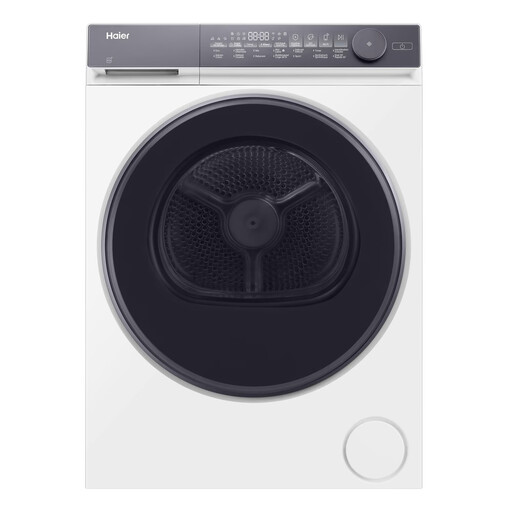 No image available
The 8 kg capacity is worth considering for shared use; choose a programme that suits the care label on each garment.
Energy class C; ION Fresh Air; Wi-Fi and Bluetooth.
 No image available
The product description lists a sportswear programme; check that the care labels and permitted programme load are suitable.
Energy class B; NL/FR panel; AutoDry and Extra Quick 40' programme according to the product description.
 No image available
The product description lists a dedicated sportswear programme; check that it’s suitable for the specific fabric and load.
Energy class B; AutoDry; German control panel.
 No image available
The 8 kg capacity may be useful for shared use; check whether the programme suits the fabric before tumble drying sportswear.
Energy class E; 15 programmes; sensor drying; programmes for synthetic and delicate laundry.
No, not automatically. Check the drying symbol and temperature restrictions on each garment, then compare them with the manual and the permitted load. For the WTH8520LNL, Bosch says SuperKort 40 is suitable for small loads of certain synthetic and lightweight fabrics.
A heat pump tumble dryer collects condensed water in a tank or drains it through a suitable connection. It doesn’t vent moist air outside in the same way as a vented tumble dryer. Check the drainage options and installation manual for your chosen model, and make sure the room is suitably ventilated.
Agree that the filter will be checked and cleaned after every drying cycle, following the manual. The Fire Service advises keeping filters clean and following the manufacturer’s maintenance instructions.
Compare the current EU energy label on the A–G scale and the accompanying product information for the models you’re considering. According to the European Commission, this scale has applied to energy labels for tumble dryers displayed in shops and online since 1 July 2025; an old A+++ label isn’t the same as a current rating.
No. According to the Dutch Government, there’s no fixed statutory guarantee period in the Netherlands; what you can expect from a product depends, among other things, on the product and the information provided at the time of sale. If a product is faulty, contact the seller.