
If you often dry small loads
You regularly run a small drying load and want to compare energy use and programme settings for this kind of use.


If you usually dry small loads, choose a capacity that suits your everyday washing and check how the model handles smaller loads. A 7 kg heat pump tumble dryer could be a good fit if you don’t need space for bulky items; a larger model with a dedicated small-load function may be more convenient if you sometimes dry bedding too. Also compare the current energy label and the programmes you’re likely to use.
You regularly run a small drying load and want to compare energy use and programme settings for this kind of use.
You usually dry a small amount of laundry, but sometimes want to dry items such as bedding too. The question is whether a larger drum with a small-load function suits the way you use it.
Sometimes you want your clothes back quickly, so check which fabrics and how much laundry the chosen model’s quick programme can handle.
First compare energy use on the current label, then check whether the capacity and programmes suit your usual loads. Energielabel.nl lists energy use per 100 drying cycles using the eco programme as a point of comparison.
| What to consider | What to look for when buying | Who should pay particular attention? |
|---|---|---|
| Energy use | Compare kWh per 100 eco programmes on the current label; this figure doesn’t automatically reflect every small or quick drying cycle. | If you dry laundry often, factor in the energy use of repeated cycles. Around 36% of consumers say energy use is their top buying priority. |
| Capacity and small-load settings | Compare the drum capacity with your usual laundry loads and check whether the exact model has a sensor or a dedicated small-load function. | If you usually dry small loads but sometimes dry bedding too, you’ll want to weigh up both types of load. Around 29% of consumers prioritise a suitable capacity and settings for small loads. |
| Drying time for a few items | Check the permitted load, fabrics and programme duration for the exact model’s quick programme. | If you occasionally need a few clothes quickly, how the short programme can be used matters more than the number of minutes alone. Around 21% of consumers give drying time for a few items top priority. |
| Installation and maintenance | Measure the space and check the installation instructions, condensation details and access to the fluff filter. | If space is limited or you want to manage moisture and regular maintenance effectively, consider the installation too. Around 14% of consumers say installation and maintenance are their main concern. |
The European Commission states that the current energy label for tumble dryers has used the A–G scale since 1 July 2025. An old label rating is therefore not an equivalent basis for comparison.
Check the current label for the exact model and compare energy use per 100 eco programmes on the same basis.
For the Bosch WQG133DBNL, Bosch specifies a 40-minute programme for a small load of thin or synthetic fabrics; this isn’t the standard programme duration for every load.
Check the permitted load size and fabrics for the exact model’s quick programme.
A low maximum capacity alone doesn’t show how much energy a particular drying cycle uses.
Compare the current label information and installation requirements for the specific model rather than choosing on capacity alone.
The available space and chosen water drainage option must be suitable for the model’s instructions. The fluff filter must also be accessible for regular maintenance.
Measure the space beforehand, check the installation manual and clean the fluff filter after every drying cycle, as advised by Brandweer Nederland.
Depending on the model, you may need an extra hose to connect it to a drain, according to the Consumentenbond.
The WQG133DBNL is an 8 kg heat pump tumble dryer for anyone who alternates small loads with the occasional larger one.
The BM3T3722W is a 7 kg heat pump tumble dryer for anyone who doesn’t need a larger stated capacity.
The DV80DG52B0AEEN is an 8 kg heat pump tumble dryer worth comparing if you’re looking at clothing-care features as well as capacity.
These models are heat pump tumble dryers with a stated capacity of 8 or 9 kg. Compare their listed programmes and features with your usual small loads and the larger items you sometimes dry.
 No image available
The stated capacity could suit you if you sometimes dry larger items as well as small loads.
Heat pump tumble dryer; 9 kg; energy class B; NL/FR control panel. The description lists Auto Dry with continuous moisture measurement and an Extra Quick 40 programme.
 No image available
The capacity could be relevant if you alternate your usual small loads with larger items.
Heat pump tumble dryer; 9 kg; energy class B; German-language control panel. The description lists AutoDry with continuous moisture measurement and an Extra Quick 40 programme.
 No image available
The stated capacity could suit you if you combine small drying loads with the occasional larger one.
Heat pump tumble dryer; 8 kg; energy class E. The description lists a drying sensor and 15 programmes, including programmes for synthetic and delicate fabrics.
 No image available
The capacity could suit anyone who usually dries small loads but sometimes has larger items to dry.
Heat pump tumble dryer; 8 kg; energy class E. The description lists Auto Dry and a 30-minute Quick Dry programme.
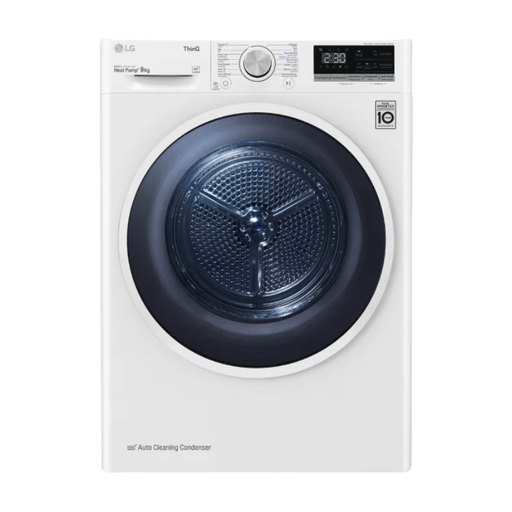 No image available
The capacity could come in handy if you dry larger items as well as small loads.
Heat pump tumble dryer; 9 kg; energy class D. The description lists Sensor Dry and Eco Hybrid, which lets you choose between faster and more energy-efficient drying.
No. The stated kilogram capacity tells you how much the dryer can hold, not how much energy it uses for your small load. Compare the current energy label for a standardised comparison, and also check the details of the programmes you plan to use.
Energielabel.nl describes this as the energy use in kWh per 100 drying cycles using the eco programme. It provides a basis for comparison, not a prediction for 100 of your own quick or very small loads. According to the European Commission, the A–G scale has applied to the current label since 1 July 2025.
No. The permitted fabrics and load size vary by programme and model. For the WQG133DBNL, Bosch specifies 40 minutes for a small load of thin or synthetic fabrics; check the conditions for the exact model.
No. According to the European Commission, a condenser dryer, including a heat pump tumble dryer, doesn’t need an external air vent. However, check which condensate drainage options and connection parts are available for the specific model.
Brandweer Nederland advises cleaning the fluff filter after every drying cycle. Also follow your model’s manual for the condensate container and any other filters.