What should you look for when buying?
Start by considering the loads you actually dry and the space available. Then compare noise, energy use and drying time on a like-for-like basis; one specification on its own won’t give you the full picture.
When drying small loads in an upstairs flat, different shoppers may prioritise different things.
| What to consider |
What to look for |
Who it matters most to |
| Small loads |
Compare your usual and largest loads with the drum capacity, and check whether the model has a sensor or suitable programme. Bosch says the WTH8520AFG has a short programme for a small amount of synthetic or lightweight fabrics; this isn’t suitable for every fabric or load. |
If I usually dry only a small amount of laundry, I want to know whether a small load will dry well without the drum being too small for larger items. Around 31% of consumers give drying results for small loads top priority. |
| Noise at home |
Compare the dB rating and, where available, independent noise assessments. Also consider the location and programme duration: a lower noise rating doesn’t in itself mean a shorter programme or better drying results. |
If my tumble dryer is near my living or sleeping area, I want to take its stated noise level into account without losing sight of drying results and cycle time. Around 25% of consumers prioritise a quieter home. |
| Energy use |
Compare the current energy label and energy consumption per 100 eco drying cycles on a like-for-like basis; also check how long the eco programme takes. The European Commission states that the A–G scale has applied since 1 July 2025; the old A+++ rating uses a different scale. |
If I use my tumble dryer regularly, I want to weigh up its energy use against programme duration for the way I use it. Around 25% of consumers prioritise energy use. |
| Installation and moisture |
Measure the available space and check the manual for water drainage, ventilation and any stacking kit required for the exact models. Compare the condensation data too; in a poorly ventilated room, it’s important to check how much moisture the tumble dryer releases into the surrounding air. |
In a small utility room, I want to know in advance whether the tumble dryer will fit safely and how to manage moisture and water collection. Around 19% of consumers make installation and moisture control their top priority. |
Tumble dryers at Joybuy
These heat pump tumble dryers are selected for comparison by capacity, drying settings and how well they fit your utility room.
 No image available
Bosch WQB245B40 Series 8, 9 kg
The automatic dryness setting may be useful if you want the tumble dryer to adjust the level of dryness; the 9 kg capacity is larger than many small loads.
Heat pump tumble dryer; AutoDry; 15 programmes; 61 dB; self-cleaning condenser. The energy label information in the product name refers to a German label.
View at Joybuy
 No image available
SHARP KDNHA8S6PWEBX, 8 kg
The product information lists sensor-controlled drying; check which programme suits the fabrics and size of your usual load.
Heat pump tumble dryer; 8 kg; energy label E; 64 dB; 15 programmes. The description mentions a sensor system that monitors moisture levels.
View at Joybuy
 No image available
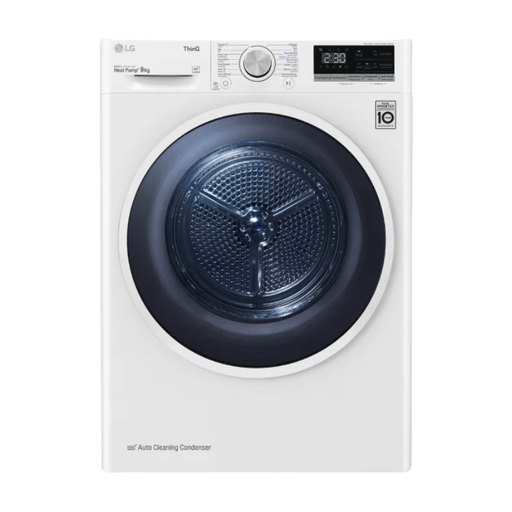
LG RH90V5AV6N, 9 kg
Sensor Dry is listed in the product information; a 9 kg drum may be larger than you need for small loads.
Heat pump tumble dryer; Sensor Dry; 64 dB; condensation efficiency class B.
View at Joybuy
 No image available
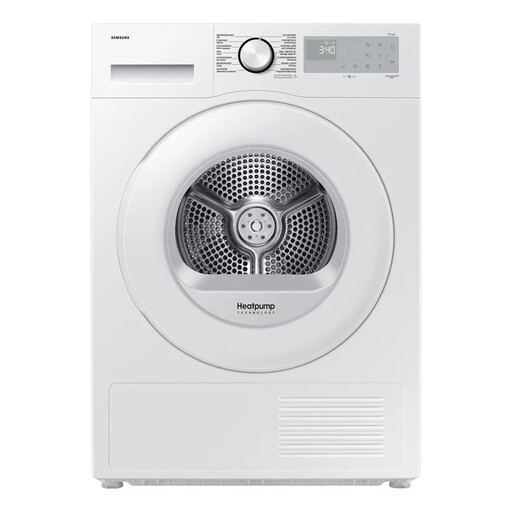
Samsung DV9UDG52A0THEN, 9 kg
Compare the 9 kg capacity with your usual small loads and check the space needed for a freestanding installation.
Heat pump technology; freestanding; 9 kg; 64 dB; condensation efficiency class B; energy label C.
View at Joybuy
 No image available
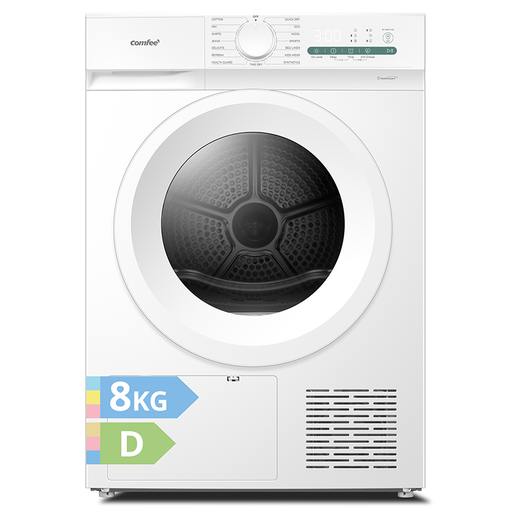
Comfee CD08EHP05W-HR, 8 kg
The 8 kg capacity gives you room for more than small loads; check the programme information for the fabrics you want to dry.
Heat pump tumble dryer; 8 kg; energy label D.
View at Joybuy
Frequently asked questions
Is a smaller drum always better for small loads?
No. Choose a capacity that also suits your largest load, and check whether the specific model has a sensor or suitable programme. Milieu Centraal suggests 6 or 7 kg as a potentially suitable capacity for someone who lives alone or rarely uses a tumble dryer; this doesn’t guarantee the drying results of every model.
What should I look for on the Dutch energy label?
Compare the label class, energy consumption per 100 eco drying cycles, capacity, noise level and programme duration on a like-for-like basis. According to the European Commission, the A–G scale has applied since 1 July 2025; the old A+++ rating uses a different scale. Condenser tumble dryers also display a condensation efficiency rating.
Can I put a tumble dryer on top of my washing machine?
Only if the manufacturer confirms that both appliances and the stacking kit you’ve chosen are suitable for that combination. Bosch recommends using a suitable stacking kit and placing the tumble dryer on top of the washing machine. Check the manuals and model numbers of your appliances.
What maintenance does a condenser tumble dryer need?
Clean the fluff filter after every drying cycle and empty the condensate reservoir after each cycle if there’s no suitable water drainage connected. Follow the manual for maintaining the condenser, humidity sensor and any drain hose; a self-cleaning condenser doesn’t mean the fluff filter is maintenance-free.
Does the new minimum efficiency requirement apply to mini dryers?
Mini dryers with a capacity of up to 3 kg are exempt from the new minimum efficiency requirement, according to Milieu Centraal. The European Commission also states that the new ecodesign requirements don’t apply to machines placed on the market before 1 July 2025 that are still in shop stock. So check the details and label for the specific appliance.


