
Student with smaller loads of their own
You’re looking for a suitable capacity and don’t want to choose a larger machine simply because that’s what’s available. Milieu Centraal says 6–7 kg is enough if you live alone or don’t use the dryer often.


If you mostly do smaller loads of your own, start by looking at a heat-pump tumble dryer with a capacity of around 6–7 kg. Milieu Centraal says this is enough if you live alone or don’t use the dryer often. If your housemates also dry bedding and towels, a shared 8 kg model may be more practical; just check whether that exact model has a setting for smaller loads. Before choosing, compare energy consumption, where you’ll install it, noise levels and maintenance requirements.
You’re looking for a suitable capacity and don’t want to choose a larger machine simply because that’s what’s available. Milieu Centraal says 6–7 kg is enough if you live alone or don’t use the dryer often.
You need to manage small individual loads and occasional larger ones, as well as noise and maintenance, together. Bosch lists a half-load option for the WQG133DANL; always check the features of the exact model.
You’ll need to check whether the dimensions, drainage and ventilation are suitable for the available space. Consumentenbond also points out that condensation performance can vary between tumble dryers.
First, work out how much laundry you usually dry and whether your housemates also do larger loads. Then compare energy consumption, drying time and the practical requirements of the installation space.
| What to consider | What to look for | Who should pay extra attention? |
|---|---|---|
| Suitable capacity | Match the capacity in kilograms to your laundry; if you’ll be sharing the dryer, check whether it has a programme or setting for smaller loads. | If you mainly dry your own smaller loads, you won’t want to choose a capacity you’ll rarely use. With shared use, it also needs to fit larger items. Around 33% of consumers put suitable capacity first. |
| Overall energy consumption | Compare the current energy label and kWh per 100 eco cycles on the same basis, and factor in how often you expect to use the dryer. | If energy use is a major consideration, compare the label with your expected usage rather than looking only at the purchase price. Around 27% of consumers give overall costs the highest priority. |
| Installation and disruption | Measure the space and access route; check the noise level and condensation details, and whether the model has a tank or a suitable drain connection. | If you’re using a small shared space, you’ll want to know where the condensed water goes and whether the dryer will disturb your housemates. Around 27% of consumers prioritise installation and disruption. |
| Drying time | Compare the duration of the eco cycle; if there’s a short programme, check what load size and fabrics it’s suitable for. | If you need an item of clothing quickly, check whether a short programme is suitable for that load and how long it takes. Around 13% of consumers choose drying time as their main consideration. |
The energy label for tumble dryers changed on 1 July 2025. The old letter rating therefore isn’t directly comparable with a class on the new label.
Compare current models using the applicable A–G label and consumption in kWh per 100 eco cycles.
A capacity of up to 3 kg means a limited load and an exemption from parts of the new EU ecodesign requirements; this alone doesn’t prove that energy consumption is low.
Check the capacity, drying technology and energy consumption information for the exact model. A small drum may also mean extra cycles if all your laundry won’t fit at once.
A drain connection may require a suitable hose, while filters and the installation space need ongoing attention. In a student house, it should also be clear who is responsible for maintenance.
Read the manual and check the space, drainage options and maintenance instructions in advance. Agree with your housemates who will clean the filters and keep up with other maintenance.
Depending on the model and installation, you may need a suitable drain hose or an installation service.
Beko’s range includes the 7 kg BM3T3722W heat-pump tumble dryer, available in the Netherlands. It’s a specific model to consider if you mainly dry smaller loads.
The Bosch WQG133DANL is an 8 kg heat-pump tumble dryer with a half-load option described by Bosch, designed for smaller loads in a larger drum.
The LG RHX1008NWH is an 8 kg heat-pump tumble dryer. LG describes this model as having sensor drying and a self-cleaning condenser.
The Inventum VDW8030W is an 8 kg model with a collection tank or water drain, making it worth including in a comparison for shared use.
This selection focuses on 8 kg heat-pump tumble dryers for shared use. Check whether each model’s features and connection options suit your laundry and the available space.
 No image available
The capacity is suitable for shared use; the product description lists six short programmes for anyone looking for a quicker drying cycle.
C energy label; moisture sensor; six short programmes.
 No image available
The 8 kg capacity may suit a shared machine; check that the listed drain hose and filter work with your planned installation.
C energy label; B condensation class; 91% condensation efficiency; integrated lint filter.
Clean the lint filter after every cycle; if you use the water tank, it needs to be emptied.
 No image available
With an 8 kg capacity, this is an option to compare for a shared laundry area; check whether the programmes suit the types of laundry you dry.
E energy label; moisture sensor; 15 programmes, including options for delicate fabrics.
Empty the water tank and clean the filter after use; the condenser needs regular cleaning.
 No image available
The 8 kg capacity is designed for shared use; the product description lists a Quick Dry programme if you’re considering a shorter drying cycle.
E energy label; moisture sensor; Quick Dry programme up to 30 minutes.
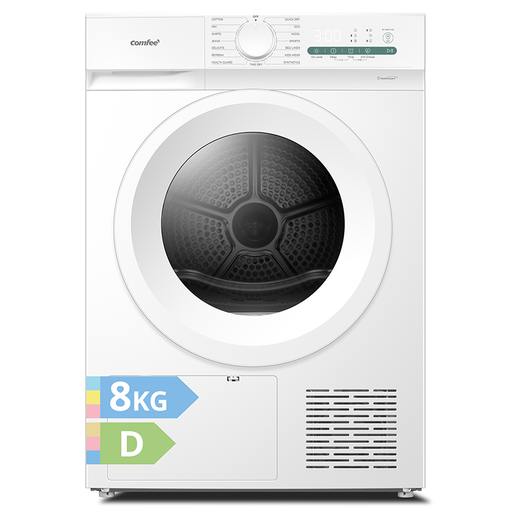 No image available
The capacity is suited to shared loads; check how the quick programme and water collection fit your usage and installation.
D energy label; three drying settings; quick programme.
Clean the lint filter after every cycle. If there’s no drain hose, the water tank needs to be emptied.
Not necessarily, if your housemates also dry larger items. Compare your usual loads with the capacity and check whether the exact model has a setting for smaller loads; Bosch lists one for the WQG133DANL, for example.
Not always: heat-pump and condenser tumble dryers may have a condensate tank. Some models can also be connected to a drain; check whether your chosen model supports this and whether a drain point and suitable hose are available.
Agree who will clean the lint filter after use and who will follow the other maintenance instructions. Brandweer Nederland stresses the importance of keeping filters clean; you should also follow the manual for your chosen model.
New EU efficiency requirements apply to tumble dryers placed on the market from 1 July 2025; according to Energielabel.nl, existing shop stock may still be sold. EU Regulation 2023/2533 exempts household tumble dryers with a rated capacity of up to 3 kg from certain requirements. Check the details and status of the specific appliance.
Report a faulty product to the seller. The Rijksoverheid explains that the Netherlands doesn’t have a fixed statutory two-year guarantee period; what you can reasonably expect from a product is relevant to your statutory rights. A manufacturer’s or additional warranty doesn’t replace those rights.