Who is this buying guide for?

People with limited drying space

You dry cotton laundry in winter in a small flat and want to know whether a freestanding dryer will fit, perhaps on top of your washing machine, without adding unnecessary moisture to your home. The Consumentenbond points out that you need to allow for connections and ventilation, not just the appliance’s external dimensions.

Regular tumble dryer users

You use your dryer often and take electricity use, drum capacity and maintenance into account. Milieu Centraal says that how often you use a dryer and how much it can hold are factors to consider when choosing one.

People sharing their living space

You can hear the dryer from your living or sleeping area, so you want to consider its noise level and how long a cotton programme takes. The Consumentenbond includes noise and drying speed in its assessments of tumble dryers.

What should you look for when buying?

Freestanding heat pump tumble dryer

A good fit if: you have space for a separate appliance and regularly dry cotton laundry.

Trade-off: according to Milieu Centraal, this technology uses much less electricity than older condenser and vented dryers, but drying times are not always short.

Traditional condenser tumble dryer

A good fit if: you are considering a current or second-hand appliance and carefully check its condition and energy use.

Trade-off: this technology can dry clothes faster, but uses more electricity than a heat pump dryer. Don’t compare old energy labels directly with the current scale.

Washer-dryer

A good fit if: you only have room for one machine and want to wash and tumble dry your laundry.

Trade-off: you save space by not needing a second appliance, but drying programmes on typical washer-dryers take a long time.

Existing vented tumble dryer

A good fit if: you already have a suitable external vent and the appliance is in good condition.

Trade-off: it needs an external vent and uses more electricity than a heat pump dryer.

What to consider What should you check? Who is this most important for?
Space and moisture Measure the width, height and depth, as well as the space needed for the door and connections; compare the condensation efficiency on the label. If I dry laundry in a small flat, the machine needs to fit and I want to know how to limit excess moisture in the room. Around 33% of consumers say space and moisture are their top buying priorities.
Electricity use Compare the current energy class and energy figures on a like-for-like basis, and take your usage into account. If I use the dryer often, I want to consider its electricity use over time rather than looking at just one label letter. Around 27% of consumers give running costs top priority.
Cotton load and drying Compare the stated cotton capacity with the loads you usually dry, and check independent drying results where available. If I want to dry my usual cotton laundry in as few loads as possible, I look at both capacity and drying performance. Around 20% of consumers put cotton capacity and drying at the top of their list.
Noise and programme duration Compare the stated noise level and the duration of the cotton or eco programme. If the machine is close to my living or sleeping area, I want to weigh up noise and waiting time. Around 20% of consumers make these two points their top buying priority.

Common buying mistakes

  • Comparing only the appliance’s external dimensions with the available space

    The door, connections and required clearance can mean that an appliance appears to fit on paper but is difficult to install or use in practice.

    Measure the full installation space and check the installation instructions. If stacking appliances, use only a suitable stacking kit or stacking frame.

  • Assuming all condenser dryers release the same amount of moisture

    Condensation efficiency varies between dryers. In a poorly ventilated room, moist air can contribute to damp problems.

    Compare the condensation class and take the ventilation in the intended location into account.

  • Choosing a washer-dryer based only on its washing capacity

    A washer-dryer’s drying capacity may not be the same as its washing capacity. A larger wash load may therefore need to be dried in several batches.

    Compare the separate drying capacity with your usual cotton load and check the cotton programme.

  • Assuming an old A+++ label is equivalent to a current A rating

    The EU energy label scale for tumble dryers has changed, so old and current label letters are not directly comparable.

    Use the current label and product information for the exact model when making comparisons.

Brands to compare

Beko

The BM3T3722W is a 7 kg heat pump tumble dryer to compare if you have smaller cotton loads and limited depth to work with.

  • Beko lists this model as 54.5 cm deep, with a noise level of 64 dBA.
  • The stated depth does not automatically include the extra space needed for the door and connections.
  • Beko lists this model as energy class E on the current A–G scale.

Bosch

The WQG233DLNL is a heat pump tumble dryer with a stated capacity of 8 kg and automatic moisture sensing.

  • Bosch gives this model’s dimensions as 842 × 598 × 613 mm and its noise level as 63 dB(A).
  • Bosch says this model does not have a self-cleaning condenser.
  • A short programme description alone does not tell you how long a full cotton load will take.

Siemens

The WQ33G1DANL is worth comparing if you are considering features for smaller loads and programme duration.

  • Siemens lists a half-load option and speedPack for this model.
  • These features do not prove that a full cotton load will dry faster or more efficiently than in other models.

LG

The RHX1009NWK is a heat pump tumble dryer with a stated capacity of 9 kg, offering a comparison point for larger loads.

  • LG lists sensor drying and a self-cleaning condenser for this model.
  • Check the dimensions and drying results for your exact set-up and the cotton programme.

AEG

Depending on the model, AEG offers heat pump tumble dryers with sensors and programmes for different types of fabric.

  • Features can vary by model, so check and compare them in the product information.
  • Claims about caring for delicate fabrics do not automatically apply to every AEG model; check the specifications for cotton.

Heat pump tumble dryers at Joybuy

These Joybuy products are freestanding heat pump tumble dryers to compare for cotton laundry in a small flat. As well as capacity, consider the space needed for installation, the energy label and the information about the cotton programme.

Candy BR 8N3BX-S heat pump tumble dryer, 8 kg, energy label C

Candy BR 8N3BX-S heat pump tumble dryer, 8 kg, energy label C

An option to compare if you’re looking for a heat pump tumble dryer with a stated capacity of 8 kg for cotton laundry.

The product name lists Wi-Fi (hOn) and energy label C.

View at Joybuy

SHARP KDNHA8S6PWEBX heat pump tumble dryer, 8 kg, energy label E

SHARP KDNHA8S6PWEBX heat pump tumble dryer, 8 kg, energy label E

Compare this model if you’re looking for a heat pump tumble dryer with a stated capacity of 8 kg.

The product name lists energy label E.

View at Joybuy

TCL DP4408WE1NL heat pump tumble dryer, 8 kg, energy label E

TCL DP4408WE1NL heat pump tumble dryer, 8 kg, energy label E

An option to compare if you’re looking for a heat pump tumble dryer with a stated capacity of 8 kg.

The product name mentions a 30-minute quick cycle for small, slightly damp items. This does not indicate how long a full cotton load will take.

View at Joybuy

Midea MD205H80WB/W-NL heat pump tumble dryer, 8 kg, energy label C

Midea MD205H80WB/W-NL heat pump tumble dryer, 8 kg, energy label C

Compare this model if you’re looking for a heat pump tumble dryer with a stated capacity of 8 kg.

The product name mentions sensor-controlled drying. According to the product information, the filter and condenser should be cleaned after every drying cycle.

View at Joybuy
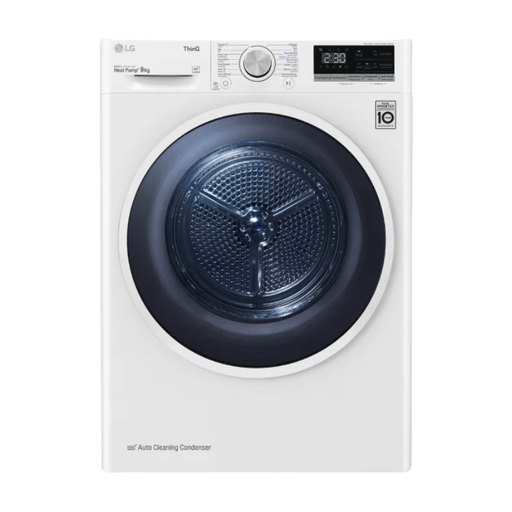
LG RH90V5AV6N heat pump tumble dryer, 9 kg

LG RH90V5AV6N heat pump tumble dryer, 9 kg

An option to compare if you usually dry larger cotton loads and are looking for a 9 kg heat pump tumble dryer.

Check the appliance dimensions and condensation efficiency information for the space available in your flat.

View at Joybuy

Frequently asked questions

Does a heat pump tumble dryer in my flat need a hose to the outside?

No, a heat pump tumble dryer does not need an external vent. The water is collected in a tank or, if the model and connection allow, drained through a hose. Also check the condensation efficiency and the installation instructions for your space.

Can I put a tumble dryer on top of my washing machine?

You can if both appliances are suitable for stacking and you use a compatible stacking kit or frame. Put the washing machine underneath, and check the dimensions, access to the door and tank, and installation instructions for both models.

What maintenance does a tumble dryer need after a cotton load?

Clean the filters as directed in the manual; Brandweer Nederland stresses that filters need to be cleaned thoroughly. Empty the condensate tank if necessary and follow the maintenance schedule for your model.

Does the legal guarantee end after two years?

No, in the Netherlands there is no fixed two-year period for the legal guarantee. According to ACM ConsuWijzer, how long it lasts with normal use depends on what you can reasonably expect from the product; the retailer is your point of contact. A separate manufacturer’s or commercial guarantee may have its own terms and end date.

Which energy label scale is currently used for tumble dryers?

Since 1 July 2025, tumble dryers have used the revised EU energy label, with a scale from A to G, according to the European Commission. Don’t compare an old A+++ rating directly with a current letter class; check the label and product information for the exact model.
