Who is this relevant to?

Parents with clothes needed for the next morning

When you get home, you may only have a small load that needs drying quickly. Check the programme duration and load limit, and whether the care label says the clothes can be tumble-dried. Consumentenbond offers advice on choosing a tumble dryer.

Families with a weekend’s washing piling up

If you want to get through several loads of school and family washing, drum capacity and energy use when drying regularly are useful points of comparison. Milieu Centraal discusses capacity for households that use a tumble dryer more often.

Households with limited laundry space

Measure the available space and check that the dimensions, required clearance and drainage will suit your set-up. Consumentenbond also highlights practical considerations around water drainage.

What should you look for when choosing?

Buying a heat pump tumble dryer

When to choose it: if you’re looking for a new dryer for regular use and want to take energy consumption into account.

Trade-off: compare the programme duration and load limit for your school clothes. A programme name that sounds quick doesn’t, by itself, tell you whether the load will be dry in time.

Continuing to use a suitable tumble dryer you already own

When to choose it: if you already have a suitable dryer and only tumble-dry school clothes occasionally, comparing it with a replacement can help you decide.

Trade-off: a vented tumble dryer needs an outlet to the outside. Keep the filters and vent clean according to the instructions.

Using an airer as well

When to choose it: if only the clothes you really need in time have to go in the dryer, while the rest can take longer to dry.

Trade-off: on a rainy day, an airer won’t necessarily tell you when the clothes will be dry.

What to consider What to look for Who should pay particular attention?
Drying time for a small load For each model, check the duration and maximum load for the suitable programme, as well as which fabrics it can handle. If I only need to dry an outfit for the next morning after a weekend away, I want to know whether the programme suits that small load. Around 33% of consumers prioritise drying school clothes in time.
Capacity for weekend washing Compare your usual load with the drum capacity and the individual load limit for the programme you choose. When I have several loads of school and family washing, I want to choose a capacity that suits what I usually dry. Around 27% of consumers prioritise capacity for laundry that has piled up.
Suitability for the fabric Read the care labels and check that the model has a suitable programme and load limit. If my school clothes are made from different fabrics, I want to know first which items can be tumble-dried. Around 20% of consumers prioritise suitable fabric care.
Energy use and installation Compare kWh per 100 eco cycles on the same label basis. Also measure the space and check the drainage and clearance required. If I dry clothes more often and have limited laundry space, I want to consider both energy use and whether the dryer will fit. Around 20% of consumers prioritise running costs and a practical set-up.

Common buying mistakes

  • Assuming a short programme can handle a full drum

    A programme name doesn’t tell you how much laundry it can take or which fabrics are suitable. The actual drying time may therefore differ from what you had planned for the next morning.

    Check the manual for the exact model to find the maximum load, suitable fabrics and programme duration.

    An unsuitable load could mean you need to run another cycle, or that your clothes aren’t dry in time.

  • Comparing an old A+++-label directly with the new A–G scale

    The label classes don’t necessarily use the same scale. Since 1 July 2025, tumble dryers have been rated on the A–G scale; the European Commission explains the new label system.

    Compare models using the applicable label system and check energy consumption in kWh per 100 eco cycles, too.

    Comparing labels that use different scales can give you a misleading idea of energy use when drying repeatedly.

  • Assuming a self-cleaning condenser means no maintenance

    Even a model with a self-cleaning condenser needs its fluff filter maintained. Consumentenbond also notes that a build-up of dirt can affect drying time and energy use.

    Before you buy, check how easy it is to access the filters, then follow the model’s maintenance instructions.

  • Looking only at the appliance’s dimensions

    You may also need to allow for extra clearance, condensate drainage and any accessories required for your chosen set-up.

    Measure the space and check the installation requirements and what your set-up needs before you order.

    Depending on your set-up, you may need a suitable drain hose or accessories for stacking, for example.

Brands to compare

Bosch

Bosch Netherlands describes the Serie 6 WQG245D5NL as a 9 kg heat pump tumble dryer with a moisture sensor, self-cleaning condenser and SuperKort programme.

  • The manufacturer lists a 40-minute duration for SuperKort.
  • That doesn’t guarantee it will dry a full drum of school clothes. Check the programme’s load limit and suitability for your clothes.

AEG

AEG describes the TR738C4B as an 8 kg heat pump tumble dryer with MixDry for suitable mixed loads.

  • According to AEG, PreciseDry adjusts the time to suit the load.
  • The stated 2:59 duration for a fully loaded eco programme doesn’t apply to every mixed or small-load programme.

Beko

Beko describes the BM3T3824W as an 8 kg heat pump tumble dryer with an OptiSense drying sensor.

  • For this version, Beko lists energy class C on the new label.
  • The stated depth is 60,7 cm. If you’re looking at a different version of the model, check all the specifications again.

LG

LG describes the RHX1008NWH as an 8 kg heat pump tumble dryer with Sensor Dry and a self-cleaning condenser.

  • For this model, the manufacturer says the condenser needs less manual cleaning.
  • The fluff filter still needs separate maintenance.

Miele

Miele describes the TEA528WP 8kg Active as a T1 heat pump tumble dryer with features including an Express programme.

  • The product description lists an Express programme.
  • Having this programme doesn’t prove that every load of school clothes can or should be dried quickly. Check the load limit and conditions for this exact model.

Tumble dryers at Joybuy

These heat pump tumble dryers are options for planning smaller or larger loads. For each model, check whether the programme suits the clothes you need to dry in time.
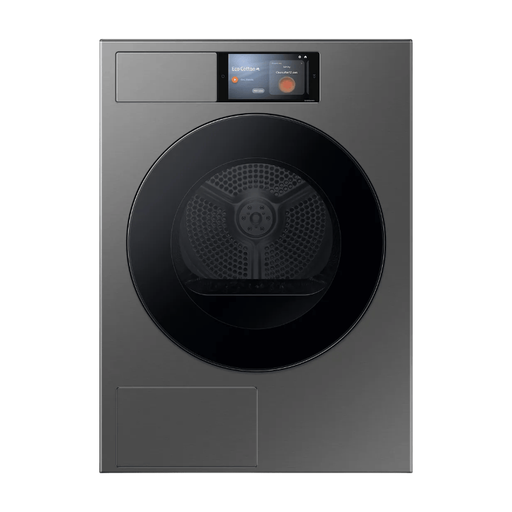
Samsung DV90F09F4SU3 heat pump tumble dryer

Samsung DV90F09F4SU3 heat pump tumble dryer, 9 kg

The stated 9 kg drum capacity suits larger loads. The product information also lists a 35-minute Super Speed programme for small loads, not a full drum.

AI Dry+ is described as a system that monitors moisture, temperature and fabric type. Keep the ventilation space clear and clean the fluff filter after every cycle.

View at Joybuy

Bosch WQH246DPFG Serie 6 heat pump tumble dryer

Bosch WQH246DPFG Serie 6 heat pump tumble dryer, 9 kg

The 9 kg capacity may be useful for larger loads. For school clothes, check whether the 40-minute Extra Quick programme is suitable for the fabric and load size.

The product name lists energy class B. The product information also mentions AutoDry, which continuously monitors moisture, and a self-cleaning condenser.

View at Joybuy

Bosch WQB245B40 Serie 8 heat pump tumble dryer

Bosch WQB245B40 Serie 8 heat pump tumble dryer, 9 kg

If you’re planning a cotton load, the product information lists a duration of 195 minutes for a full load and 125 minutes for a partial load. Check that the programmes are suitable for the clothes you want to dry.

The product name lists energy class B and a German control panel.

View at Joybuy

Haier HD80-C367U1-DF heat pump tumble dryer

Haier HD80-C367U1-DF heat pump tumble dryer, 8 kg

The stated 8 kg capacity and programmes for cotton, synthetics and delicates, among other fabrics, can help you plan different types of family washing. Always check the care labels.

The product name lists energy class C. According to the product information, the dryer must be installed in a well-ventilated room of at least 4 m², with an earthed 220–240 V socket and no extension lead. The R290 refrigerant circuit must only be serviced by qualified technicians.

View at Joybuy

Frequently asked questions

Can every programme handle a full drum?

No. Compare the stated drum capacity with the load limit for the specific programme in the manual, and don’t overfill the drum.

How do I compare energy labels for tumble dryers?

Since 1 July 2025, tumble dryers in the Netherlands have been labelled on a scale from A to G. As well as the letter, compare energy use in kWh per 100 eco cycles, capacity, noise and eco programme duration. An older A+++ label isn’t directly equivalent to the same class.

Does a heat pump tumble dryer need to vent outside?

A heat pump tumble dryer doesn’t need an external air vent. Condensed water goes into a tank or, if the model and installation allow, into a drain. Check the installation instructions and leave enough space for heat to escape.

What should I clean after drying?

Clean the fluff filter after every cycle and empty the condensate tank if no drain is connected. Follow your model’s instructions for the condenser and sensors. A self-cleaning condenser doesn’t mean the fluff filter needs no maintenance.

What can I do if a tumble dryer bought in the Netherlands turns out to be faulty?

The seller is your point of contact for the legal obligation to supply a product that works as it should. Depending on the applicable conditions, you may be entitled to a free repair or replacement. Information from the Dutch government makes clear that a manufacturer’s warranty doesn’t replace this right.
