
You need your laundry dry before moving day
You have a specific deadline and want to assess how long the cotton programme takes with your load, rather than relying on the time for a quick programme with a small load.


Before moving, compare the programme time for a similar cotton load; a short programme for a small amount of synthetic laundry won’t tell you how long a full drum of cotton will take to dry. A heat pump tumble dryer may suit regular use and help reduce energy consumption, but it often dries more slowly than a traditional condenser dryer. Measure the available space too, and check the drainage and conditions in both locations.
You have a specific deadline and want to assess how long the cotton programme takes with your load, rather than relying on the time for a quick programme with a small load.
You want to check that the appliance will fit in both locations and work out where the condensate will go, how much ventilation space is needed and what the noise will be like.
You’re factoring capacity and energy consumption into your decision, as you may use the tumble dryer several times a week after moving too.
Best for: regular drying when you want to factor in energy consumption, including after your move.
Trade-off: according to the Consumentenbond, heat pump tumble dryers are generally more energy-efficient, but often take longer to dry and can cost more to buy.
Best for: when a shorter drying time is a priority and you’ve checked the specific appliance on offer and the label that applies to it.
Trade-off: the Consumentenbond describes this technology as generally faster, but less energy-efficient than a heat pump tumble dryer.
Best for: cotton laundry when there’s enough time and a suitable place to dry it, either on its own or alongside machine drying.
Trade-off: you’ll need space, and you can’t work out how long laundry will take to dry in a particular room in winter from general guidance alone.
Compare energy labels on a like-for-like basis. As Energielabel.nl advises, look beyond the letter at the energy use per 100 drying cycles on the eco programme.
| Priority | What to look for | Who prioritises this |
|---|---|---|
| Drying cotton in time | Compare the duration and load capacity of the cotton or eco-cotton programme; check whether the model also uses moisture sensors. | If your cotton laundry needs to be dry before moving day, the time for a real cotton load matters more than a short synthetic programme; around 33% of consumers put this deadline first. |
| Fitting in both locations | Measure both spaces and check the appliance depth, door clearance, air circulation, noise and whether a condensate drain is available. | If the tumble dryer will be moving to another room, you’ll want to know in advance whether it will fit and can be connected there; around 27% of consumers put having a suitable space in both locations at the top of their list. |
| Energy use if you dry regularly | Compare kWh per 100 eco drying cycles using the same labelling basis, and match the capacity to how you use it. | If you’ll be drying regularly after your move, energy use per cycle matters, not just drying time; around 20% of consumers prioritise energy use for repeated drying. |
| A suitable cotton programme | Check the care labels and compare the cotton programmes and dryness settings available on the exact model. | If you want to dry cotton clothes in line with their care labels, look for a programme that suits your garments; around 20% of consumers make suitability for their fabrics their first consideration. |
Bosch’s SuperKort 40 is intended for a small amount of synthetic and lightweight laundry; its programme time won’t tell you how long cotton will take to dry.
Compare the cotton and eco programme details for the load that needs to be dry before moving day.
The next room may have a different floor area, drainage options, ventilation space or noise environment.
Measure both spaces and check the model’s manual. If you’re stacking appliances, don’t assume stacking kits are interchangeable.
Also check whether the new location needs a suitable drain connection, hose or stacking kit.
The label system changed on 1 July 2025. An older A+++ rating isn’t directly comparable with a current A–G rating.
Compare current labels on the same basis and check energy use in kWh per 100 eco drying cycles.
The Consumentenbond highlights the trade-off between faster drying cycles and lower energy consumption. If you use the dryer repeatedly, energy use matters too.
Factor in how often you expect to use it after your move, and if you’re looking at older shop stock, check which label applies to the specific appliance.
Bosch lists the WQG233DENL as an 8 kg heat pump tumble dryer with a cotton programme, moisture sensing and specified dimensions.
Beko’s Dutch product information lists the BM3T3824B as an 8 kg heat pump tumble dryer with energy class B under the EU 2025 rating system.
Miele describes the TEA528WP 8kg Active as a T1 heat pump tumble dryer with an 8 kg capacity.
AEG provides information about heat pump tumble dryers and service advice for drying performance.
These product picks are heat pump tumble dryers with cotton programmes or details that help you compare drying time, capacity and installation requirements.
 No image available
Worth comparing if you want to factor in the drying time for a cotton load before moving day.
The product information lists an 8 kg cotton capacity, a programme time of 190 minutes, energy class C, condensation efficiency class B and 62 dB(A). The door isn’t reversible.
 No image available
A model to compare if you’re looking for a larger capacity and cotton programmes.
The product information lists a 9 kg capacity, cotton programmes, Auto Dry with continuous moisture sensing, energy class B and 59 dB(A). It also lists a reversible door and condensate drain hose.
 No image available
Worth considering if you want to compare the stated cotton programme time with the time you have before moving day.
The product information lists 195 minutes for a full cotton load and 125 minutes for a partial load, as well as Cotton and Cotton Eco programmes. It also lists AutoDry, energy class B, a drain hose and dimensions of 84,2 × 59,8 × 66,2 cm.
 No image available
An option to compare if you want to look at different cotton programmes and capacity.
The product information lists an 8 kg capacity, Cotton Extra Dry, Eco Cotton and Cotton Iron Dry programmes, sensor drying, energy class E and 64 dB(A). It also lists a remaining-time display and water tank indicator.
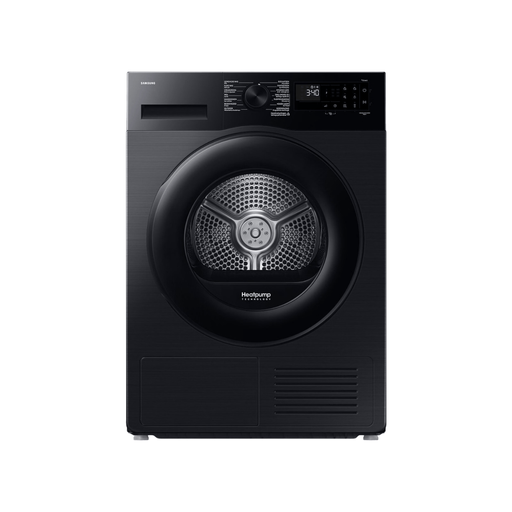 No image available
Worth comparing if you’re looking for a larger capacity and moisture sensing during drying.
The product information lists a 9 kg heat pump tumble dryer, energy class C and 64 dB. According to the product information, OptimalDry measures humidity and temperature; a reversible door and SmartThings controls are also listed.
Use the programme time on the current energy label as a guide to the eco programme, and also check the cotton programmes and load capacity of the exact model. A quick programme for a small amount of synthetic laundry won’t give you an indication of the time needed for a full cotton load.
Check the temperature requirements in the manual for your specific model. AEG’s service advice gives a range of 5–35 °C and warns that a lower ambient temperature can extend drying time; this range doesn’t automatically apply to every tumble dryer.
Not necessarily: if your model has a condensate tank, you can empty it by hand. If you want to use a permanent drain, check the drainage point in both locations, the model’s connection and the hose you’ll need.
Clean the lint filter as instructed in the manual and follow the model-specific guidance for the condenser and moisture sensor. The Consumentenbond recommends cleaning the filter after every drying cycle; also empty the condensate tank if it isn’t connected to a drain.
No, this doesn’t apply to every appliance on offer without distinction. According to the European Commission, the new European ecodesign requirements have applied since 1 July 2025 to appliances newly placed on the market from that date. Appliances already placed on the market before then and held in shops’ stock aren’t retrospectively subject to the new requirements. For a specific offer, check which appliance it is and which rules apply.