
Weekend washer with full loads
You want to dry the cottons that have built up over the weekend in as few suitable loads as possible. Compare the stated cotton capacity with your own laundry, rather than relying on your household size alone.


For a winter weekend load of cottons, choose a tumble dryer whose stated cotton capacity and programme duration suit a full load. A short programme for a small load won’t tell you how long a full drum takes to dry. Then compare the energy label on the current A–G scale, and check that the dimensions, noise level and condensate drainage suit your laundry space.
You want to dry the cottons that have built up over the weekend in as few suitable loads as possible. Compare the stated cotton capacity with your own laundry, rather than relying on your household size alone.
You need your laundry back quickly and want to compare the drying time for a full load of cottons with short programmes for smaller loads.
Your choice depends on the floor or stacking space available, the noise level and how condensate is collected or drained away.
Start with the cotton capacity and the programme duration for a full load. Then compare energy consumption and check that the dryer can be installed and its condensate drained in your laundry space.
| What to consider | What should you check? | Who should pay particular attention? |
|---|---|---|
| Cotton capacity | Compare the stated cotton capacity with your usual load and check the appliance dimensions. | I want to dry as many cottons as possible in suitable loads after a weekend; around 33% of consumers put sufficient capacity at the top of their list. |
| Drying time for a full load | Look up the programme duration for cottons at the load size you want to dry. Check separately how much laundry can go in a quick programme. | If I need my laundry back quickly, I look at the duration of a full cotton load; around 27% of consumers prioritise drying time. |
| Energy consumption | Compare the A–G label and consumption figures for the same programme. According to the European Commission, this scale must be displayed in shops and online from 1 July 2025. | When I run several drying cycles, I want to be able to assess consumption on a like-for-like programme basis; around 27% of consumers make energy consumption their top priority. |
| Installation and condensate | Measure the available space and check each model’s dimensions, drainage options and stacking requirements. | If space is tight or I want to drain away the condensate, the appliance needs to suit the available space and connection; around 13% of consumers prioritise installation. |
A short programme may be intended for a smaller load. This can lead you to underestimate how long your weekend laundry will take to dry.
Check the duration of the cotton programme for the load size you actually want to dry.
The energy label scale for tumble dryers has changed. According to the European Commission, the A–G scale must be displayed in shops and online from 1 July 2025.
Compare new offers using the A–G scale and check the accompanying consumption figures; don’t treat older A+++ ratings as if they use the same scale.
You still need to take care of the lint filter, even on a model with a self-cleaning condenser. Brandweer Nederland recommends cleaning the filter after every use.
Also follow the manual’s instructions for maintaining the condenser and any filters.
Dimensions and condensate drainage options vary by model, and can determine whether the tumble dryer will fit in your chosen spot.
Measure beforehand and check the manual if you plan to stack the dryer or drain the condensate directly away.
Depending on your set-up, you may need installation accessories.
The BM3T3824W is an 8 kg heat-pump tumble dryer worth comparing for weekend loads of cottons.
The WQG245D9NL is a 9 kg heat-pump tumble dryer to consider if you want to compare a larger stated cotton capacity.
The TR8ESSEN is an 8 kg heat-pump tumble dryer to consider if you also want to compare programmes for other fabric types.
The TWC640WP 8kg is another 8 kg heat-pump tumble dryer to compare for its features and controls.
This selection includes heat-pump tumble dryers with a stated capacity of 8 or 9 kg. Check each model’s maximum cotton load and the drying time for the programme that suits your laundry.
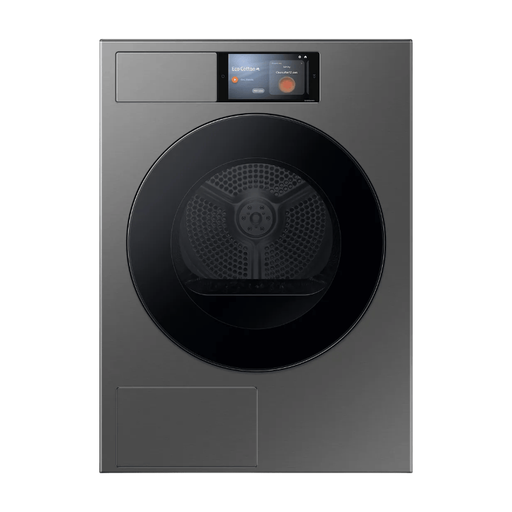 Image unavailable
The stated 9 kg capacity could suit a larger weekend load; check the maximum load for the cotton programme.
 Image unavailable
The stated 9 kg capacity could suit a larger load of laundry; check that it applies to the cotton programme you want to use.
 Image unavailable
The stated 9 kg capacity could be useful for a larger weekend load; check the cotton capacity and programme duration for your needs.
Bear the German control panel in mind when making your choice.
 Image unavailable
The stated 8 kg capacity could suit a weekend load of that size; check the permitted cotton load for the programme you choose.
 Image unavailable
The stated 8 kg capacity could suit a weekend load of that size; check the cotton programme’s load capacity and duration before estimating drying time.
Not based on the programme name alone. Check the permitted load and stated duration for a full load of cottons separately; a short programme doesn’t tell you how long a full drum will take.
Compare the A–G scale. According to the European Commission, this scale must be displayed for tumble dryers in shops and online from 1 July 2025; don’t compare it directly with the older A+++ to D scale.
No, a condenser tumble dryer doesn’t need an external vent. Condensate collects in a tank or, if the model and installation allow, can be drained away.
Clean the lint filter after every use. Also follow the manual’s instructions for the condenser or condenser filter; a self-cleaning condenser doesn’t make the lint filter unnecessary.
You may do. According to ACM ConsuWijzer, your statutory guarantee depends on what you could reasonably expect from the product under normal use, and isn’t automatically limited to a two-year manufacturer’s warranty. If the product is faulty, contact the seller.