What should you look for when buying?
Start with the type of load you dry most often: an urgent wash calls for a suitable programme, while regular larger weekly loads also make capacity and energy use important.
| What to consider |
What should you check? |
Who is it relevant to? |
| Drying school uniform in time |
Check which fabrics and load size the short programme is designed for; also compare the drying time of the standard programme. |
If you need to dry a few suitable items quickly after a rainy day, you’ll want to know whether the programme is designed for that type of load. Around 26% of consumers say being able to dry urgent loads on time is their main purchasing concern. |
| Mixed fabrics |
Check the drying symbols on each item and see which programmes the exact model offers. Remove any items that must not go in the tumble dryer. |
If you want to dry different fabrics together, you’ll want to make sure a mixed-load programme doesn’t override the instructions on a garment’s care label. Around 21% of consumers prioritise suitability for mixed fabrics. |
| Energy use with regular drying |
Compare energy labels and stated consumption on a like-for-like basis; work out your own running costs using your electricity tariff and expected number of drying cycles. |
For regular weekly laundry, energy use and running costs can matter more than speed. Around 21% of consumers put running costs first. |
| Capacity for varying loads |
Compare your usual small and larger loads with the capacity for each programme. Milieu Centraal recommends 8 or 9 kg for a large family or more frequent drying. |
If you alternate between small loads and larger family loads, you’ll want a size that suits the laundry you usually do. Around 16% of consumers say varying load sizes are their main purchasing concern. |
| Space, moisture and maintenance |
Measure the space and check the appliance dimensions, condensate drainage, ventilation and access to the filters. A drain connection may require a suitable outlet and, in some cases, an extra hose. |
If your laundry room is small or poorly ventilated, fitting the appliance, draining moisture and carrying out maintenance become important considerations. Around 16% of consumers focus mainly on laundry-room space and maintenance. |
Tumble dryers at Joybuy
These models include heat pump tumble dryers for small urgent loads and varying weekly laundry. Compare their capacity and energy class, and check which programmes suit your clothes and how you use the appliance.
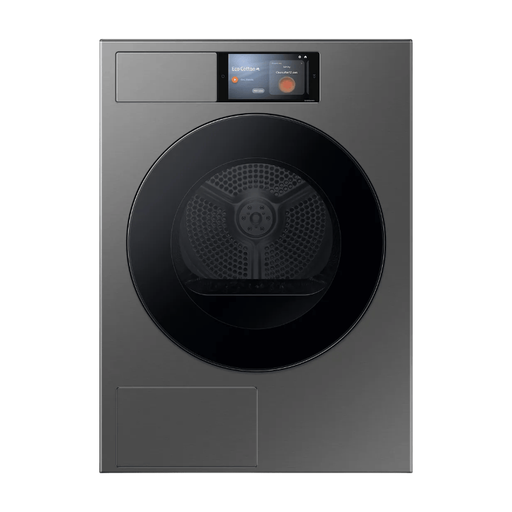 Image unavailable
Samsung DV90F09F4SU3 heat pump tumble dryer, 9 kg, energy class A, silver
The 9 kg capacity and stated small-load programme may suit varying weekly laundry; check the programme conditions for the fabrics you want to dry.
Capacity: 9 kg. The product name lists energy class A, AI Home, AI Dry+ and Wi-Fi (SmartThings).
Joybuy
 Image unavailable
Haier HD80-C367U1-DF heat pump tumble dryer, 8 kg, energy class C, white
The stated 8 kg capacity may suit varying weekly loads; check whether this model’s programmes are suitable for the fabrics in your laundry.
Capacity: 8 kg. The product name lists energy class C, ION Fresh Air, Wi-Fi and Bluetooth.
Joybuy
 Image unavailable
Bosch WQH246DPFG Serie 6 heat pump tumble dryer, 9 kg, energy class B
The 9 kg capacity and stated Mix and short programmes may be useful for larger, varying loads; check which fabrics and load sizes are allowed for each programme.
Capacity: 9 kg. The product name lists energy class B and an NL/FR control panel.
Joybuy
 Image unavailable
Bosch WQB245B40 Serie 8 heat pump tumble dryer, 9 kg, energy class B
With a stated capacity of 9 kg, this model may suit larger weekly loads; check that its programmes are suitable for the different fabrics you dry.
Capacity: 9 kg. The product name lists energy class B and a German-language control panel.
Joybuy
 Image unavailable
Sharp KDNHA8S6PWEBX heat pump tumble dryer, 8 kg, energy class E, white
The stated 8 kg capacity may suit a mix of smaller and larger loads; check whether the programmes are suitable for the fabrics in your weekly laundry.
Capacity: 8 kg. The product name lists energy class E.
Joybuy
Frequently asked questions
Can I put all wet school uniform in the tumble dryer together?
Not before checking the care labels. The drying symbol tells you whether tumble drying is allowed; a Mix programme doesn’t make an item suitable for tumble drying if its care label says otherwise.
Does the tumble dryer need to be connected to a water drain?
No, not always: a heat pump tumble dryer can collect condensate in a tank. To connect it to a drain, the model must be suitable and you’ll need a drain outlet; you may also need an extra hose.
What do I need to maintain after a drying cycle?
Clean the fluff filter after every drying cycle and empty the condensate tank, unless the appliance is connected to a water drain. For other filters and the heat exchanger, follow the instructions for your exact model.
Do my rights end after the two-year manufacturer’s guarantee?
No. For consumer purchases in the Netherlands, statutory rights are separate from any additional manufacturer’s guarantee. According to ACM ConsuWijzer, the product must meet what you could reasonably expect with normal use. If something goes wrong, the retailer is your point of contact, and the appropriate solution depends on the circumstances.
Which energy label should I compare in the Netherlands?
For tumble dryers, compare the A–G scale used in shops and online since 1 July 2025. The European Commission says the old A-plus classes are not directly comparable with the current scale; check the label and product information sheet for the exact model.


