
People with limited space for an appliance
You want to dry bedding, but the appliance’s depth, the doorway or whether you can stack the dryer on top of a washing machine will determine what fits in practice.


Start with the care label and the amount of bedding you want to dry in each load. An 8kg dryer is a useful starting point, while a 9kg model may suit larger loads. Next, measure the available space and compare noise levels, condensation efficiency and the current energy label. A shallower appliance isn’t automatically quieter or more energy-efficient.
You want to dry bedding, but the appliance’s depth, the doorway or whether you can stack the dryer on top of a washing machine will determine what fits in practice.
You want to dry larger items in each load, so you’ll need to consider the capacity, the programme you choose and whether there’s enough room for the bedding to move around.
Noise levels and condensation efficiency may matter more to you, alongside electricity use.
First check that the dryer is suitable for your bedding and the space available. Then compare the features that matter most in your home.
| What to consider | What should you check? | Who should pay extra attention? |
|---|---|---|
| Room for bedding | Compare the capacity in kg with the maximum load for the programme you want to use. Also check whether your bedding can move around freely. | If you want to dry larger items in each load, consider both the drum space and the recommended load for the programme. Around 29% of consumers say having enough room for bedding is their top priority. |
| Suitable installation | Measure the space and allow for the door, filters and water tank. If stacking the dryer, check the manual and make sure the stacking kit is suitable. | If space is tight, you’ll want to know in advance whether the appliance will fit and remain easy to access day to day. Around 24% of consumers put installation space first. |
| Noise and moisture | Compare the stated noise levels on the same basis and check the condensation efficiency. Also consider where the dryer will go and how well the area is ventilated. | If the dryer is close to your living space, you’ll want to factor in noise and moisture. Around 18% of consumers make these their top priorities. |
| Electricity use | Compare the current A–G energy label and energy consumption figures on the same basis. The European Commission has applied the revised scale since 1 July 2025. | If you use your dryer regularly, consider how its energy consumption fits with your own usage. Around 18% of consumers put electricity use first. |
| Purchase and installation | Check what’s included with delivery and installation, whether you need a drain or stacking accessory, and how to arrange servicing. | If you want to know what to expect from installation and aftercare, look beyond your choice of appliance. Around 11% of consumers put purchase, installation and aftercare first. |
The dryer’s maximum capacity won’t necessarily apply to every programme. Larger bedding items can also tangle together during drying.
Check the care label and the programme load in the manual. Also think about how many large items you want to dry at once.
You’ll also need to allow room for the door, controls, filters and water tank. Stacking requires compatible appliances and a suitable stacking kit.
Measure the entire space and check the installation instructions for the exact models. If stacking, also make sure the stacking kit is compatible.
The European Commission has used the A–G scale for tumble dryers since 1 July 2025. This means an old A+++ rating isn’t based on the same criteria as a rating on the new scale.
Compare current labels and energy consumption figures on the same basis.
If your dryer is near your living space, noise, condensation efficiency and electricity use may also affect your day-to-day experience.
Compare the noise and condensation figures, and consider energy consumption in relation to how often you dry clothes. Clean the filters as instructed in the manual; the Netherlands Fire Service recommends this as a fire safety measure.
The models listed offer two 8kg heat pump tumble dryer options with different appliance depths.
The Serie 4 WQA23305NL is an 8kg heat pump tumble dryer you can compare for features such as dimensions and condensation water drainage.
The DV90DB7845GEU3 is a 9kg heat pump tumble dryer to consider if you’re looking at larger loads.
The TEA528WP 8kg Active is another 8kg heat pump tumble dryer to consider alongside your installation and load requirements.
The iQ500 WQ33G2DCNL is an 8kg heat pump tumble dryer you can compare for features such as dimensions and noise levels.
This selection of Joybuy products includes 8kg and 9kg heat pump tumble dryers to compare for bedding loads, available space and features that may be useful in a small flat.
 No image available
An 8kg model to consider if you’re looking for a heat pump tumble dryer for bedding.
The product information lists energy class C, 62 dB(A) and a drum capacity of 108 litres.
 No image available
An 8kg model to compare if you want to dry bedding and need to consider the available depth.
The product information lists energy class C, 62 dB(A), condensation efficiency class B and dimensions of 595 × 586 × 850 mm.
 No image available
A 9kg model with a dedicated Bedding programme to consider for larger loads of bedding.
The product information lists a depth of 66,2 cm, a noise level of 61 dB and condensation efficiency of 12%. The listed energy class B is from the German energy label.
 No image available
An 8kg model to include in your comparison if you also want to assess the doorway and installation depth.
The product information lists energy class C, a depth of 600 mm, a reversible door and a drum capacity of 115 litres.
 No image available
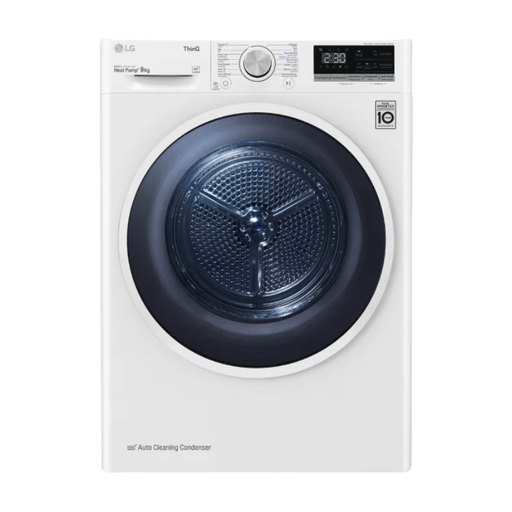
A 9kg model to consider if you want to dry larger loads in each cycle and its external dimensions fit your space.
The product information lists energy class D, condensation efficiency class B, 64 dB and a depth of 69 cm.
No. 8 kg is a starting point, not a guarantee that every bedding load will fit. Check the care label, the maximum load for the programme you’ve chosen and whether the bedding can move around freely. Larger items can tangle together during drying.
Only if the appliances and stacking kit are suitable and you install them according to the instructions. Bosch recommends using a stacking kit to prevent the appliances from shifting or falling. Check that the exact models are compatible.
Not necessarily: the condensation water can collect in a tank. Many models can also be connected to a drain. Check whether your chosen model needs an extra hose for this.
Compare the current A–G label and energy consumption figures on the same basis. The European Commission has applied the revised scale for tumble dryers since 1 July 2025, so don’t compare an old A+++ rating directly with a class on the new scale.
Follow the manual and clean the filters. The Netherlands Fire Service recommends cleaning tumble dryer filters as a fire safety measure.