
Vandaag of morgen in huis

Kwaliteit gegarandeerd

Welkomstaanbiedingen ontgrendelen: GRATIS bezorging | Tot 80% korting | Gratis 30 dagen JoyPlus-proefperiode
Download de app
A trolley with wheels can make it much easier to move shopping, garden waste, camping equipment or boxes. However, not every transport trolley is suitable for the same surfaces or loads. A compact shopping trolley works differently from a heavy-duty transport trolley for moving house. So don’t just look at the price or a high load capacity. Pay particular attention to the construction and the intended use of the trolley.
A specification such as 150 kg trolley or 200 kg trolley may sound clear, but it does not tell you everything. The weight must be distributed evenly, and the surface affects stability. For example, a narrow hand trolley with wheels may have a high stated load capacity, but be less practical for wide boxes or uneven loads.
Also check the difference between:
A foldable trolley is handy in the car, storage room or utility cupboard. However, the folded dimensions can vary considerably between models. As well as the folded height, check the width and whether the wheels or handles stick out.
A foldable transport trolley with removable wheels may be easier to clean and store. With any folding mechanism, always check that the frame is fully locked before loading the trolley.
Small swivel castors are practical indoors, but less suitable for grass, sand or cobblestones. For a camping trolley, wider off-road tyres are often a more sensible choice. A trolley with a brake is particularly useful when it needs to remain temporarily on a slope or uneven surface.
Look out for:
Choose a load capacity that suits your needs and leave some margin for unexpected loads. For shopping and light household items, a capacity of 25 to 80 kg may be sufficient. For compost, tools or moving boxes, models rated at 90 to 150 kg are more suitable. A 200 kg trolley is primarily intended for heavy or bulky loads, provided the surface is flat and stable.
A low centre of gravity, sturdy joints and evenly distributed weight all help to reduce the risk of tipping. Place heavy items at the bottom of a utility wagon or camping trolley.
An aluminium frame keeps the tare weight low. Steel can provide a sturdy base, but usually makes the trolley heavier. With a fabric wagon, the fabric thickness, base support and attachment to the frame are particularly important. 600D Oxford fabric is used in various product descriptions; this is a material specification, not a general guarantee of waterproofing.
For a platform trolley or warehouse trolley, a hard loading platform is more practical than a fabric compartment. For shopping, picnics and gardening, a removable fabric compartment offers greater flexibility.
An adjustable handle makes the trolley suitable for people of different heights. Check the available positions and the overall handle height. A handle that is too low can be uncomfortable over longer distances.
For households with limited storage space, a flat folding mechanism, removable wheels and the ability to stand upright independently are useful features. A multi-tier storage trolley, on the other hand, requires particular attention to the maximum load per shelf and the stability of the swivel castors.
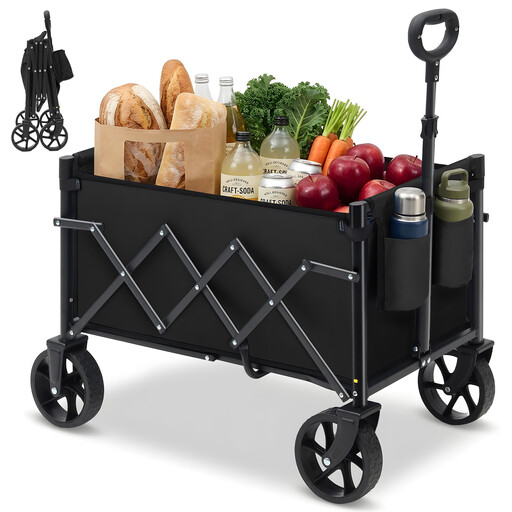
Why it suits this profile: This lightweight wagon weighs 4.8 kg and is suitable for shopping, picnics and everyday use. The frame folds down compactly, while the handle’s three positions offer flexibility.
The product description states both the tare weight of 4.8 kg and the maximum load of 80 kg. This allows you to assess both values side by side.
Stated load capacity of 80 kg; foldable design and clip-on removable wheels.
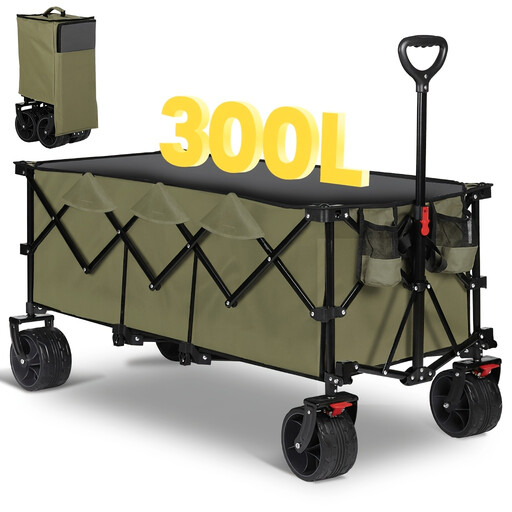
Why it suits this profile: This spacious wagon is designed for large loads in the garden, at the campsite or when moving house. It has a stated capacity of 200 kg and a volume of 300 litres.
The volume is stated alongside the load capacity. The wide 7-inch tyres and brakes are useful specifications for heavy or bulky loads.
Stated capacity of 200 kg; 300-litre volume and brakes according to the product information.
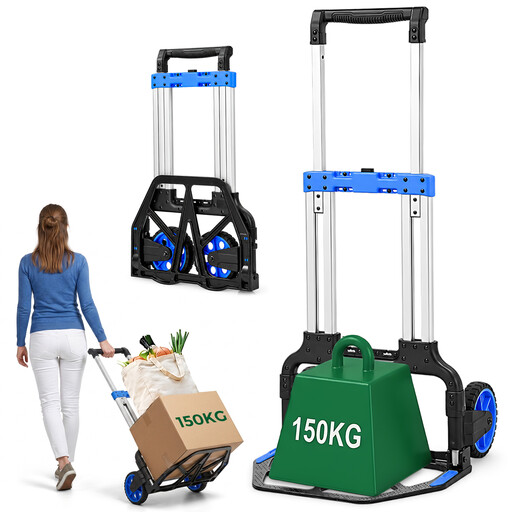
Why it suits this profile: This heavy-duty transport trolley is designed for boxes, furniture, building materials, warehouse work and gardening projects. The aluminium frame and adjustable handle are practical for regular use.
The specifications state a load capacity of 150 kg, an anti-slip loading surface and handle heights of 77 and 107 cm. Always distribute heavy loads evenly.
Stated load capacity of 150 kg; TPR wheels with ball bearings and adjustable telescopic handle.
We have put together a complete, up-to-date list of products that fully meet these strict selection criteria and the applicable European safety regulations.
This varies by model. The range includes lightweight models from 25 to 80 kg and heavier transport trolleys from 150 to 200 kg. Treat the stated capacity as the upper limit, distribute the weight evenly and check that the surface is suitable.
It can be, but look at the wheels, frame and covering. Small swivel castors are mainly intended for flat floors. For grass, sand and cobblestones, wider off-road wheels are more practical. Allow a fabric wagon to dry thoroughly after use before folding it away.
Remove dirt from the wheels and folding hinges, and check the fastenings regularly. Clean metal and plastic parts with a soft, damp cloth. Fabric compartments may require gentle cleaning. Do not use a trolley above its stated load capacity, and use the brakes when the model has them.
