
Vandaag of morgen in huis

Kwaliteit gegarandeerd

Welkomstaanbiedingen ontgrendelen: GRATIS bezorging | Tot 80% korting | Gratis 30 dagen JoyPlus-proefperiode
Download de app
A trolley with wheels seems simple: put your belongings inside, take hold of the handle and go. Yet many people buy a model that disappoints them after a short time. The wheels get stuck on thresholds, the frame turns out to be too lightweight for shopping or tools, and a folding trolley still takes up a surprising amount of space.
The main pitfalls are usually not related to appearance, but to the specifications. Pay particular attention to the load capacity, dimensions, type of wheels and how you intend to use the trolley.
A statement such as “up to 90 kg” or “150 kg capacity” does not always indicate how stable the trolley will remain in your situation. The weight must be distributed evenly across the load platform. A high centre of gravity, loose boxes or an uneven surface can make the trolley more difficult to move.
So check:
For example, a kitchen trolley with multiple levels is intended for lighter household items. A transport trolley or sack truck generally has a larger loading surface and a higher load capacity.
A folding trolley is useful for a car, storage area or small home. However, not every folding mechanism is equally practical. Check whether the model opens and closes without requiring much force, how large it is when folded and whether the wheels can be removed.
A folding transport cart with large wheels is often more suitable for garden paths or moving boxes than a compact shopping trolley with wheels. For everyday indoor use, a narrow rolling trolley may be easier to manoeuvre.
Small castor wheels are useful on a flat floor, but less suitable for pavements, gravel or an uneven garage floor. Look at the wheel size, the number of fixed and swivel wheels, and whether the trolley has a brake.
With a trolley featuring brakes, you should check the brakes before use. Do not use a mobile storage trolley on a slope if the manufacturer advises against it. The product description and safety instructions should always be followed.
Choose the load capacity based on your heaviest typical use, rather than an occasional light load. For shopping and picnic items, a wagon cart with 80 kg capacity may be sufficient. For moving boxes, compost or building materials, a transport trolley with a higher stated load capacity is the more obvious choice.
Also look for:
Never exceed the stated capacity. For example, the 5five kitchen model has a maximum capacity of 15 kg total and 5 kg per shelf.
Measure not only the space where the trolley will stand, but also doorways, lifts and the space beside cupboards. A narrow storage trolley measuring 15 cm wide will fit between pieces of furniture, while a wagon cart needs considerably more room.
The following points are practical when it comes to storage:
A 3-tier rolling trolley is suitable for cleaning products, kitchen utensils or bathroom items. However, check whether each shelf can support the weight of your belongings individually.
For indoor use, swivel wheels that rotate 360 degrees are often sufficient. If you use the trolley outdoors, larger tyres or wide wheels will be more useful. A warehouse trolley or sack truck intended for more intensive use should also have a stable handle and a sturdy loading platform.
Use a trolley on a flat, stable surface whenever this is specified in the safety information. Keep your fingers clear when folding and unfolding it, and check all screw connections before first use.
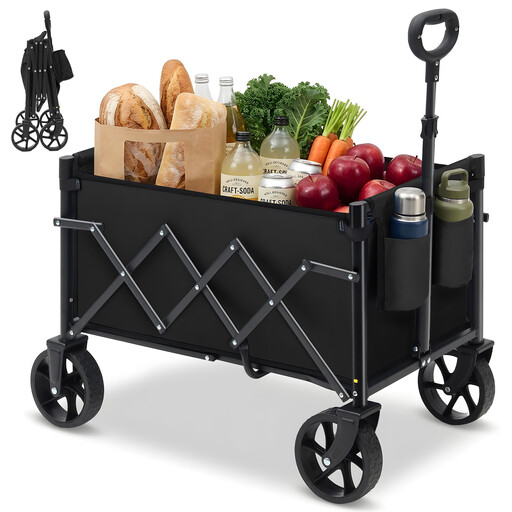
Why it suits this profile: A lightweight trolley for shopping, outings and everyday transport. The model weighs 4.8 kg and is ready to use without assembly.
The stated capacity, product weight and folding function are clearly specified. The wheels can also be removed for storage.
Folding design, stated load capacity of 80 kg and adjustable handle with three positions.
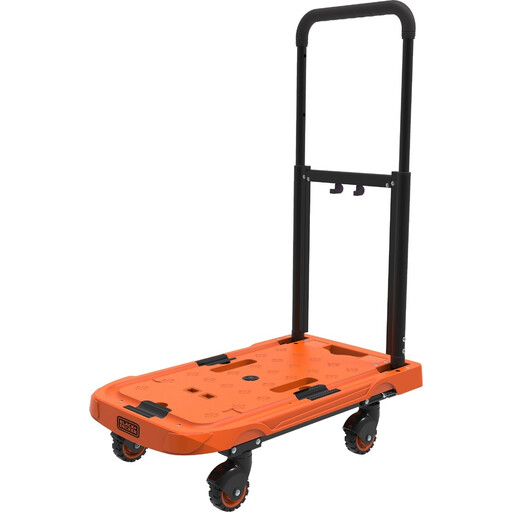
Why it suits this profile: Suitable for moving house, boxes, compost and materials you want to transport in a car or van.
The loading platform measures 61.4 by 37.3 cm and the handle is adjustable. This makes it easy to check the dimensions and working position in advance.
Folding design, handle with three height settings and a stated maximum capacity of 89 kg.
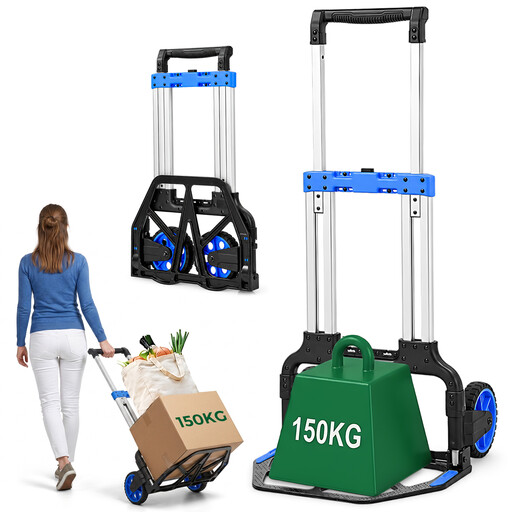
Why it suits this profile: A sack truck for DIY projects, warehouse work, moving house and transporting gardening materials. The telescopic handle has two positions.
The loading surface has a non-slip finish and two straps are included. Distribute the load evenly and stay within 150 kg.
Reinforced aluminium frame, folding design, TPR wheels and a stated load capacity of 150 kg.
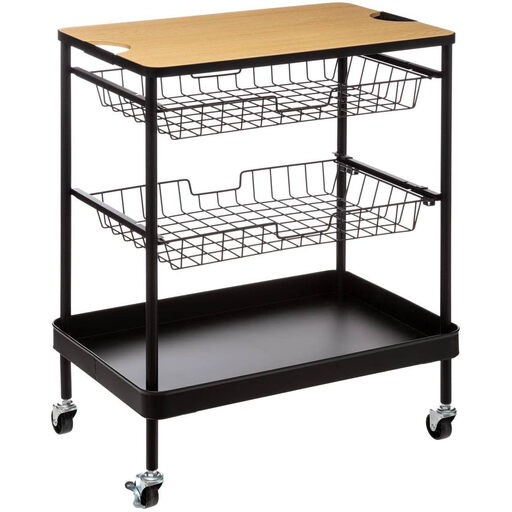
Why it suits this profile: For households looking for extra storage space in the kitchen and wanting to move ingredients or kitchen items around easily.
The product information lists two pull-out baskets, a shelf and a brake on one side. According to the safety information, the removable shelf is not intended to be used as a cutting surface.
Steel frame, bamboo shelf, two pull-out baskets and dimensions of 40.5 × 60.5 × 79.5 cm.
We have put together a complete, up-to-date list of products that fully meet these strict selection criteria and the applicable European safety regulations.
Use this quick checklist before placing your order:
A model with lots of features is not automatically the right choice. A narrow kitchen trolley, a folding transport cart and a warehouse trolley are designed for different situations.
For shopping, a lightweight wagon cart or shopping trolley with wheels is practical. Pay attention to the product weight, folding design, capacity and wheel size. If you will only use it in the supermarket or on a flat pavement, a compact model is often sufficient. For longer distances or heavy crates, a wider frame with larger wheels is more convenient.
Its lifespan depends on the load, surface, storage conditions and maintenance. Do not exceed the capacity, distribute the weight evenly and regularly clear dirt from the wheels. Store a folding trolley in a dry place and check the bolts, connections and brakes before intensive use.
Brakes are useful when the trolley needs to stay in place while it is being loaded, for example in the kitchen or beside a workbench. They are not a substitute for a safe surface. Use the brake according to the instructions, and do not push or pull a loaded trolley up or down a steep slope if this is not recommended.
