
Vandaag of morgen in huis

Kwaliteit gegarandeerd

Welkomstaanbiedingen ontgrendelen: GRATIS bezorging | Tot 80% korting | Gratis 30 dagen JoyPlus-proefperiode
Download de app
A trolley with wheels can make it considerably easier to move shopping, camping equipment, garden waste, boxes or cleaning products. However, the range often looks more straightforward than it really is. A low price says little about stability, while a high load capacity does not automatically mean that a cart is pleasant to manoeuvre.
The right choice depends on three things: what you are transporting, where you are travelling and how compact the trolley needs to be for storage. Use the checks below to avoid buying a transport trolley that becomes difficult to push, unstable or too large for your storage space after just a few uses.
A product may be able to carry 150 or 200 kg, for example, but that does not mean you can safely move this weight over every type of surface. Also consider the wheel width, how the load is distributed and the stability of the frame. Stacking heavy items high increases the risk of tipping over.
Also check whether the load capacity applies to the entire trolley or to a single shelf. With a 3-tier trolley, the maximum load may apply to each level.
“Foldable” sounds practical, but the dimensions after folding determine whether the trolley will actually fit in a cupboard, car or garage. In addition to the folded height and width, check whether the wheels and handle can be removed.
A foldable hand cart with a narrow folded profile is suitable for a boot or small storage space. A large high-capacity wagon takes up more room even when folded.
Four wheels often provide greater freedom of movement, but not every wheel configuration is suitable for outdoor use. Swivel castors are useful in a kitchen, warehouse or salon. For grass, gravel and uneven paths, wide tyres are generally more suitable.
Also pay attention to the brakes. A brake is designed to keep the trolley parked, not to slow down a heavy load while travelling downhill. Always follow the manufacturer's safety instructions.
Choose a model with some capacity to spare above the weight you usually transport. A compact model is sufficient for light shopping or towels. For crates, compost or camping equipment, a wheeled transport trolley with a higher stated load capacity is the more logical choice.
When comparing products, check:
The product description is the most important source for these specifications. Do not use the stated maximum as a guideline for consistently overloading the cart.
For indoor use, swivel castors with a parking brake are practical. A kitchen trolley or bathroom trolley should move smoothly between furniture and must not be too wide. For the garden, camping or the beach, wide tyres and a sturdy base are more important than a small turning circle.
Look at:
Steel frames are suitable for heavier-duty applications, while aluminium keeps the overall weight down. Oxford fabric is often used for foldable wagons. This material is lightweight and can be cleaned with a damp cloth, but it must be completely dry before you store the wagon.
For a permanent storage solution, metal baskets or plastic shelves are practical. A wooden or bamboo trolley often fits better in a living space, but usually has a lower load capacity than a warehouse trolley.
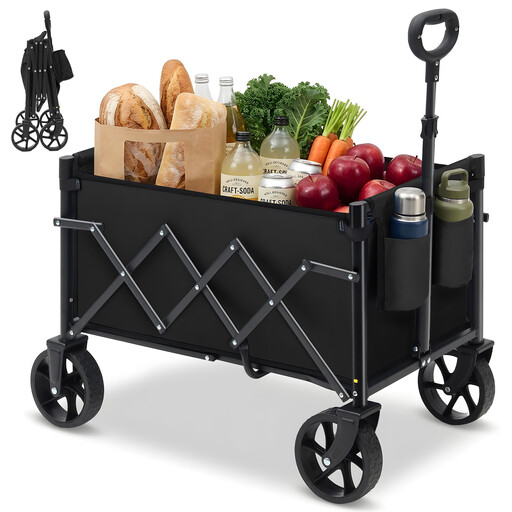
Why it suits this profile: This lightweight 4.8 kg wagon is designed for shopping, picnics and everyday use. It folds down compactly and requires no assembly.
The stated 80 kg load capacity, its own weight and the click-off wheels are clearly specified. This means you do not have to rely solely on a vague marketing term such as “compact”.
80 kg load capacity, a net weight of 4.8 kg and a handle adjustable to three positions.
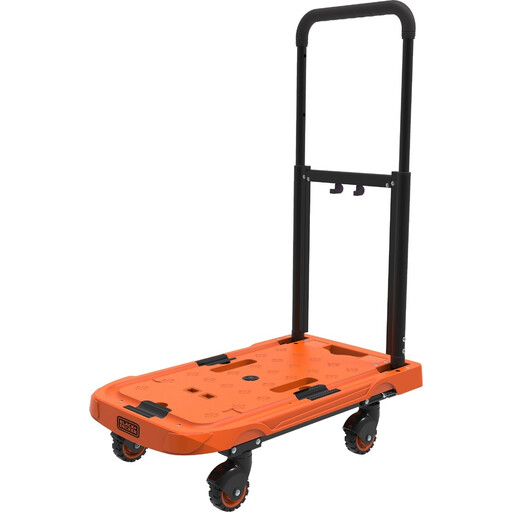
Why it suits this profile: This platform trolley is designed for moving house, workshops and transporting boxes or bags of compost. The handle is adjustable and the trolley can be folded down.
The loading platform measures 61,4 × 37,3 cm and the stated maximum load is 89 kg. This makes it easier to measure your boxes in advance.
Two fixed and two swivel castors; handle adjustable to 64, 76,7 or 89,4 cm.
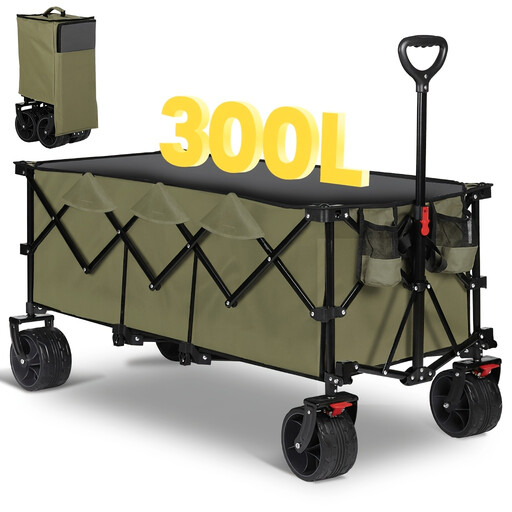
Why it suits this profile: This spacious foldable trolley is designed for campers, keen gardeners and families who need to transport a lot of equipment at once.
The product information states a capacity of 300 litres, a maximum load capacity of 200 kg and 7-inch-wide tyres. However, check that the wagon is fully locked in place before loading it.
300-litre capacity, wide tyres, brakes and a folding mechanism that can be operated with one hand.
We have put together a complete, up-to-date list of products that fully meet these strict selection criteria and the applicable European safety regulations.
A trolley remains useful when you load it appropriately and store it in a dry place. Wipe the frame with a soft cloth and allow fabric parts to dry completely before folding them down. Check regularly:
Do not use a foldable transport cart as a seat or step. Place heavy items low down and distribute them evenly across the base. Take extra care on slopes or uneven surfaces.
For shopping, a lightweight foldable trolley with enough base space and an adjustable handle is practical. A model with a load capacity of around 80 kg provides plenty of capacity for everyday shopping, but always check the dimensions and net weight.
Its lifespan depends on the load, surface, moisture and maintenance. A trolley that remains below its maximum weight, is stored dry and is checked regularly will avoid unnecessary wear. When used outdoors, pay particular attention to the tyres, hinges and folding mechanism.
Running costs are generally limited to maintenance and the possible replacement of wheels or fixings. With a warehouse trolley or storage trolley, spare parts and cleaning may play a greater role. Therefore, check the warranty, included parts and maintenance instructions in advance.
