
Vandaag of morgen in huis

Kwaliteit gegarandeerd

Welkomstaanbiedingen ontgrendelen: GRATIS bezorging | Tot 80% korting | Gratis 30 dagen JoyPlus-proefperiode
Download de app
A treadmill with incline can be useful if you want to walk, jog or run more at home, while working from home or at the office. However, not every compact treadmill is suitable for every use. Some models take up more space than expected when unfolded, while others have an incline that cannot be adjusted. The difference between a treadmill and a walking pad can also matter, depending on your training goals.
Before you buy, look out for these three common pitfalls:
A treadmill with a 9-degree incline makes walking or running more challenging without you having to increase your speed straight away. This can be useful if you’re looking for more variety in your workouts. Check whether the incline is manual, electric or fixed.
A fixed 9° incline means the running surface is permanently set at an angle. This is best suited to people who have specifically chosen this type of training. For gentle walking at a desk, a flat walking pad is usually more practical. So, look beyond the incline percentage and consider how you plan to use the treadmill.
A treadmill with a top speed of 12 km/u supports a range of activity levels:
A compact treadmill saves space, but its running surface is often narrower or shorter too. If you have a long stride or run regularly, compare the dimensions of the running surface with your height and running style.
A quiet treadmill is particularly useful in a flat, shared home or office. Consider motor noise, vibrations and the sound of the treadmill against the floor together. A rubber mat can help protect the floor and reduce vibrations, but it won’t eliminate loud motor noise entirely.
When considering a treadmill with shock absorption, check exactly what the manufacturer means. The number of layers, materials and construction tell you more than the term “cushioning” alone. According to the Lugia Fit Pro product description, the running surface has five layers of shock absorption. The manufacturer says this is designed to support comfort and reduce vibrations. This is a product claim from the brand, not a guarantee that every user will have the same experience.
A treadmill for the office or home working should be easy to operate and ideally fit under a sit-stand desk. Check the height of your desk, the position of the control panel and whether the handle can be folded down. A remote control is handy if you don’t want to reach for the control panel while walking.
A folding treadmill or compact treadmill is suitable for homes where you need to clear the floor space after use. Check the dimensions when folded beforehand. “Fits under the sofa” isn’t a universal guarantee: measure the available clearance and allow for skirting boards, legs and ventilation space.
For jogging and running, speed, stability, running surface and maximum user weight matter more than a compact design alone. A fixed incline can add intensity, but it doesn’t automatically make the treadmill suitable for long running sessions. Check the product specifications and instruction manual.
The available product information includes one model that directly matches the search for a treadmill with incline. So, below, we’ve transparently matched the same model to three different user profiles. The right choice depends on your space, training goals and expectations.
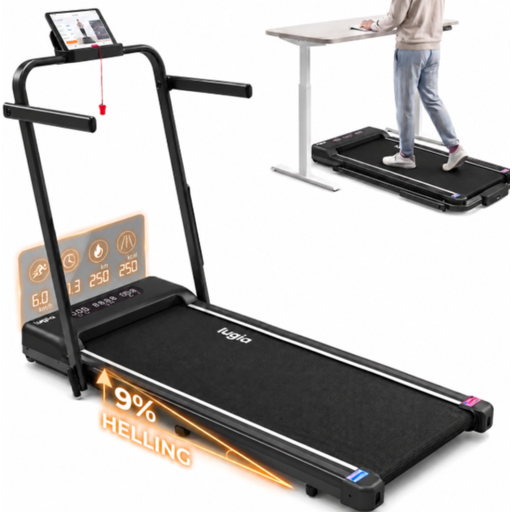
Why it suits this profile: With speeds from 1 to 12 km/u, a fixed incline and a folding design, it’s an easy introduction to walking, jogging and recreational running.
The product description clearly states the fixed 9° incline and speed range. This means you know in advance that the incline cannot be adjusted freely.
1-12 km/u, LED display, remote control, transport wheels and a folding handle.
Why it suits this profile: This model combines features for everyday use with an information display and a design that can be put away after use.
The description lists specific features such as five layers of shock absorption, a quiet motor and an LED display, rather than relying on general claims about comfort.
Displays time, speed, distance and calorie information; also includes a cup holder and remote control.
Why it suits this profile: The fixed 9° incline and top speed of 12 km/u are aimed at users who want more than a gentle walk.
The speed and incline angle are clearly stated. However, bear in mind that the fixed incline may not suit every running workout.
Speed range up to 12 km/u, fixed 9° incline, five-layer shock absorption and transport wheels.
Electricity costs depend on the motor’s power, your weight, speed, incline and how long you use the treadmill. You can only calculate them accurately if you know the actual power consumption in watts. So, check the energy label, manual or technical specifications before estimating your regular monthly costs.
To help your treadmill last longer:
We’ve put together a complete, up-to-date list of products that meet these strict selection criteria and current European safety regulations in full.
It can be, but a fixed incline makes walking more strenuous than walking on a flat surface. Start gently and check that the incline suits your fitness level and training goals. For walking while you work, a flat walking pad is often easier to use.
It varies by model, speed, flooring and user. The product description says that the Lugia Fit Pro has a quiet motor and five-layer shock absorption. These are specifications and claims from the product information; the noise level you experience may vary from home to home.
Measure the treadmill both unfolded and folded. Also leave space behind and beside the running surface so you can get on and off safely. Check that the folded treadmill will actually fit under your sofa, bed or desk.
