
Vandaag of morgen in huis

Kwaliteit gegarandeerd

Welkomstaanbiedingen ontgrendelen: GRATIS bezorging | Tot 80% korting | Gratis 30 dagen JoyPlus-proefperiode
Download de app
A treadmill for home can be useful if you want to walk, jog or run regardless of the weather or opening hours. However, not every model is suitable for every home. A machine that looks compact in product photos may take up a lot of floor space in reality. Terms such as “quiet”, “smart” and “shock absorption” only tell you so much, too, unless you check the specifications behind them.
A treadmill with a top speed of 12 km/u sounds versatile, but your experience also depends on the running surface, motor and stability. For a gentle walk, a walking pad with a top speed of 6 km/u may be enough. If you plan to run regularly, a longer and wider running surface is more important.
So check:
Even a quiet treadmill makes some noise from the motor, running surface and footsteps. A stated figure such as 50 or 60 dB is a product specification under certain conditions, not a guarantee that your neighbours won’t hear it.
A level surface, a protective mat and regular maintenance can help reduce vibrations and other noise. In a flat, a compact walking pad for gentle walks is often more practical than a large running treadmill.
A foldable treadmill saves space, but check its dimensions both when in use and when folded. Also consider its weight and whether it has transport wheels. A heavy machine that’s difficult to move may end up staying in the same place.
Measure in advance:
A shorter running surface may be enough for walking. For jogging and running, you’ll want more room for a natural stride. A running surface of 38 × 100 cm, for example, is compact, while a model measuring around 40 × 16 inch offers a little more room to move.
Don’t just look at the maximum weight capacity; also allow for your shoes, clothing and any additional load. Models with a capacity of 120 kg or 150 kg have different weight limits. Don’t exceed the stated limit.
A walking pad with a speed range of 2–6 km/u is suitable for walking and light jogging, especially while working from home. If you also want to run, look for a model with a range of 1–12 km/u.
A treadmill with incline can make your workout more challenging without a big increase in speed. Check whether the incline is adjusted manually or electronically. With a manual incline, you’ll usually need to change the setting in advance.
Motor power isn’t always listed in the same way. A figure such as 2,5 HP peak power should therefore be considered alongside the top speed and intended use. Gentle walking calls for a different level of performance from daily running.
When it comes to shock absorption, it’s useful to check how the belt is constructed. According to Mobvoi’s product description, the belt has five layers, including a supportive, shock-absorbing layer. This describes the construction; it isn’t a medical claim or a guarantee of a particular running experience.
A treadmill with an LED display usually shows speed, time, distance and calories. A treadmill with Bluetooth can also connect to music or a training app. Always check which apps are actually supported and whether all features work without a subscription.
Apps can be useful for tracking your progress, but they aren’t essential for a good basic workout. A remote control and clear shortcut buttons can sometimes be more important for everyday use.
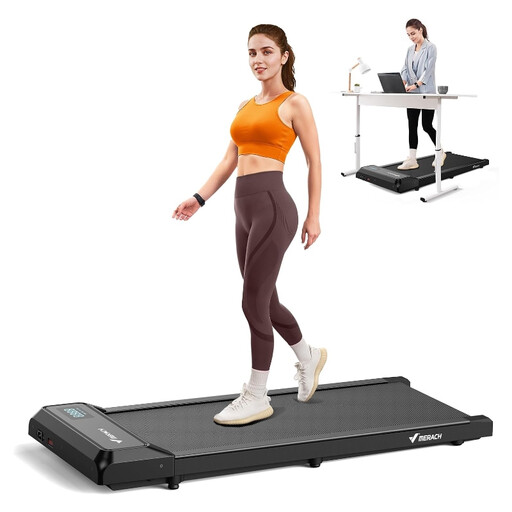
Why it suits this type of user: Its compact dimensions and top speed of 6 km/u make it suitable for walking or light jogging in a smaller home or home office.
The product information lists dimensions of 54 × 115 × 12 cm, a weight of 13 kg and a maximum capacity of 120 kg. This makes it easier to assess its storage dimensions and portability in advance.
According to the specifications, this model has a 2,5 HP motor, a stated noise level of 50 dB, a remote control and connectivity with the MERACH app.
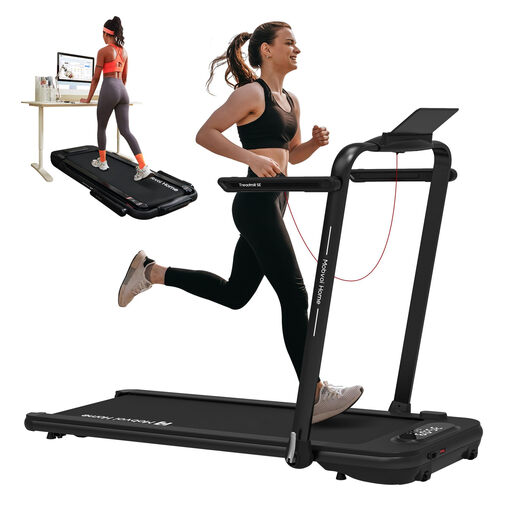
Why it suits this type of user: The combination of walking, working and running modes makes it a good fit for anyone who wants one machine for different situations.
The three modes make it clear what the different speeds are intended for: 1–6 km/u for walking and working, and 1–12 km/u for running.
The specifications list a maximum capacity of 120 kg, a folded height of around 5 inch, built-in wheels, an LED display and a stated noise level of up to 60 dB.
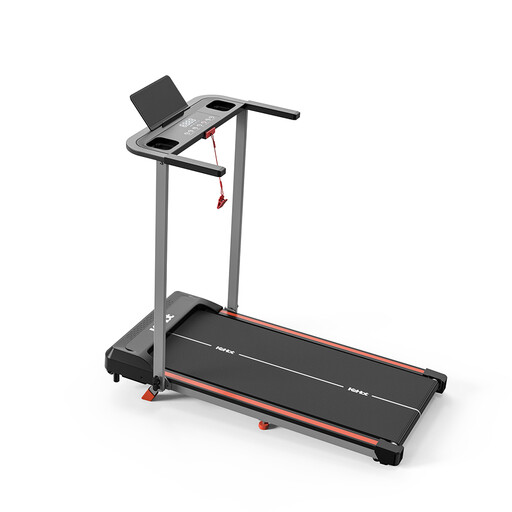
Why it suits this type of user: This model is aimed at users who want a manual incline and a higher weight capacity, as well as the option to walk and jog.
The product information lists a running surface of 38 × 100 cm, a weight limit of 150 kg and a manual incline of 9%. This makes the key usage limits clear in advance.
According to the specifications, the machine offers speeds of 1–12 km/u, an LED display, Bluetooth and support for EQI SPORTS, Zwift and Kinomap.
We’ve put together a full, up-to-date list of products that meet these strict selection criteria and the applicable European safety regulations.
As well as the machine’s dimensions, it’s important to leave clear space around it. Make sure you have enough room to get on and off safely, and always follow the manufacturer’s safety instructions. Also measure the folded height if you want to store the machine under a bed, sofa or desk.
Power consumption depends on the motor power, workout duration, speed and your body weight. You can calculate your energy use with: power in kilowatts × hours of use × your electricity tariff. A short walking session will generally use less energy than a long run, but the exact cost varies by model and energy tariff.
Keep the belt and surrounding area free of dust, check the alignment regularly and follow the manual’s instructions for lubrication. Use the treadmill on a level surface and make sure the mains cable isn’t a trip hazard. With a foldable model, the belt must come to a complete stop and the motor must be allowed to cool as instructed before you put the machine away.
